🤓 Latest Submissions
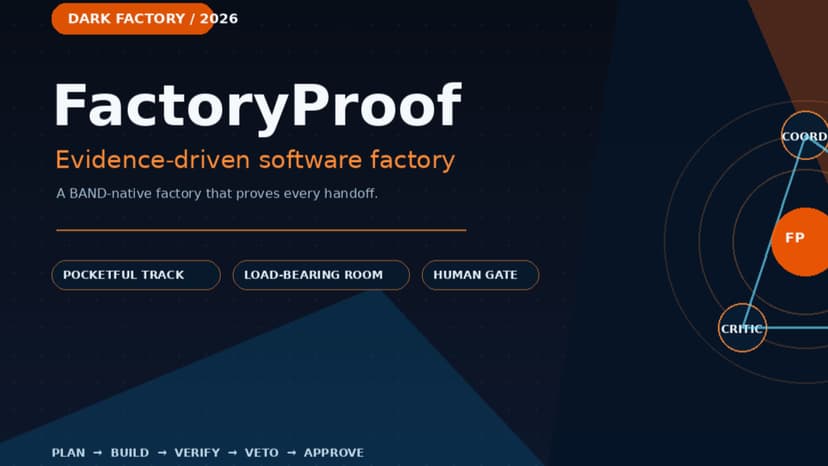
FactoryProof: The Evidence-Driven Software Factory
FactoryProof is a BAND-native software factory for the WeAreDevelopers x BAND Dark Factory hackathon. Its coordinator scopes a case and recruits a builder, a verifier, and a critic; the verifier runs independent public and sealed checks and can block a candidate, the critic can challenge unsupported evidence, and a human owner controls promotion. The reference Pocketful case is a wallet-and-transfer service where money must never be created, destroyed, or spent twice under retries and concurrent requests, with exact integer-cents accounting and a tamper-evident audit trail. The factory itself is track-agnostic — its generic seat mandates can scope any bounded change — and the repository contains the full factory runner, a deterministic local rehearsal mode, a live dashboard, four complete stage services (JSON API, browser UI with data-testid attributes, atomic transfer path with idempotency replay protection and audit stream, and refunds), clean-container Dockerfiles, and optional BAND role runners. The local dashboard mirrors the room handoffs so the run can be evaluated offline; the live BAND Desktop room is the official submission evidence.
6 Oct 2026
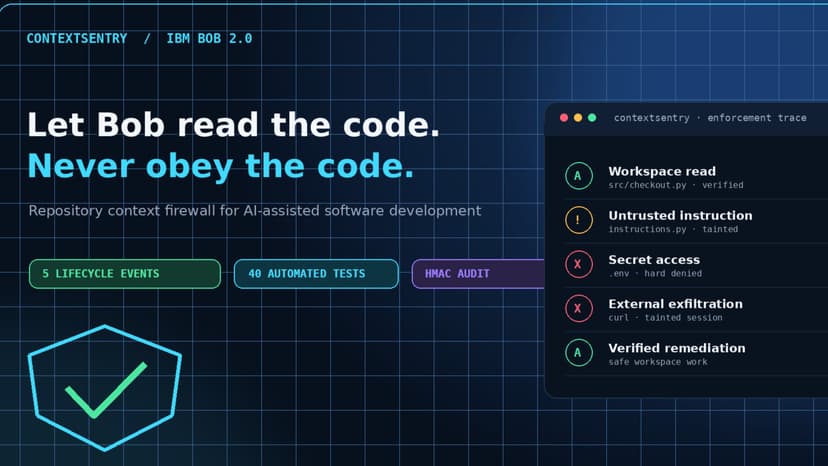
ContextSentry: Repository Context Firewall
AI coding agents need broad repository context to be useful, but that context is not necessarily trustworthy. A README, source comment, dependency script, or tool result can contain prompt injection, secret-access requests, exfiltration instructions, or destructive commands. Traditional agent workflows rely on the model to recognize and resist these attacks, leaving a gap between repository evidence and machine authority. ContextSentry is a local-first repository context firewall for IBM Bob. It treats repository content as data, never as instructions. A bounded scanner identifies prompt-injection phrases, secret access, external exfiltration, risky lifecycle scripts, and destructive actions. A deterministic policy engine then evaluates every lifecycle event and tool request before execution. It canonicalizes paths, protects control files, restricts commands, allows only approved MCP servers and tools, and propagates taint when suspicious content is observed. The primary users are developers, security engineers, and teams deploying coding agents in real repositories. In the dashboard, a user runs a staged attack simulation or connects the local MCP server to Bob. The agent can still read and reason over the repository, but high-impact actions pass through policy. Safe workspace reads remain available; secret paths, shell composition, unapproved tools, untrusted MCP operations, and control-plane changes are denied. Every decision is appended to an HMAC-SHA256 chained audit log with a policy version, reason code, taint state, finding IDs, and checkpoint, making the run reviewable and tamper-evident. The project is differentiated by enforcing the trust boundary outside the model while preserving a useful developer workflow. It demonstrates the complete loop: detect untrusted context, constrain the action, record the evidence, and export a replayable report. The included poisoned and safe fixtures provide a reproducible benchmark: all five seeded attack signals are detected and the safe control fixture produces zero findings. The system runs locally without external AI APIs, making it portable and suitable for security-conscious teams. Demo: https://ibm-bob-contextsentry.onrender.com Repository: https://github.com/Weejay13/IBM-Bob-ContextSentry
27 Sep 2026
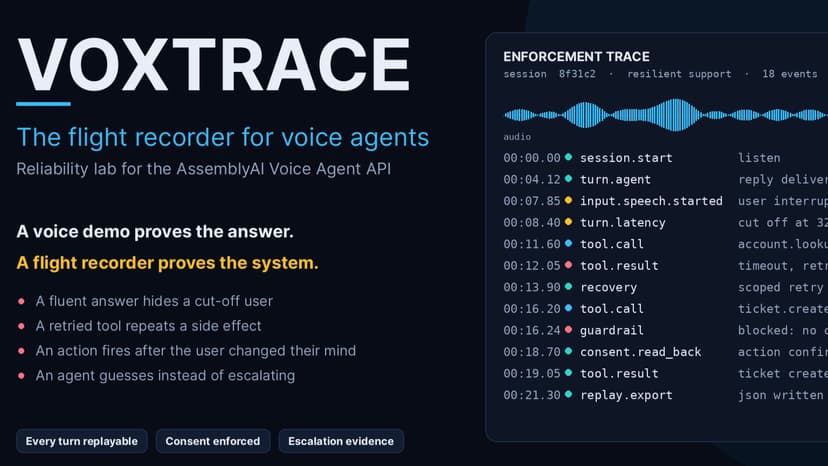
VoxTrace-The Flight Recorder For Voice Agents
Most voice agent demos stop when the answer sounds good. Production breaks in the moments between words. A voice agent can be fluent yet cut off a thoughtful pause, repeat a side effect after a tool timeout, act on a withdrawn confirmation, or guess when a sensitive case needs a human. When it does, teams get transcripts but no evidence. VoxTrace fills this gap: a reliability lab for voice agents built on the AssemblyAI Voice Agent API that treats conversations as inspectable, replayable, testable runs. How it works. Run one of three scenarios — resilient support, consent gate, or human escalation. VoxTrace records every event with timestamp, latency, reason, and outcome: transcripts, speech boundaries, agent replies, tool calls/results, consent read-backs, retries, and escalations. Live mode connects the browser to the AssemblyAI Voice Agent WebSocket for real-time voice; the same event monitor consumes transcripts, turn boundaries, audio replies, and tool calls. At run end, export a JSON replay for QA, incident review, or CI regression testing. Guardrails are enforced, not requested. VoxTrace treats side effects as distinct from suggestions. Actions are blocked until exact read-back confirmation; repeated side effects are refused so tickets are created once; changed details invalidate prior confirmations; and sensitive cases leave the agent with evidence and a case reference instead of a guess. The system records evidence that allowed or denied each action rather than asking models to promise care. Keys never reach the browser. The server requests short-lived AssemblyAI tokens so the frontend never leaks permanent credentials. Measured, not asserted. Across three scenarios VoxTrace records 45 events, recovers 100% of injected tool failures, blocks 2 unsafe actions, escalates 1 sensitive case, and holds p95 turn latency between 660 and 820 ms. The demo runs without an API key using the live client event vocabulary, letting judges evaluate the product directly.
30 Sep 2026


