🤝 Top Collaborators
🤓 Latest Submissions
FieldVoice
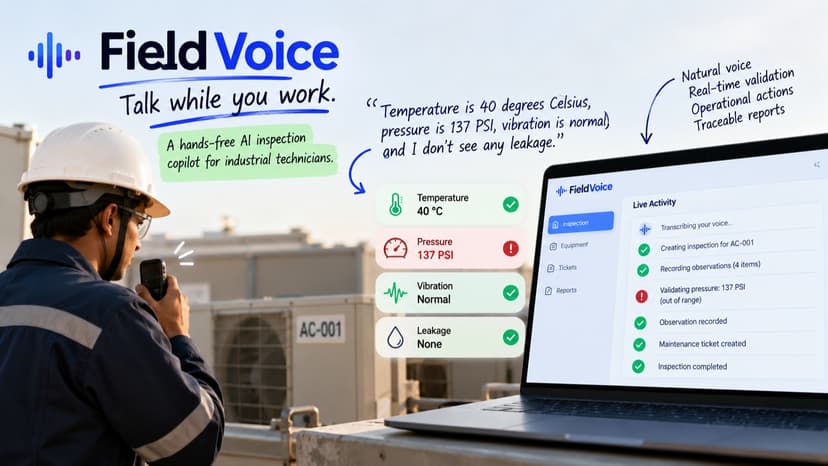
FieldVoice is a hands-free AI inspection copilot for industrial and HVAC maintenance technicians. Instead of stopping to type inspection checkpoints, technicians speak naturally while working. FieldVoice uses the AssemblyAI Voice Agent API for real-time voice interaction, speech recognition, turn-taking, and tool calling over WebSockets. A single spoken turn can capture multiple observations such as temperature, pressure, vibration, and leakage. The Flask backend stores structured observations and preserves spoken evidence in PostgreSQL. Measurements are validated deterministically against equipment-specific operating limits rather than relying on the language model to invent thresholds. For example, AC-001 has a configured pressure range of 40–100 PSI, so 137 PSI is identified as out of range and a corrected reading of 96 PSI is revalidated as normal. Technicians can ask for inspection status, correct previous readings, create maintenance tickets, trigger safety alerts, and complete inspections using natural voice commands. Live Activity shows conversation events, tool calls, backend responses, and validation results. Completed inspections produce traceable results and reports linking observations to their spoken evidence.
30 Sep 2026

AMD VisionOCR: Robust OCR on ROCm
AMD VisionOCR is a GPU-accelerated OCR application built for the Lablab x AMD AI Academy Mini Challenge 2. It uses Qwen2.5-VL-3B-Instruct with AMD ROCm to extract text from challenging real-world images, including license plates, stop signs, speed-limit signs, advisory speed plaques, and road-work warning signs. The OCR prompt is designed around the challenge requirements, including preserving relevant regional characters, excluding license-plate slogans and state names, reading multi-line signs in order, and returning advisory speed numbers only. The application supports PNG, JPEG, and TIFF inputs and handles image orientation before inference. The model and application are packaged into a self-contained Docker image using the mandated ROCm PyTorch base image, with the model weights included locally. Testing achieved 10/10 on the prepared OCR benchmark, followed by additional stress testing involving blur, darkness, low contrast, rotation, glare, and different image sizes. The final container is publicly available through GitHub Container Registry.
1 Dec 2026


