🤓 Latest Submissions

Voice Operations Console
Voice Operations Console makes voice interfaces safer for operational work. Voice is fast and convenient, but a transcription error in an amount, recipient, date, or requested action can create a costly real-world mistake. Instead of treating a transcript as execution authority, Voice Operations Console inserts an explicit verification boundary between speech recognition and operational readiness. The application uses AssemblyAI realtime speech-to-text to capture a spoken instruction. It then structures the action, recipient, amount, and date, highlights critical values, and presents the interpretation for review. The user must explicitly confirm the interpreted fields before the system creates an execution-ready audit receipt. The demo intentionally performs no external side effect. Its core principle is simple: speech captures intent, AssemblyAI provides the realtime voice layer, and the human remains the final authority for critical operational actions.
30 Sep 2026
HandoffGuard
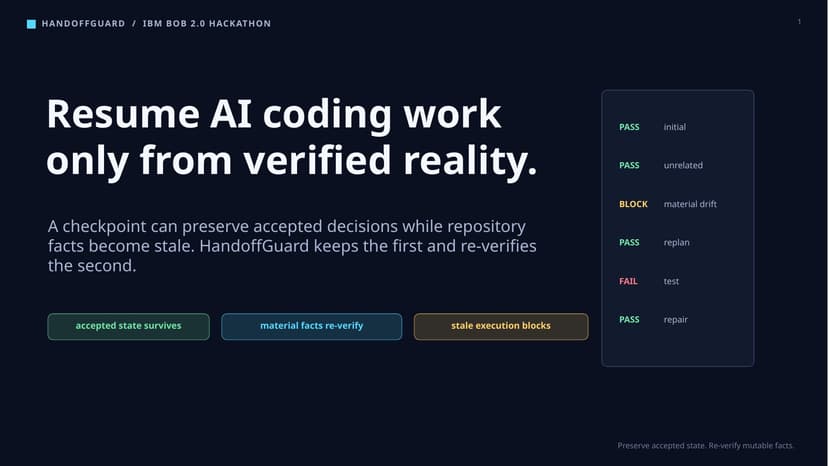
AI coding work increasingly spans long-running tasks, interrupted sessions, and agent-to-agent handoffs. The problem is subtle: a checkpoint can preserve decisions that are still valid while repository facts inside that checkpoint have already changed. Restarting everything wastes accepted work. Blindly resuming can execute a once-correct plan against stale source. HandoffGuard separates accepted state from mutable repository facts. A sender handoff records accepted scope, decisions, authority boundaries, the next move, material file hashes, acceptance-command binding, and lineage. Before another coding session continues, HandoffGuard verifies those facts against the current repository. An unrelated repository change does not force a restart. But when a declared material source changes, HandoffGuard fails closed with BLOCKED_STALE_HANDOFF and identifies the changed path. The successor must fresh-read the affected source, perform a bounded re-plan, and create a new verified handoff while preserving accepted work that remains valid. Continuation then requires executable evidence. In the demonstrated workflow, the unchanged acceptance test first returns FAIL_EXECUTABLE_PROOF. IBM Bob performs the bounded repair, the same acceptance is rerun and returns PASS_EXECUTABLE_PROOF, and final adjudication returns PASS_CONTINUATION only when the verified handoff, executable receipt, and current covered source bytes remain consistent. IBM Bob 2.0 is a material part of the demonstrated workflow: Bob Plan analyzes the handoff and changed repository state; Bob Agent performs fresh-read, re-plan, repair and executable verification; and a separate Bob Review task audits the resulting evidence and current bytes. The prototype demonstrates a practical developer workflow for teams using AI coding agents across sessions: preserve what is still valid, re-verify what can become stale, and require proof before continuing. HandoffGuard deliberately makes a bounded claim. It does not claim general software correctness, production security, autonomous authority, or generic multi-agent orchestration.
27 Sep 2026


