
🤓 Latest Submissions

Proofsheet
Proofsheet is the analyst that shows its work. Every AI data tool can make a chart. The hard part is defending the number: which definition was used, which rows were dropped, whether the model invented a figure. Proofsheet turns a messy CSV into an audit-ready report. The user uploads an export, asks a question in plain English, and approves the business definition before any code runs: which orders count, whether shipping is revenue, how missing values, discounts, and ambiguous dates are handled. The definition is stored with the run, shown on every report, and reused on replay. A Rust control plane profiles the file, calls Vultr Serverless Inference for a plan and a pandas script, and executes it in a disposable gVisor sandbox with no network, no secrets, a read-only root, and hard caps. A second model, which never sees the first script, recomputes the same metrics in a separate sandbox; both import the same deterministic parsing contract. Agreement produces the two-execution stamp. The note may only cite placeholders resolved from the execution ledger, and a chart audit checks the series, top category, peak month, assumptions and rows used. A live “try to make it lie” check injects a fake claim, and the stamp is withheld. The result: every claim opens the exact code, stdout, sandbox and isolation level that produced it. A saved pipeline replays on a new export with no model in the loop, and Rust computes the period comparison. The production run: 522 rows in, 506 out, 333 used, 6/6 claims receipted, 5/5 independent agreement, +3.0% net revenue on replay. Stack: Rust (Axum, Tokio, SQLx) on a Vultr Cloud Compute VM, Vultr Serverless Inference, gVisor, React + TypeScript. Track: Blast Radius Zero, Pattern A. Live: http://149.28.225.246 Report: http://149.28.225.246/r/7263a5f0-e0be-47e1-9f6c-f29e23d3ffd8 Source: https://github.com/PhiBao/proofsheet Demo: https://youtu.be/bdNI-FLgZxI
8 Nov 2026
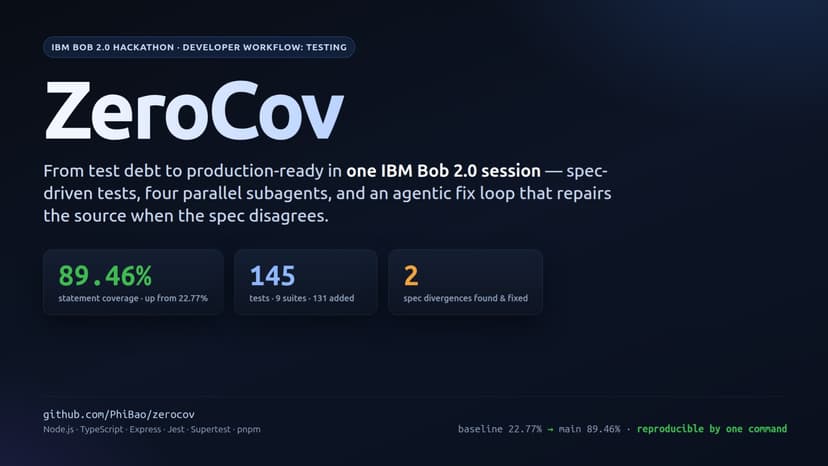
ZeroCov
Problem. Every engineering team has deferred tests: "we'll write tests next sprint." Months later, authentication, expense handling, and approval workflows have zero coverage, and fixing that by hand is a two-to-three-week project. The root cause is tooling: existing AI assistants suggest test lines, but none can read a specification, plan a layered strategy, run the suite, and repair the source when the tests and the contract disagree. Solution. ZeroCov is a six-step workflow executed by IBM Bob 2.0 on a real-shaped Node.js/TypeScript REST API (ExpenseFlow). Step 1 — Bob reads openapi.yaml, docs/auth-security-requirements.md and docs/approval-workflow.md, then measures the baseline: 22.77% statements, 14 tests. Step 2 — Plan mode writes TEST-STRATEGY.md, risk-ranking modules and assigning test layers; a human approves before any code. Step 3 — four subagents (auth, API, integration, utils) write spec-driven tests in parallel, each with isolated context. Step 4 — Agent mode runs pnpm test:coverage, reads failures, and fixes the source until green. Step 5 — COVERAGE-REPORT.md documents the delta and every finding. Step 6 — the session diff becomes a reviewable pull request. Result. 145 tests across 9 suites; 89.46% statement and 91.57% line coverage, up from 22.77% / 25.36%. Eight tests fail at the test commit and pass after two source fixes: the auth middleware now returns 401 for every token verification failure (EXP-TOKEN-401), and expense amount validation reuses the shared validator, enforcing integer, finite, positive, capped amounts per openapi.yaml. No assertion was weakened to make a test pass. Target users. Developers assigned to reduce test debt before a release, teams adding coverage gates to CI, and engineers onboarding to an untested service. They interact with it through IBM Bob IDE: attach the specs, approve the strategy, let subagents execute, review the diff. Why it is different. (1) Tests are derived from the contract, not from current behavior, so divergences surface as failures instead of being blessed; (2) parallelism is real — four isolated subagents cover four layers in one wall-clock; (3) the red-to-green sequence is auditable in git: tests land first, fixes second; (4) a project rule forbids weakening an assertion to match a bug, and the rule is enforced across all subagents. Efficiency. The session takes about 25 minutes versus a 2–3 week manual estimate. Reproduction is one command on a baseline tag, and captured evidence is in the repository: docs/coverage-before.txt, docs/red-state-failures.txt, docs/coverage-after.txt, plus Bob task session screenshots in bob_sessions/. Honesty note. ExpenseFlow is a synthetic fixture; the two divergences were seeded deliberately so the workflow is demonstrable and fully reproducible end to end. The deliverable is the workflow — the defects exist to prove it works.
27 Sep 2026

SilverLine
Every voice bot hangs up on Grandma first. It mistakes thinking for finished: default turn-taking cuts off slow speakers, mangles drug names, and leaves zero proof that anything was agreed. Families end up calling clinics on their parents' behalf, and front desks drown in reminder phone tag. SilverLine is the voice line that waits. An elderly patient calls one number — no app, no account, even a landline works — and a slow, warm agent confirms the clinic visit, teaches back each medication one at a time, and ends every call with a signed voice receipt the family can verify online. Nothing books without a slow read-back of the full visit and an explicit "yes"; any edit to a receipt breaks its HMAC-SHA256 signature. Three engineering choices make it different: a slow-safe turn-taking envelope (1200/3500 ms) with semantic interruption handling so pauses are waited through and backchannels never kill a reply; per-stage keyterm narrowing that boosts clinic names, then drug names like Metoprolol succinate, updated live mid-call; and proof-gated action backed by transactional booking and server-side caller memory. It is proven, not promised: a live 8-minute PSTN call to the public number produced a real booking, a 3-for-3 medication teach-back, and a receipt that verifies true — all for about sixty cents of AssemblyAI time. The browser demo runs the same loop against the same backend, with toggles that let judges feel the difference between fast and patient modes themselves. Built with the AssemblyAI Voice Agent API, Twilio voice/SMS/SIP trunking, Next.js, Supabase, and Vercel. Next: supervised pilots with older adults, a single-clinic trial priced per confirmed visit, then pharmacy refills.
30 Sep 2026

PrintRunner, Closed-Loop Earnings Agent
PrintRunner is an autonomous, auditable earnings-season options agent built for Alpaca paper trading. Every position is one defined-risk mleg order — vertical debit spreads for run-up drift or iron condors for volatility crush — with max loss known before submission. An LLM swarm (earnings, flow, technicals, sentiment, macro) with no cross-talk picks from a deterministic shortlist; it never invents strikes, prices, or symbols. Ten hard gates (missing data, stale quotes, price sanity, structure consistency, expiry window, liquidity, risk budget, market shock, runup, edge) plus conviction-scaled sizing (max $1k per event, $4k aggregate, 5 concurrent, 2/day) sit in code, not prompts, and are re-checked on fresh quotes immediately before submission. Fail-closed throughout: stale data, missing history, or provider downtime means "say NO" and journal it. The loop is the product. Research (Finnhub calendar + yfinance fallback with point-in-time provenance and two-cycle confirmation), code (structure desk from live chain), backtest discipline (breaker re-prices every open position at 2x spread and worst SPY regimes), live (Alpaca Trading + Market Data + throttled caches, deterministic client_order_id, reconcile-before-write), post-mortem (every decision, gate failure, and fill is hash-chained in data/journal.jsonl), and fine-tune (persistent hypothesis graph that stores every rejected hypothesis and its regime; the next swarm query retrieves the 3 most similar failures first). A preregistered thesis (expected move, hold days, invalidation) is immutably hashed before submission and later compared in autopsy. A latched kill-switch (drawdown 8% or day loss 5%) persists until pr resume --confirm ACK. The static dashboard (docs/index.html, GitHub Pages) shows open risk, theses, hypothesis graph, breaker kills, and equity. Forward paper only — one contest week proves process, not profitability.
4 Sep 2026


