🤝 Top Collaborators


🤓 Latest Submissions

Drug-Drug Interaction Predict
Problem : Dangerous drug-drug interactions (DDIs) are a leading cause of preventable hospitalisation worldwide. Patients managing multiple chronic conditions, family caregivers, and community health workers in low-resource settings often have no quick, accessible way to check whether two medications are safe to combine. Existing reference tools are either locked behind professional paywalls, require clinical literacy to interpret, or only cover English speakers. Solution - DDI-Predict : DDI-Predict is a full-stack AI web application that lets anyone check whether two or more medications are safe to take together — in seconds, in plain language, and in two languages (English and Telugu). At its core is a two-tower Graph Attention Network (GAT) trained on the DrugBank DDI dataset via the Therapeutic Data Commons (TDC). The model encodes each drug's molecular structure (from its SMILES string via RDKit) as a graph and learns pairwise interaction embeddings across 1,706 drugs and 191,808 known interaction pairs, covering 86 distinct interaction types. This is a genuine ML inference step not a lookup table. The application exposes three interaction modes through a React/TypeScript frontend: Search mode type two drug names, get a colour-coded risk tier (None / Minor / Moderate / Major), interaction type, confidence probability, and side-effect summary. Chat mode ask in plain English ("Can I take Aspirin with Warfarin?"). The backend extracts drug mentions via fuzzy NLP, runs the GNN, and passes the structured result to Google Gemini, which rephrases it into a safe, readable dual-language response. Image mode upload a photo of a prescription label. EasyOCR extracts text, the fuzzy matcher resolves drug names, and interactions are checked automatically. Every response includes an FDA adverse-reaction lookup, Gemini-generated side-effect summaries in English and Telugu, and a mandatory medical disclaimer. Target Users Patients managing polypharmacy, family caregivers, community pharmacists, and rural health workers — particularly in Telugu-speaking regions of India where English-only tools create access barriers. What Makes It Unique Unlike static drug interaction databases, DDI-Predict uses a real trained GNN that encodes molecular chemistry. The dual-language (English + Telugu) output, voice input via Web Speech API, prescription photo scanning, and the no-hallucination Gemini prompt (forced to rephrase only GNN output never add clinical claims from its own training data) make this a genuinely novel, responsible AI health tool
27 Sep 2026
BCBob
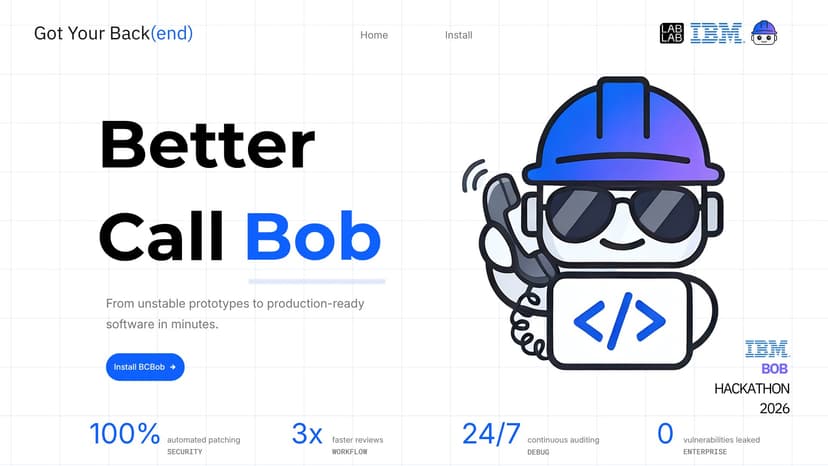
The Problem: While AI-driven development scales code velocity by 4x, it accelerates security debt tenfold. The current generation of AI tools are incredible at writing code, but terrible at securing it because they lack broader architectural context. Today, almost 83% of rapidly generated "vibe-coded" projects contain exploitable security flaws, particularly in infrastructure. We are trading long-term safety for short-term speed. The Solution: Better Call Bob (BCBob) is an automated DevSecOps fixer built directly on the IBM Bob framework. By utilizing IBM Bob's ability to read complete repository context, BCBob doesn't just flag isolated snippets; it understands your entire system to automatically write, verify, and commit secure fixes. Target Audience: High-velocity startups, AI-native builders, and agile developer teams who rely on rapid code generation but cannot afford to ship broken, vulnerable applications. Unique Features & Benefits: - Targeted AI-Specific Auditing: BCBob hunts down the exact types of hidden logic flaws and vulnerabilities that rapid AI code generation introduces. - System-Wide Vulnerability Patching: Instead of just putting a band-aid on one spot, BCBob applies secure, non-breaking fixes across your entire repository. IBM Bob automates complex transformations to patch holes without causing recurring dependency breakages downstream. - Sandbox Verification Loops: Every fix is automatically validated in an isolated runtime sandbox before it reaches production to guarantee that the patch is both secure and stable.
17 May 2026


