

🤓 Latest Submissions
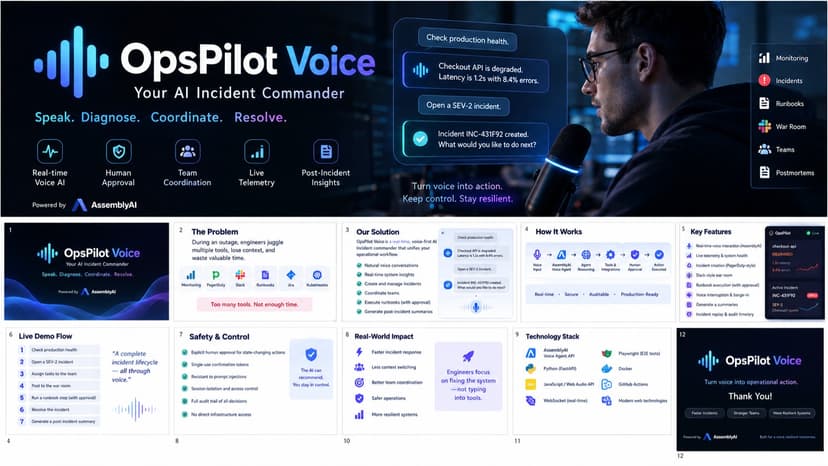
OpsPilot Voice: AI Incident Commander
OpsPilot Voice is a real-time, voice-first AI incident commander designed to help engineering teams respond to production outages without constantly switching between dashboards, runbooks, chat, monitoring tools, and incident-management systems. Powered by AssemblyAI's Voice Agent API, OpsPilot listens to engineers in real time, understands operational requests, speaks naturally, and converts conversations into structured actions. Engineers can ask for system health, identify degraded services, open incidents, assign investigation tasks, post updates to an incident war room, execute simulated runbook steps, and resolve incidents entirely through voice. The key difference is that OpsPilot does not give the AI unrestricted control. Potentially state-changing operations pass through a backend authorization layer that requires explicit human approval using single-use confirmation tokens. Even if the agent misunderstands a command or receives a prompt-injection attempt, protected actions cannot execute automatically. The project also includes real-time service telemetry, incident timelines, action tracking, latency metrics, voice interruption and barge-in support, dynamic turn-detection tuning, session reconnection, incident replay, post-incident summaries, and an auditable history of tool-backed decisions. OpsPilot demonstrates how voice AI can become a practical operational interface rather than simply another chatbot. The same architecture could connect to real platforms such as monitoring systems, PagerDuty, Slack, Kubernetes, and cloud infrastructure while preserving human control over sensitive actions. The goal is simple: during an outage, engineers should spend their attention fixing the system—not typing updates and navigating six different tools.
30 Sep 2026
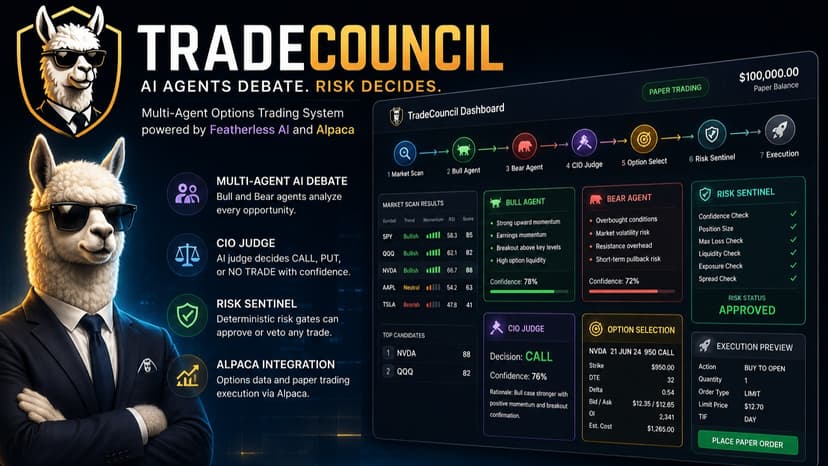
TradeCouncil — Multi-Agent Options Alpha
TradeCouncil is an explainable multi-agent options trading system built for the Alpaca AI Trading Agents Hackathon. Instead of giving one LLM unrestricted control over a brokerage account, TradeCouncil separates market analysis, AI reasoning, contract selection, risk management, and execution into independent layers. Python first scans a watchlist using deterministic indicators such as trend, moving averages, RSI, momentum, and volatility. Only the strongest candidates are sent to Featherless AI, which helps conserve inference credits and reduces unnecessary LLM calls. For each candidate, a Bull Agent builds the strongest case for the trade while a Bear Agent challenges it with downside risks and conflicting signals. A CIO Judge then compares both arguments and chooses CALL, PUT, or NO TRADE with a confidence score and rationale. If a trade is proposed, deterministic code selects an options contract using factors such as expiration, strike, delta, bid/ask spread, liquidity, and open interest. A hard-coded Risk Sentinel then checks position size, confidence, maximum loss, order value, liquidity, and portfolio exposure. The AI cannot override a veto. Approved trades can be routed to Alpaca paper trading through the Alpaca execution layer. The dashboard exposes the full decision trail: quant screen, Bull and Bear reasoning, CIO decision, selected contract, risk result, and execution preview.
4 Sep 2026
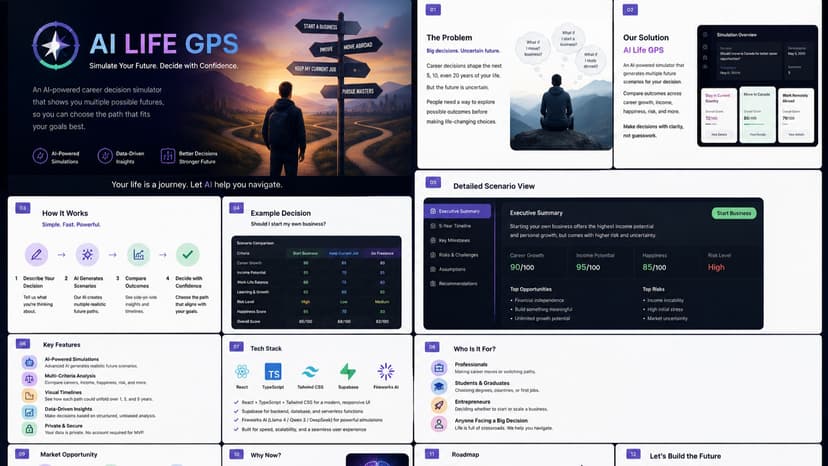
AI life GPS
Target Users Students choosing a major or career Professionals considering a career change Entrepreneurs deciding whether to launch a startup People planning to relocate or study abroad Anyone facing an important life decision What We Want to Build AI Life GPS is an AI-powered decision simulator that helps users navigate major life choices, much like a GPS helps drivers navigate roads. Users describe a decision they are considering, for example: "Should I quit my job to start a business?" "Should I move to Canada?" "Should I pursue a Master's degree?" "Should I buy a house or continue renting?" Instead of giving a single recommendation, AI Life GPS generates multiple future scenarios based on different decisions. For each scenario, it simulates outcomes across several dimensions: Career growth Financial outlook Work-life balance Personal happiness Health and stress Learning opportunities Risks and uncertainties The platform presents these scenarios through an interactive timeline, visual dashboards, and AI-generated explanations, allowing users to compare paths side by side and understand the trade-offs before making a decision. Key Features Multi-path future simulation Side-by-side comparison of different decisions Personalized recommendations based on user goals Interactive timeline showing projected milestones AI explanations highlighting risks and opportunities Confidence scores and assumption transparency Impact AI Life GPS empowers people to make better-informed decisions by exploring possible futures instead of relying solely on intuition. It transforms AI from a question-answering assistant into a decision-support system that helps users navigate life's biggest choices with greater confidence.
10 Aug 2026

FireRoute Agent
FireRoute AI is a Dockerized general-purpose AI agent built for Track 1 of the AMD Developer Hackathon ACT II. It processes batches of natural language tasks by reading `/input/tasks.json`, solving each prompt and writing valid answers to `/output/results.json` before the container exits. The agent is designed to handle all required Track 1 capability areas: factual knowledge, mathematical reasoning, sentiment classification, text summarization, named entity recognition, code debugging, logical reasoning and code generation. Its architecture uses lightweight task routing and task-specific prompting to improve accuracy while keeping responses concise. FireRoute AI follows the official Fireworks AI runtime contract. It does not hardcode API keys or model IDs. Instead, it reads `FIREWORKS_API_KEY`, `FIREWORKS_BASE_URL` and `ALLOWED_MODELS` from the judging harness environment and routes all model calls through the provided base URL. The project is fully containerized and includes GitHub Actions validation to confirm the Docker contract online. The final image is intended to be built for `linux/amd64`, publicly pullable and ready for automated evaluation. FireRoute AI focuses on passing the accuracy gate first, then improving token efficiency through compact prompts, dynamic model selection and structured JSON output.
13 Jul 2026


