
Syeda Mariya Haque Mujaddedi@mariya2568921383
2
Events attended
2
Submissions made
Pakistan
3+ years of experience
About me
AI Engineer experienced in LLMs, RAG, FastAPI, and AI application development. Worked on real-world projects including Travel Bot, EzQanoon, and Commify AI, with experience in conversational AI, backend APIs, and AI integration. Skilled in Python, C++, Java, CSS, data analysis, data entry, and creative writing.
🤓 Latest Submissions
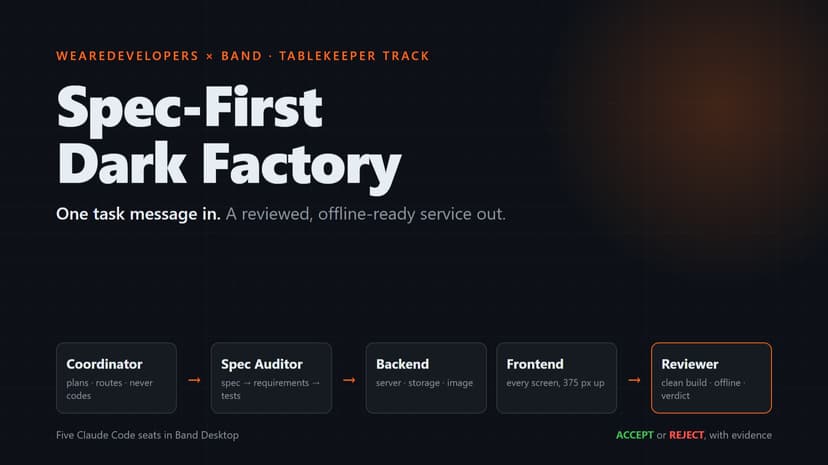
Spec-First Dark Factory: tablekeeper
We built a factory, not an app. Five Claude Code seats in Band Desktop share one room and one Git repository, and the task message is the only human input. The Coordinator plans and routes work but never writes code. The Spec Auditor turns every sentence of each stage specification into a numbered requirement, lists the edge-case hazards (races, retries, time zones, upgrades) and writes black-box acceptance tests from the spec. That way the band builds to the specification, not to the partial checks it can see. The Backend and Frontend Engineers each take one scoped work item at a time and hand off the full commit id. The Reviewer checks out that exact commit in a clean worktree and builds it with no runtime network. It runs every suite so far plus the event checker in isolated mode, looks at every screen at phone and desktop width, and returns ACCEPT or REJECT with evidence. A REJECT goes back to the owner through the room until the stage closes. In the submitted run the factory reached stage ⟨N⟩ of 4 in ⟨X⟩ hours for ⟨$Y⟩ of model spend, with ⟨Z⟩ reviewer rejections that changed the work. Before the judged run we rehearsed the whole loop on the practice track, where all four stages were accepted and every suite passed. We fed each failure from that rehearsal back into the mandates. Every seat's mandate is generic: point it at a different specification and it still applies. FACTORY.md explains how to stand the factory up, what each design choice cost, and how it catches bad work.
6 Oct 2026
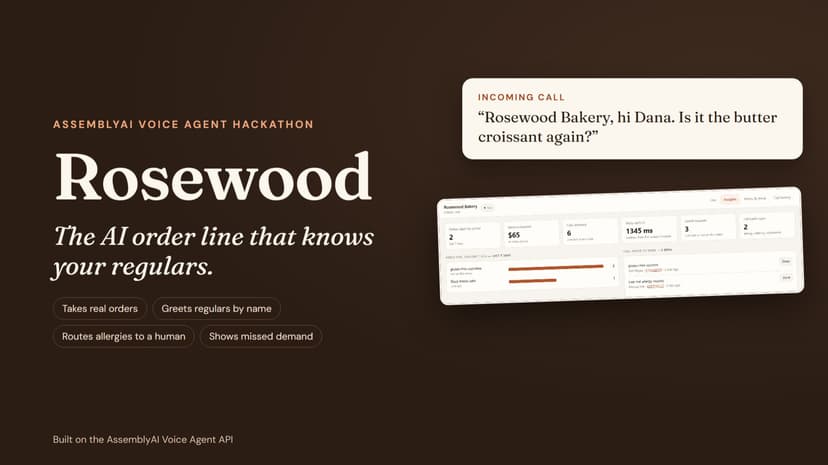
Rosewood: AI Phone Orders for Small Bakeries
Small food shops lose phone orders during the rush, when nobody can pick up, and most callers who go unanswered never try again. Rosewood answers every call. Built on the AssemblyAI Voice Agent API, it takes real orders: it checks live stock and prices through HTTP tools, offers an alternative when a cake is sold out, finds a pickup slot the kitchen can handle, reads the order back and puts it on the owner's live board. It knows the regulars. A pre-connect request looks up the caller's number before the call is answered, so Dana hears "Hi Dana, the butter croissant again?" It knows its limits. Allergy questions, complaints and catering go to the owner as a call-back with a written reason, and "gluten-free cupcakes" is never matched to the ordinary ones. It also covers what happens after the call. Sold-out and off-menu requests are logged, so the owner sees "gluten-free cake, asked 6 times this week." On every hang-up, a signed webhook fires, the backend pulls the timeline from the Sessions API, and the LLM Gateway writes an outcome, sentiment, summary and next step, with the agent's reply latency per turn. New menu items are pushed to speech recognition as keyterms. AssemblyAI features: Voice Agent API, HTTP tools, pre-connect requests, keyterms, Voice Focus, webhooks, Sessions API, LLM Gateway. A call costs about 7.5 cents a minute; a cake order is worth $40 to $100. The design fits any shop that takes orders by phone.
30 Sep 2026

