
🤝 Top Collaborators
🤓 Latest Submissions
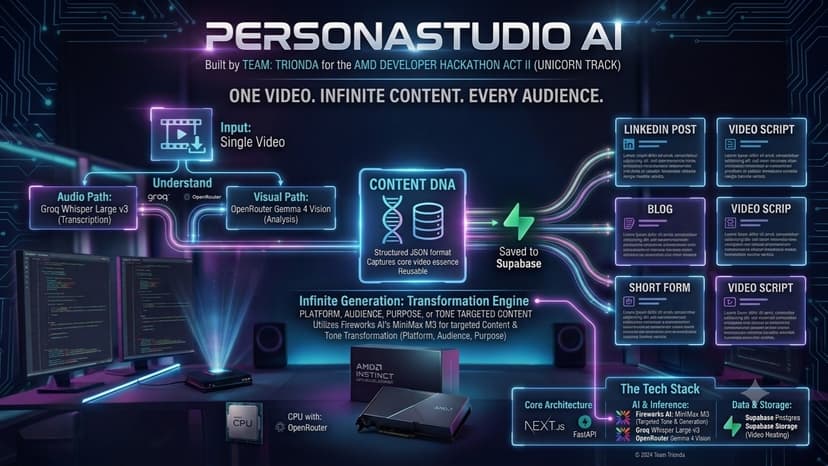
Persona Studio AI
Project Overview & Vision: PersonaStudio AI introduces an efficient "Write Once, Run Everywhere" paradigm for digital media assets. Traditional content creation workflows are heavily fragmented; adapting a single master video for diverse platforms and audiences usually demands repetitive human effort or computationally expensive AI re-parsing. PersonaStudio AI addresses this bottleneck by decoupling heavy video ingestion from the generation layer. Built for the AMD Developer Hackathon (Unicorn Track), the platform analyzes a raw video exactly once to extract its semantic essence into a highly compressed, persistent JSON payload called Content DNA. Dual-Path Ingestion & Multi-Model Architecture: The core innovation lies in its flexible Understanding Engine, which maps video data via two selectable methods: Whisper Transcript Path: Leverages ffmpeg and Groq (Whisper Large v3) to extract audio and generate precision timestamped transcripts, which are compiled into the Content DNA using Fireworks AI LLMs. Gemma 4 Vision Path: Samples evenly-spaced frames using ffmpeg and passes them directly to a vision-capable Gemma 4 model via OpenRouter, mapping visual context without requiring any audio transcription. Decoupled Transformation at Scale: Both ingestion channels converge on the identical ContentDNA schema persisted as a JSONB object in Supabase Postgres. Once saved, users can instantly trigger /generate requests to transform that single structural blueprint into platform-specific LinkedIn posts, blog articles, short-form scripts, or captions customized by tone and persona. Because the Transformation Engine queries the static database payload instead of re-processing the source media, the system minimizes API latency, avoids redundant AI compute overhead, and optimizes throughput on scale.
13 Jul 2026

Dr. ROCm
Project Overview: Dr. ROCm is an advanced, high-performance medical AI agent designed to perform rapid "first-pass" triage of medical imagery and documentation. Built to address the bottleneck in clinical diagnostic workflows, the system leverages state-of-the-art Vision-Language Models (VLMs) to analyze X-rays, MRIs, clinical photographs, and handwritten prescriptions. The core mission of Dr. ROCm is not to provide a definitive diagnosis, but to serve as an intelligent triage layer—categorizing cases by severity, extracting critical clinical data, and preparing a structured handoff for medical professionals. Key Technical Features: Radiology: Detection of abnormalities in X-rays and MRIs. Clinical Photos: Analysis of visible symptoms or skin lesions (e.g., using datasets like HAM10000). Image Classification: Identifying the modality (e.g., X-ray vs. MRI). Conservative Triage Labeling: Categorizing cases into Normal, Monitor, Urgent, or Emergency. Clinical Findings: A bulleted summary of potential abnormalities. Clinical Workflow & Impact: Analysis: The agent performs an immediate "Visual Triage," identifying life-threatening abnormalities (like a hyperintense lesion in an MRI or a potential fracture in an X-ray). Result: Critical cases are flagged for immediate review, significantly reducing the "time-to-doctor" for patients in urgent need. The Future of the Project: Dr. ROCm is designed with an Open-Ended Agent Protocol philosophy. The current architecture supports the integration of a Vector Database (ChromaDB) for long-term clinical memory, allowing the agent to reference historical cases and literature to provide even more nuanced triage recommendations. It stands as a scalable blueprint for how AI can assist, rather than replace, the clinical workforce through high-speed, hardware-optimized intelligence.
10 May 2026


