
🤓 Latest Submissions
MachineSage AI: Evidence-Based Maintenance Copilot
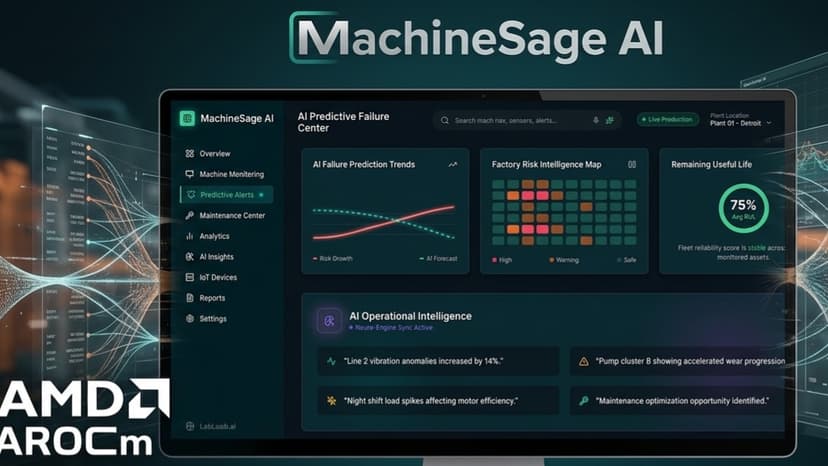
MachineSage AI is an evidence-based industrial maintenance copilot designed to help factory technicians investigate machine incidents more efficiently. Industrial teams often need to interpret sensor readings, error reports, and technical documentation before deciding on the next troubleshooting step. The application combines deterministic Python-based sensor checks with an AI-powered explanation workflow. Users can enter a machine incident, inspect abnormal readings, review relevant technical manual excerpts, and receive a structured report containing possible causes, evidence, suggested checks, and uncertainty warnings. The system is designed to distinguish observed readings from AI-generated interpretations. Recommendations should be supported by available evidence, and uncertain or potentially high-risk cases are flagged for human review rather than treated as confirmed diagnoses. The prototype will integrate an AMD-hosted AI model so that AMD infrastructure contributes directly to the application's core inference workflow. Its evaluation will use controlled example incidents to examine response relevance, evidence support, uncertainty handling, and processing time. MachineSage AI aims to demonstrate how AI can make industrial troubleshooting information more accessible while keeping technicians involved in important decisions.
18 Oct 2026

MC3 RAG: GPU-Optimized Document QA
This project is a containerized Retrieval-Augmented Generation (RAG) system developed for AMD Mini Challenge 3. It is designed to answer questions using information retrieved from a supplied document collection and provide evidence-based responses with exact source citations. The system processes the available documents, retrieves relevant information, and generates structured answers for evaluation queries. It is designed to follow the challenge requirements for reliable document-grounded question answering, including handling cases where information is missing or documents cannot be read. In such cases, the system should avoid unsupported claims and return empty answers and citations when required. The solution is packaged as a Docker image based on the provided ROCm/PyTorch environment, targeting deployment and evaluation on AMD GPU infrastructure. The implementation focuses on reproducibility, efficient retrieval, structured JSON outputs, and compliance with the challenge's runtime and resource constraints. The goal is to demonstrate a practical, portable RAG pipeline that combines document retrieval and answer generation while maintaining traceable citations and predictable outputs during automated evaluation.
1 Dec 2026
VoiceFlow AI
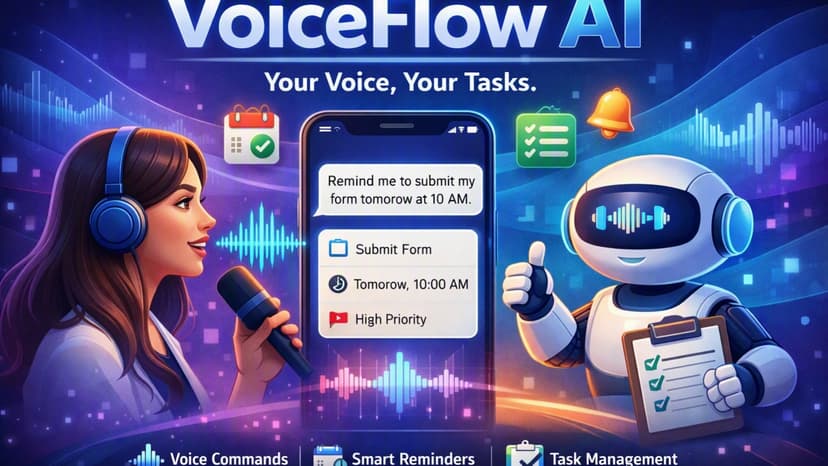
VoiceFlow AI is built for the AssemblyAI Voice Agent Hackathon to showcase how speech can seamlessly drive productivity. 🎤 Voice Input: Users speak commands like “Remind me tomorrow at 10 AM to submit my form.” 🧠 AI Understanding: AssemblyAI transcribes and parses intent (task, date/time, priority). ✅ Confirmation Workflow: The agent confirms before saving tasks. 📜 Task History: Keeps a log of all voice commands. 🔄 Natural Corrections: Supports conversational edits like “No, make it Friday” or “Cancel that.” This project demonstrates the potential of voice‑driven AI agents in everyday productivity. Technologies Used: Python (Flask) AssemblyAI API (real‑time transcription) HTML/CSS (frontend)
30 Sep 2026
ChangeScope AI
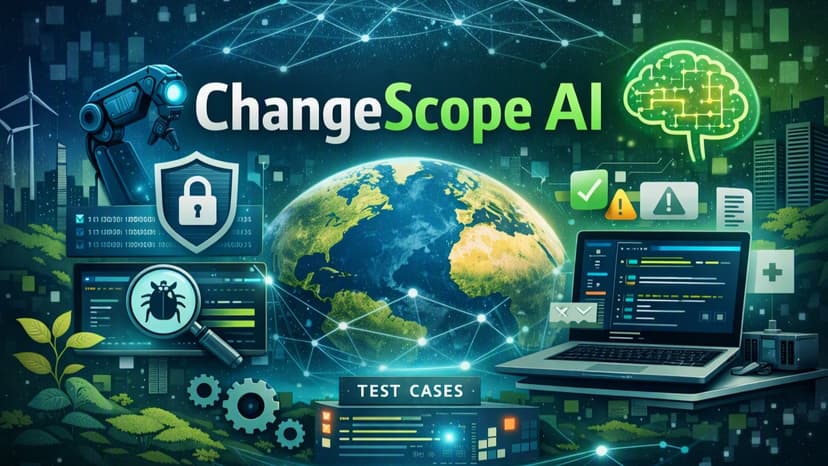
Software repositories often lack automated analysis for security and testing, forcing developers to spend hours manually checking vulnerabilities and writing repetitive test cases. This slows down development and increases the risk of overlooked issues. ChangeScope AI solves this challenge by leveraging IBM Bob 2.0 to automatically scan repositories, detect bugs, highlight security flaws, and generate synthetic demo code with comprehensive test suites. Target users are developers, QA engineers, and software teams who want faster, safer, and more reliable code. They interact with ChangeScope AI through a simple dashboard that provides instant analysis results, suggested fixes, and downloadable reports. What makes the solution unique is its combination of AI‑powered repository analysis with automated test generation, turning fragmented developer workflows into one intelligent process. This approach saves time, reduces human error, and ensures projects are delivered with higher quality and confidence.
27 Sep 2026


