🤝 Top Collaborators

🤓 Latest Submissions

CareThread: Clinical Handoffs with Context
When clinical teams change shifts, unfinished work can lose its owner, timing or context. A pending scan result may be misunderstood as complete, leaving the next team unclear about what still needs attention. CareThread is a voice-guided clinical handoff simulation that turns spoken conversations into a shared, reviewable plan. It captures unfinished tasks, clinician-stated owners, timing, conditions and uncertainty, with each detail linked to its source statement. Missing information stays unresolved until someone clarifies it. The receiving participant reviews and acknowledges the plan. Acknowledging responsibility does not mark the task complete. When important information changes, CareThread creates a new revision and requires renewed acknowledgment. AssemblyAI's managed Voice Agent API handles speech and conversation. Final transcripts pass to a server-side AssemblyAI LLM Gateway planner, which proposes structured updates. Application rules check these proposals against source statements and current revisions before saving them. Built with Next.js, React and TypeScript and hosted on Vercel, the prototype includes a guided synthetic scenario, live voice interaction, revision history, source evidence, JSON export and printable handoffs. Our initial audience is clinical educators and simulation centers practicing clearer team communication. The project passes 80 automated software checks and one synthetic spoken integration test. Browser microphone-device testing and clinical evaluation remain outstanding. CareThread is a training prototype using synthetic data. It does not diagnose, prescribe or authorize discharge.
30 Sep 2026
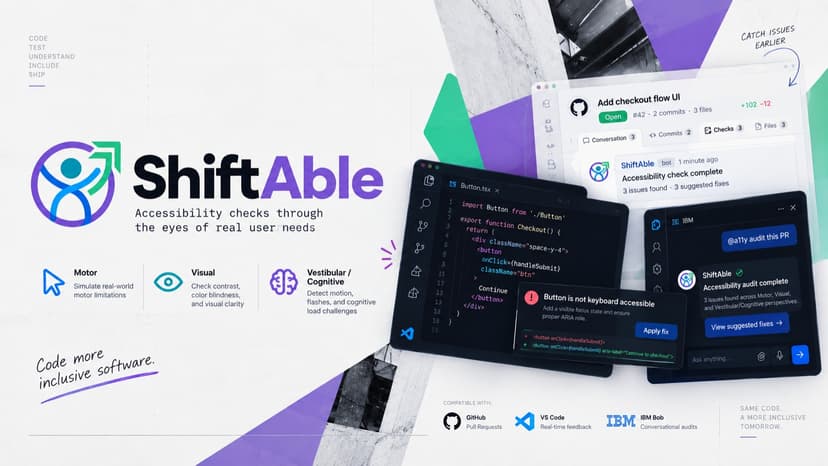
ShiftAble
Accessibility is one of the most chronically deferred quality concerns in software development. Despite WCAG standards existing for over two decades, the majority of accessibility failures are still discovered late — during QA, user testing, or after deployment — when fixes are expensive, time-consuming, and politically difficult to prioritize against feature work. ShiftAble solves this by embedding accessibility validation at the earliest possible moment: the pull request. When a developer opens a PR touching any UI file — HTML, JSX, TSX, CSS, or SVG — ShiftAble automatically intercepts it, fetches the diff, and runs a multi-persona accessibility simulation entirely without a browser or visual rendering engine. The engine is structured as a pipeline of specialized subagents. A Rule Engine ingests the full WCAG 2.2 index, filters it to the criteria actually relevant to the changed components (based on whether they contain interactive elements, images, color declarations, or motion), and optionally cross-references a linked Jira ticket's acceptance criteria to allow AAA-level enforcement when needed. Three Persona agents then run in parallel: the Motor persona statically analyses the DOM for keyboard-inaccessible elements, missing focus indicators, unlabelled inputs, non-semantic interactive elements, and broken tab order; the Visual persona computes WCAG contrast ratios and applies a Viénot 1999 Protanopia simulation matrix to detect color-blindness failures; the Vestibular persona detects auto-playing media, auto-advancing carousels without pause controls, CSS animations missing prefers-reduced-motion guards, and content that flashes above the seizure-risk threshold. Every failure is fed to a Debugger subagent that generates a ready-to-apply unified diff — a concrete code patch the developer can accept in one click. Fixes are grounded in the team's own design-system token palette when available, so suggested color replacements are always on-brand and compliant. The system operates across three surfaces: a GitHub Actions workflow that gates PRs and posts a consolidated comment with Accept-Fix deep links; a VS Code extension with inline diagnostics, hover tooltips, and a CodeLens "Fix" action that applies patches without leaving the editor; and an IBM Bob integration that responds to @a11y audit conversational commands and renders per-failure diffs in Bob's Review Mode. All three surfaces share the same underlying engine — no separate scan logic, no duplication. ShiftAble requires zero changes to existing test suites, CI pipelines, or component architecture. It is installed once, configured with environment variables, and from that point forward every UI pull request is automatically reviewed through the eyes of users with disabilities — shifting accessibility left to where it is cheapest and fastest to fix.
27 Sep 2026

