MOEZ ALI KHAN@moezkhan198
5
Events attended
3
Submissions made
Pakistan
2+ years of experience
About me
👨💻 Tech Enthusiast | AI Explorer | Code Composer 🌐 Welcome to my digital playground! I’m a passionate IT graduate with a penchant for coding, AI, and all things tech. Here’s a glimpse into my story: Master’s in IT: 🎓 I recently completed my Master’s degree, diving deep into databases, cloud services, and cybersecurity. My thesis? A harmonious blend of theory and code. Coding Alchemist: 💡 My fingers dance across keyboards, weaving Python spells, Java incantations, and JavaScript enchantments. LeetCode puzzles? Consider them solved! 💪 AI Odyssey: 🤖 Curious about the neural networks that power our world? I explore deep learning, image processing, and generative AI. My muse? Pixels and probabilities. GitHub Commits: 🚀 You’ll find me committing to open-source projects, sprinkling code like stardust. From bug fixes to feature enhancements, I’m on a mission to make the digital realm better for all. Bytes & Coffee: ☕ When I’m not debugging, I’m sipping coffee and dreaming up algorithms. Oh, and I believe semicolons have secret lives—they escape when we’re not looking. Remember, code is poetry, bugs are puzzles, and every merge conflict is a chance to collaborate. Let’s connect and build something magical! 🌟✨
🤝 Top Collaborators



🤓 Latest Submissions
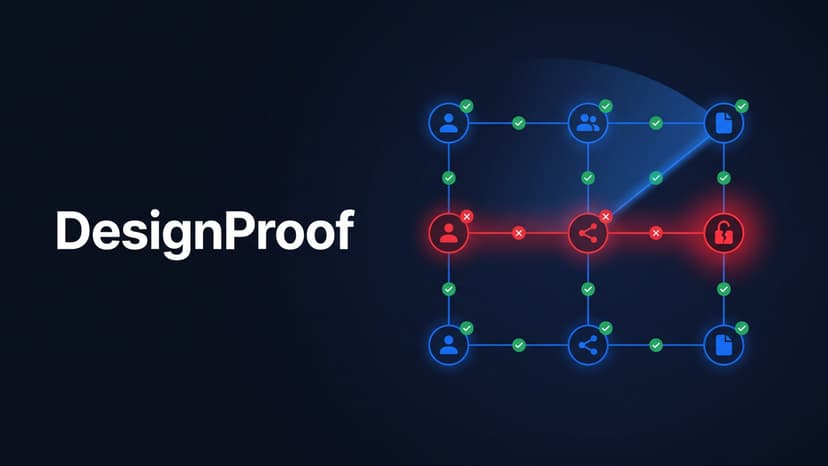
DesignProof: Code That Does What Your Policy Says
66% of developers say AI generated code is "almost right, but not quite" (Stack Overflow Developer Survey 2025). The most dangerous "not quite" hides in permission logic: who can access what. These bugs pass unit tests and code review, because tests only check the cases someone thought of, and they end up as data leaks. DesignProof improves the code review workflow for permission logic. IBM Bob 2.0 reads a plain English policy document and the application code, using parallel subagents: one extracts the rules, one traces how the code enforces them. Bob then writes an Alloy 6 model of what the code actually does, with one assertion per policy rule. Our designproof.py checker runs the Alloy Analyzer, which searches every combination of users, teams, files, and share links up to scope 4 for a counterexample. For each violation, Bob writes a failing test, applies a minimal fix, and rechecks until every rule is verified. We demonstrated it on a sample FastAPI file sharing app whose 4 existing tests all passed. DesignProof found that a user removed from a team could still edit the team's files through an old share link. The first fix then introduced a second bug, which was not planted: re-added members were wrongly blocked. Bob found it, and Alloy confirmed it by rechecking the model of the code after fix 1. After both fixes, all rules are verified and tests grew from 4 to 20. The workflow is packaged as a reusable DesignProof custom mode in IBM Bob, a command line checker, and a GitHub Actions workflow that fails the build whenever a modeled rule is violated. A live Streamlit dashboard runs Alloy on the server so anyone can reproduce the results. IBM Bob features used: Plan mode, parallel subagents, document understanding, Agent mode, and a custom mode. Honest limits: Alloy checks are complete up to the chosen scope, and every finding is confirmed by a real failing test against the actual code.
27 Sep 2026

VoiceShield
VoiceShield is built around a simple question: how can we be sure an AI voice agent is safe before letting real people talk to it? In real life, conversations don’t always go as planned. People can be angry, confused, vulnerable, emotional, or simply unpredictable. Traditional testing usually focuses on expected scenarios, so it can easily miss these difficult situations. VoiceShield tackles this by creating AI-powered personas that act like different types of real callers and put voice agents through realistic conversations. During each test, these personas challenge the voice agent with different situations while VoiceShield analyzes the conversation as it happens. It looks for things that could go wrong—such as unsafe or inappropriate responses, policy violations, risky behavior, or poor handling of vulnerable users. This helps teams discover potential problems before the AI agent is exposed to real customers. We use Speechmatics for voice interaction and speech processing, DataBright to bring relevant EU policies and regulatory information into the evaluation process, and our Smith evaluation agent to analyze conversations and determine risks, violations, and severity. The results are then presented through VoiceShield as clear Pass, Flag, or Fail outcomes with actionable recommendations. Our goal is to make AI voice testing feel less like traditional QA and more like putting an AI agent through a realistic stress test before real customers do it. VoiceShield helps businesses find problems early, understand where their agents are vulnerable, and build voice AI that people can trust.
10 Aug 2026

ShopGini
The idea is to use Gemini's power of multi-modal power to get a better idea of a product using pictures, text, and documents. Our system will use Gemini AI to analyze product descriptions, and Compare different products and identify the best value proposition. Review product reviews by previous buyers and the repeat purchasing pattern by the same buyer. Recommend superior alternatives based on user preferences and market trends. Allow users to input information about their personality traits for personalized recommendations. Provide an insightful report explaining the reasoning behind each recommendation. Feature a chatbot interface to guide users through the product evaluation process. Product description could be provided through various means like:- URL of the product page, PDF copy of Product Description, Photo of Product itself, A click on the product page through a Chrome Plug-in, or pre-integrated in an e-commerce site, or in a mobile shopping app, where a photo of the product could be taken in real-time
25 Mar 2024


