
🤝 Top Collaborators



🤓 Latest Submissions
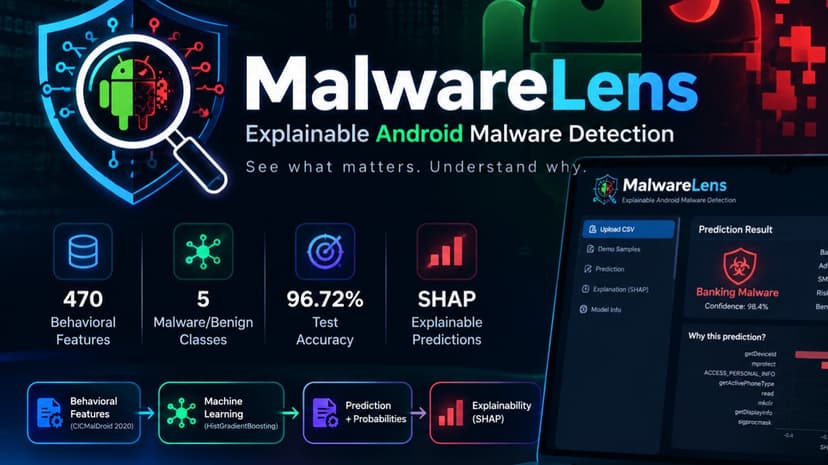
MalwareLens: Explainable Android Malware Detection
Android malware detection often ends with a simple classification label, leaving users with little insight into why a model reached that decision. MalwareLens addresses this interpretability gap by combining behavioral machine learning with explainable AI. MalwareLens uses 470 behavioral features from the CICMalDroid 2020 dataset and a HistGradientBoosting classifier to distinguish five categories: Adware, Banking malware, SMS malware, Riskware, and Benign. The final model achieved 96.72% accuracy and a 0.9607 macro F1 score on a locked test set. During dataset preparation, duplicate and conflicting feature vectors were identified and handled, followed by a group-aware stratified split to prevent feature-vector leakage between training and testing. The key feature of MalwareLens is explainability. For every prediction, the application provides class probabilities and SHAP-based feature contributions, showing which behavioral signals pushed the model toward or away from a class. These explanations are presented in the model's raw boosting-score space and are intended to explain the model's reasoning rather than serve as proof that an individual behavior is malicious. The project is deployed as a Streamlit web application and supports validated behavioral-feature CSV inputs and demo test cases. It also includes a CopperDroid-style JSON feature extractor for compatible structured behavioral reports. MalwareLens does not currently execute or directly analyze arbitrary APK files; it operates on extracted behavioral information.
27 Sep 2026

VoiceShield
VoiceShield is built around a simple question: how can we be sure an AI voice agent is safe before letting real people talk to it? In real life, conversations don’t always go as planned. People can be angry, confused, vulnerable, emotional, or simply unpredictable. Traditional testing usually focuses on expected scenarios, so it can easily miss these difficult situations. VoiceShield tackles this by creating AI-powered personas that act like different types of real callers and put voice agents through realistic conversations. During each test, these personas challenge the voice agent with different situations while VoiceShield analyzes the conversation as it happens. It looks for things that could go wrong—such as unsafe or inappropriate responses, policy violations, risky behavior, or poor handling of vulnerable users. This helps teams discover potential problems before the AI agent is exposed to real customers. We use Speechmatics for voice interaction and speech processing, DataBright to bring relevant EU policies and regulatory information into the evaluation process, and our Smith evaluation agent to analyze conversations and determine risks, violations, and severity. The results are then presented through VoiceShield as clear Pass, Flag, or Fail outcomes with actionable recommendations. Our goal is to make AI voice testing feel less like traditional QA and more like putting an AI agent through a realistic stress test before real customers do it. VoiceShield helps businesses find problems early, understand where their agents are vulnerable, and build voice AI that people can trust.
10 Aug 2026


