
🤓 Latest Submissions
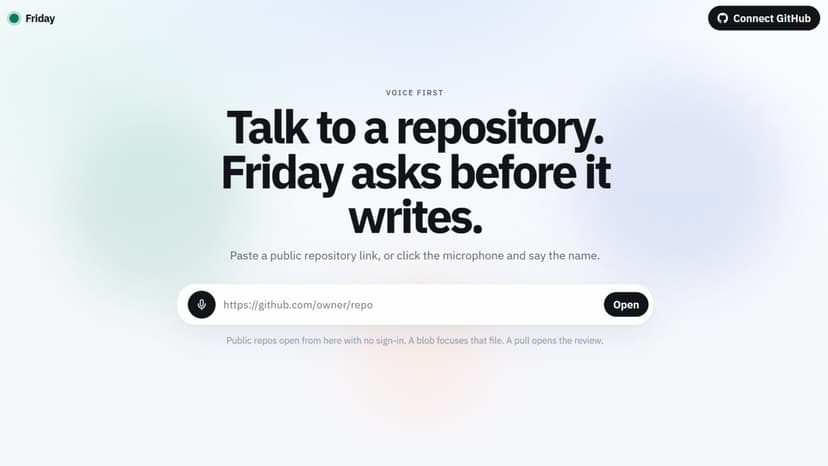
Friday: Voice Repo Agent
We are in an existential squeeze: models generate code at a pace no team can fully review, while AI-driven exploitation of vulnerabilities keeps improving. Humans are still the approval layer—but they no longer see the whole system, only endless diffs and tabs. Friday is a voice-first control surface for an open GitHub repository. A circle-pack map shows entry points, core files, and hotspots so you grasp shape before depth. You speak or type: explain the landmarks, what changed in the last commit, whether it is safe to merge, scan for security issues, list blockers—or stage an issue or comment. Nothing posts to GitHub until you confirm yes on a separate turn. Friday grounds answers in deterministic ingest (real paths, imports, landmarks) plus live GitHub data—not a generic chatbot over filenames. AssemblyAI powers live voice; an LLM Gateway tool loop handles multi-step triage; optional review intelligence (Jev with escalation) structures merge-risk answers when confidence is low. Built for the moment we are in: stay oriented, stay in control, and act deliberately when code and threats both move faster than human review.
30 Sep 2026

Sniff — The AI Mystery Shopper for Your Website
The Problem: Every founder eventually asks the same question: "Why aren't people signing up?" The honest answer is usually buried in analytics tools that show what happened (a 40% drop-off on step 3) but never why. Watching real user session recordings doesn't scale, and traditional QA testing only checks whether a flow technically works — not whether a confused, impatient, or first-time visitor can actually get through it. Landing page audit services exist (we studied existing solutions), but they're expensive per-report products that paywall most of their own findings. The Solution: Sniff is an autonomous AI agent that behaves like a real visitor — not a scripted test runner. Point it at a signup flow or a landing page, and it drives a real browser (Playwright) step by step, deciding what to click based on what it actually sees on screen, the same way a person would. It doesn't follow a hardcoded path; a vision-capable model (Gemini) looks at each screenshot and decides the next action, while a separate fast-reasoning tier (Jev) sanity-checks those decisions and catches ambiguous "did we actually succeed?" moments a keyword search would miss. Two products in one agent: 1. Signup/onboarding testing — assign the agent a goal ("sign up for an account") and a persona (confused first-timer, impatient power user, careful reader), and it attempts the flow, then classifies exactly why it failed if it did: root cause, severity (P0–P3), and likely owner (Backend/UX/Performance/Integration), escalated via Slack. 2. Landing-page conversion audit — point it at any URL and it produces a full product-manager-style teardown: an overall score, a five-dimension breakdown (Message & Clarity, Audience Fit, Action Path, Trust & Credibility, Content Depth), an annotated screenshot showing exactly what it identified as the CTA and clicked, a step-by-step narrative of what it saw and concluded, dominant colors/fonts actually sampled from the page, broken-link checks, copy rewrites, and a prioritized fix list. Every field a paid competitor report locks behind a paywall, Sniff shows in full. Who it's for: founders and PMs who want an honest, evidence-backed answer to "what's wrong with my funnel" without hiring a researcher or paying per report; and engineering teams who want signup-flow regressions caught automatically, with a diagnosis attached instead of just a red X. How they interact with it: a web dashboard — paste a URL, pick a goal or audit mode, and watch the agent work in near-real-time, then read the report with the same screenshots and reasoning trail the agent used. What makes it creative and unique: most "AI testing" tools still follow scripted selectors. Sniff's agent reasons from pixels and text like a human tester, deployed with a genuinely three-tier architecture (vision LLM, fast text LLM, ultra-fast decision model) that keeps it both smart and cheap to run at scale — and it's the only tool in this space that treats conversion auditing and functional QA as the same underlying capability: an agent that understands what it's looking at.
27 Sep 2026

One for All
Business teams know what they want to automate—onboarding, approvals, notifications—but building workflows usually means waiting on developers. One for All bridges that gap: describe your process in plain English, and the AI turns it into a working workflow you can run, edit in natural language, and export to tools like n8n. You can still build from scratch with a full node-based canvas, chain AI steps for content and analysis, and reuse everything. One app for both conversational workflow generation and hands-on automation design. Key Capabilities: -AI workflow creation: Describe a process in plain English; the AI breaks it into steps, selects the right actions, and generates a workflow. -Human-in-the-loop control: Users review, edit via natural language, and explicitly approve before deployment. -Self-debugging: When workflows fail, AI analyzes errors and suggests fixes. -Learning from examples: Successful workflows can be saved as templates to improve future generations. Manual Workflow Building: -Infinite, node-based canvas with rich controls. -Wide range of nodes: triggers, actions (HTTP, email, Slack), control flow, data transformation, and AI/prompt nodes. -Ability to chain AI outputs directly into real-world actions. Integrations & Export: -Bring-your-own API keys for major LLMs and services. -Export workflows as JSON or n8n-compatible formats for integration. Experience & Privacy: -Free, open-source (MIT). -Runs fully in the browser with local data storage. -Modern UI with dark mode and responsive design.
7 Feb 2026

Agent Smith
The complexity of building AI agents shouldn't be a barrier to innovation. We saw developers struggling with writing hundreds of lines of boilerplate code, managing complex configurations, and debugging agent interactions. We envisioned a world where anyone could describe their AI agent idea in plain English and instantly get a production-ready system. Agent Smith is an open-source visual agent creation platform built using Google's ADK simplicity and GPT-5's brains. Users describe their agent requirements in natural language, and our AI meta-agent system automatically generates complete Python agent code with custom tools, provides a modern web interface for visual management, and enables real-time testing and iteration.
24 Aug 2025
Qubic-Solana Bridge
The proposed Solana–Qubic bridge design is an attempt at building a secure, bi-directional, and production-ready solution for transferring tokens and messages between the two networks. It builds upon proven bridging architectures – using a lock/mint & burn/unlock mechanism for token transfers and a decentralized guardian network for verification – while tailoring the implementation to Qubic’s and Solana’s technical environments. The solution is leveraging Qubic’s high-performance C++ smart contracts and on-chain quorum for execution, and the Solana side will use a robust Rust program to manage wrapped assets and verify cross-chain commands. Crucially, the bridge is designed with security as the top priority: funds on each side are secured by the need for multiple independent signatures, and both contracts enforce validation before releasing assets. This minimizes trust in any single party. Combined with thorough testing, auditing, and a clear upgrade path, this bridge can be rolled out to mainnet usage. By enabling QUBIC token holders to access the Solana ecosystem (and vice versa) and even allowing cross-chain interoperability of applications via message passing, this bridge will significantly expand the utility and reach of both networks. It creates a connective infrastructure in a decentralized manner, aligning with the ethos of both Solana and Qubic. With the components and considerations detailed above, we can implement the bridge to be reliable for real-world, production use while remaining flexible for future improvements.
8 Jul 2025
pix2app
pix2app harnesses the power of ai to transform wireframes into functional code, streamlining the app development process and bridging the gap between design and development. Our platform addresses the significant challenge of manual coding from wireframes, which is time-consuming, prone to errors, and requires extensive expertise. The Need: The traditional app development process involves a lengthy and costly cycle of design, prototyping, and coding. Designers create wireframes, which are then handed over to developers, who manually translate them into functional code. This process is not only inefficient but also leads to miscommunication, inconsistencies, and delays. The Innovation: pix2app simplifies this process by directly converting wireframes into functional code. Our platform uses LLMs to analyze the wireframe design, identify patterns, and generate clean, production-ready code. This innovation enables designers and developers to focus on high-level creative tasks, rather than tedious manual coding. Business Opportunity: The demand for efficient ai-powered app development solutions is skyrocketing, driven by the growing need for digital transformation across industries. pix2app is poised to capitalize on this trend, offering a unique value proposition that saves time, reduces costs, and improves collaboration between designers and developers. What Makes This Idea Worth Pursuing: pix2app innovative approach to wireframe-to-code automation offers numerous benefits, including: - Increased Efficiency: Automating the coding process saves time and reduces the risk of human error. - Improved Collaboration: pix2app enables seamless communication between designers and developers, ensuring consistency and accuracy. - Faster Time-to-Market: With pix2app, businesses can quickly prototype, test, and deploy applications, gaining a competitive edge in the market.
15 Jun 2025


