

🤓 Latest Submissions

CurbCut: Accessibility Review That Proves Fixes
AI coding assistants have become remarkably capable, and more and more interface code is now written with their help. Their output, however, still tends to overlook the accessibility standards that people with disabilities depend on: buttons without names, text with too little contrast, forms that cannot be completed with a keyboard. Speed has improved; inclusion has not kept pace. Accessibility issues pass code review because most reviewers are not WCAG experts, and linters only catch what a rule can match. Students and citizens who use screen readers or keyboards find the gap after release. CurbCut puts an accessibility reviewer into every pull request, built entirely from IBM Bob's own building blocks. Bob read the WCAG 2.2 Recommendation and wrote a reusable skill with a policy pack of all 55 Level A and AA criteria. In the CurbCut Review mode, Bob runs a deterministic engine for measured facts, then spawns four read-only Explore subagents in parallel, one per WCAG principle. Every finding is labelled proven, backed by a measured fact, or flagged, Bob's judgment with a reason, and checks that cannot be done this way are always listed. The CurbCut Fixer mode can only edit the app and makes the smallest fix per finding. The CurbCut Prover mode writes one test per fix, and a fix counts only if its test fails on the pull request and passes on the fix. On a demo class app with planted issues, axe-core alone found 8 of 18 issues in the first pull request. CurbCut with Bob found 16, flagged no decoys, and proved 23 of 23 fixes. Results are shown on a live dashboard with a screen reader narration before and after, and exported to GitHub code scanning. CurbCut does not certify conformance, and it is no substitute for testing with disabled people.
27 Sep 2026
SynapVocal: Realtime Voice Bridge
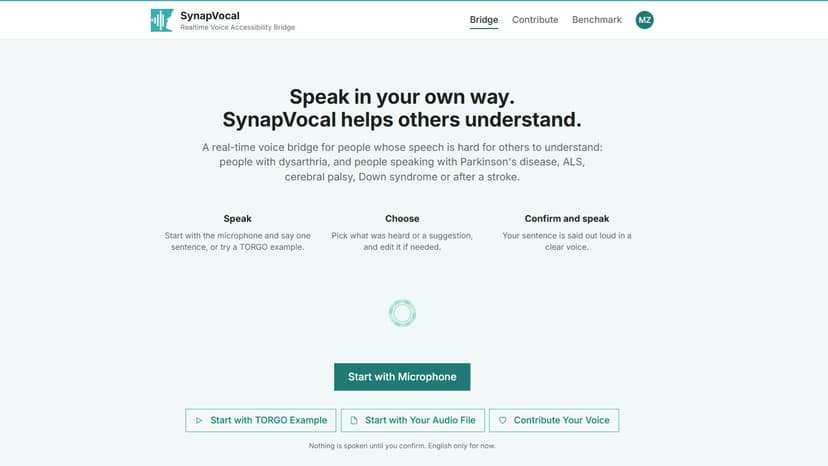
Certain medical conditions such as dysarthria, cerebral palsy, ALS, Down syndrome, or stroke can make a person's speech slow, slurred, or broken. This makes them difficult to understand for both human listeners and standard automated speech recognition systems. SynapVocal serves as a voice bridge solution that puts the user in control through a confirm-before-speak approach. The system operates in four steps. First, the browser streams audio from the microphone in real time to the AssemblyAI Universal-3.6 Pro model. Second, once a sentence ends, Gemini reads the transcript, listens to the sentence's audio, and analyzes the user's previous sentences to offer three alternative options of what the user likely meant. Third, the user confirms, selects, or edits the most accurate option. Nothing is spoken aloud before the user approves it. Finally, Deepgram Aura-2 speaks the confirmed sentence clearly to the listener. This approach has proven effective. Based on testing on the TORGO database for unique sentences from speakers with dysarthria, the best choice offered by the system yielded 426 exactly right sentences out of 680, a significant improvement compared to 324 sentences when relying solely on standard speech recognition.
30 Sep 2026

FACTOR (Factual Agentic Content Orchestrator)
FACTOR (Factual Agentic Content Orchestrator) is a A self-hostable, multi-agent AI pipeline that produces hallucination-free, fully-cited content at scale. Built on a strict Retrieval-Augmented Generation architecture, its agents research only from trusted literature, official sources, peer-reviewed journals, and curated books. Every claim is bound to a source: a separate Fact-checker (never the writer) verifies each claim against the original text, and each piece passes an 8-gate anti-hallucination pipeline, source sufficiency, grounded writing, independent fact-check, bias review, cross-lingual QA, schema validation, human review, and post-publish audit, with a capped revision loop. It then generates ready-to-publish content, titles, rich text, featured images, and full SEO metadata, in multiple languages, and injects it straight into your CMS database. No manual publishing. Proven: #1 FACTOR runs entirely on your own infrastructure, powered by Google's Gemma family on an AMD Instinct MI300X (192 GB HBM3) via ROCm and vLLM: Gemma 3 writes and fact-checks, EmbeddingGemma powers semantic retrieval, and SDXL creates featured images, all on a single AMD GPU, unquantized, with no per-token cost and no content ever leaving your infrastructure. #2 GPU: AMD Radeon PRO W7900 (48 GB · gfx1100) , LLM: Google Gemma 3 via llama.cpp (ROCm/HIP; scales to Gemma-3-27B / 70B on a bigger GPU) #3 Serverless Models on Fireworks.ai
13 Jul 2026


