
🤓 Latest Submissions

Atelier: make only what's already sold
Fashion guesses. Brands commit to hundreds of pieces per style months before anyone buys; in 2023 the industry produced an estimated 2.5-5 billion items of excess stock (McKinsey & BoF), and since July 2026 large EU companies may no longer destroy unsold clothing. Small labels pay the bill, after hours of specs and supplier emails. Atelier flips the order: design fast, sell first, make what has sold. The designer keeps the four taste calls; AI agents do the paperwork. 1. Signal: Gemma 4 (Google's open model) on AMD GPUs reads a mood board and the designer's own sketch. 2. Direction: the designer briefs changes in plain words; Atelier reads them back. 3. Tech pack: an Evolus agent on the AMD-hosted model writes a costed spec, grounded in the brand book. 4. Suppliers: RFQs go to each mill in its own language through an Evolus workflow; the Evolus document extractor reads the quotes. 5. Guardrails: plain arithmetic checks margin, cost cap, lead time and MOQ. When a quote breaks a rule the agent stops and hands the call to a person, then negotiates at the exact target price. 6. Pre-order: a real Shopify product opens for pre-order. 7. Purchase order: only once real orders clear the threshold does the PO go to the mill through Evolus. A statistical forecast (no LLM) suggests the quantity. Measured on a live run: approval to RFQs sent in 1 min 54 s. In our recorded run a supplier quoted EUR 320 for a tunic priced at EUR 310; the agent stopped, negotiated, and only sent PO-00001 after pre-orders arrived. Nothing is mocked: every model call is measured, AI images are labelled. Live: atelier.netlayerlabs.com
18 Oct 2026

Surgr: Voice Safety for the Operating Room
In surgery, drugs are ordered by voice. The safety standard is closed-loop communication: every order is read back before it is given. In a loud room under pressure, the read-back gets skipped or misheard, and nothing beeps. About one in twenty surgical medication administrations involves an error. Surgr is a voice safety layer for the operating room. It streams the room's audio through AssemblyAI Streaming in medical mode, with speaker labels that tell the surgeon, anesthesiologist and nurse apart on one microphone. Every drug order opens a ten-second window for a read-back, and Surgr compares drug, dose, unit and route, so 0.1 mg and 100 mcg agree while 100 mcg read back as 10 mcg does not. When a loop fails, Surgr speaks the alert into the room within about a second through the AssemblyAI Voice Agent API, because nobody in surgery is watching a screen. It tracks all 21 items of the WHO Surgical Safety Checklist as the team speaks them and flags a Time Out that ends with items missing. The team can ask it questions by name, such as "Surgr, what is still open?", and the Voice Agent answers from live state through tool calls. The LLM Gateway settles utterances the rules engine cannot and writes the report narrative. When the case ends, the audit record is already written: every order, read-back and alert, timestamped, with closed-loop rate and checklist compliance. It exports as a PDF, sends to Telegram or email, or is read aloud as a spoken debrief. Surgr starts where no clearance is needed, in simulation labs and residency training, then moves to silent analytics in real rooms, and to live intervention after clinical validation. It is priced per operating room.
30 Sep 2026
Deflow - Autonomous Multi-Agent Options Desk
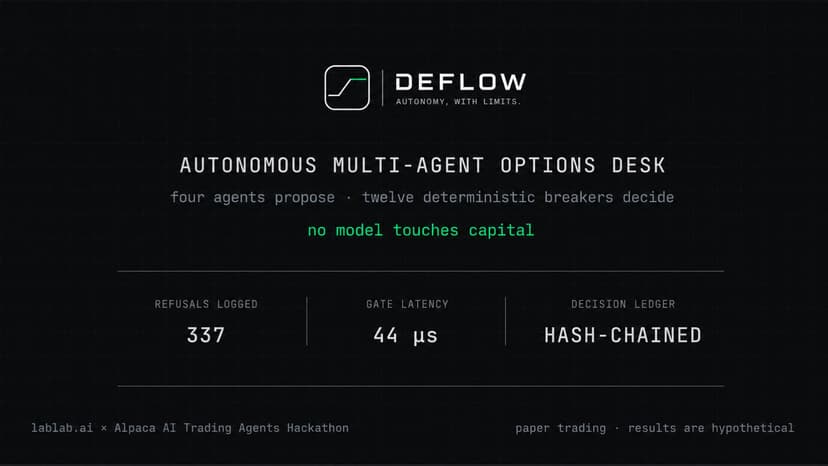
An autonomous options desk built on one principle: the language model is the least-trusted component. THE EDGE. It measures the variance risk premium - implied volatility against its own jump-robust forecast of realised volatility (bipower variation). Implied rich by 2%+, it sells defined-risk premium; implied cheap, it buys convexity; inside the band it refuses, on the record. Live, the measurement mattered more than the thesis: implied came in cheaper than forecast on NVDA, so the desk bought call spreads instead of selling premium - and that made the P&L. THE DESK. Four agents run a six-stage cycle every five minutes. A Macro & Volatility Analyst reads regime, VRP and priced-in catalysts (Alpaca has no earnings calendar, so events come from IV term-structure inversions). An Options Structurer computes strikes, widths and sizes from live quotes. An Adversarial Risk Auditor attacks each proposal with independent Greeks and 1,000-path Merton jump-diffusion, and can kill it. An Execution Agent routes native multi-leg orders. The model (Qwen2.5-72B on Featherless) picks one index from a shortlist it cannot write - its entire authority - and any failure degrades to a deterministic ranker. THE GATE. risk_gate.py: twelve circuit breakers, stdlib only, zero LLM, microseconds, fail-closed, run twice. The gate sizes trades; the model never does. Fire a naked call at it from the dashboard and watch seven breakers refuse it with live numbers. HONEST BY CONSTRUCTION. Submitted is not filled - entries and exits stay working orders until the broker confirms. Exits price off current marks, not entry. Headline equity is Alpaca's own, labelled; unfetched values show as dashes, never $0.00. Every decision is SHA-256 hash-chained, verifiable in your browser. THE MANDATE. Deflow knows the contest ends Sep 4, tightens profit targets toward it, and - announced a day ahead - flattens its book so it retires with realised results, not marks. Alpaca Trading API + CLI + MCP server.
4 Sep 2026


