
🤓 Latest Submissions

Vision-Language OCR + RAG on AMD ROCm
Two GPU-accelerated mini-challenges built on the mandated ROCm PyTorch base, each packaged as a self-contained Docker image with model weights baked in — no network access needed at evaluation time. Mini-Challenge 2 is an OCR service for license plates and road signs. A resident Qwen3-VL-8B daemon loads once at container start and serves thin-client exec calls over a Unix socket, so each image transcribes in under a second — well inside the 30-second budget. The prompt encodes the challenge transcription rules: jurisdiction banners and slogans omitted on US plates, Chinese province prefixes preserved, multi-line sign text in reading order, advisory plaques returning digits only. It scored 10/10 on the official samples and 60/60 on a locally generated degraded set (noise, blur, rotation, low light). Mini-Challenge 3 is a RAG system over a mixed-filetype corpus. An index pass parses PDF, DOCX, XLSX, CSV, logs, source code, and transcribes images via the same resident VLM — with per-file error handling so unreadable, encrypted, or unknown files never abort the walk. Retrieval combines BM25 with identifier-expansion for multi-hop questions, withdrawn documents are excluded from context, and unanswerable questions return a clean refusal (empty answer, empty citations). Retrieval-Augmented Generation over a mixed-filetype corpus, packaged on the mandated ROCm PyTorch base. A resident **Qwen3-VL-8B-Instruct** daemon loads once at container start and holds the corpus index in memory;
1 Dec 2026
Granny Firewall
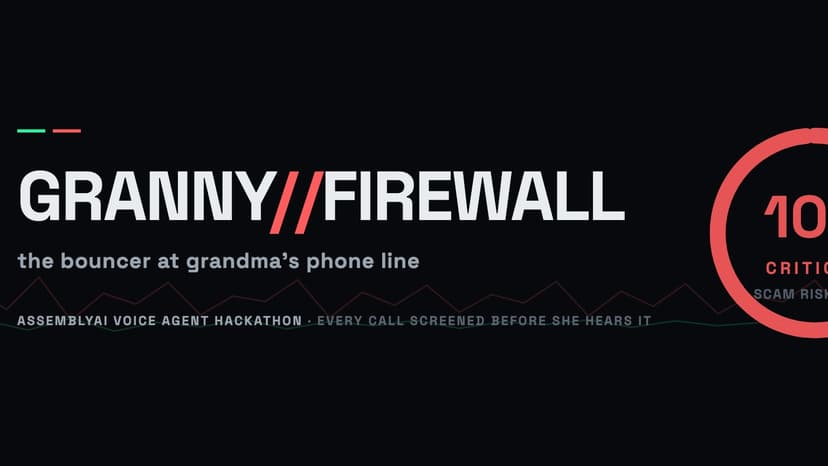
# The problem Americans over 60 reported nearly $5 billion lost to fraud in 2024 (FBI IC3), and the phone is still the scammers' favorite door. The IRS call, the bail-money call, the "your grandson is in trouble" call — they all work the same way: authority, urgency, secrecy, then gift cards. By the time a family member hears about it, the money is gone. The obvious fix — "just don't answer unknown numbers" — doesn't survive contact with real life. Pharmacies call. Doctors' offices call. The plumber calls from a cell phone. Someone has to pick up. Granny Firewall picks up instead. ## What it does Every call from an unknown number hits the firewall before it ever rings grandma's phone. The screener answers politely — "Hello, you've reached the Miller residence, who's calling?" — and starts listening. As the caller talks, a detection engine scores the conversation in real time across seven scam categories: impersonation, urgency and threats, payment demands, credential phishing, isolation tactics, fake prizes, and family-emergency cons. Each hit lands on a live dashboard mid-sentence, with the exact words that tripped it. A risk dial climbs as the case builds. Then the call forks three ways: - **Legitimate caller.** A pharmacy reminder, a neighbor, a real friend — passed through. If someone claims to be family, they're asked for the family codeword. - **Suspicious.** The screener keeps asking questions. The family gets a quiet alert. - **Clearly a scam.** Here's the part people don't expect: instead of hanging up, the firewall switches into a sweet, slightly confused 78-year-old persona and lets the scammer explain themselves. Slowly. Every minute a scammer spends coaxing card numbers out of "Ethel" is a minute they're not calling an actual victim. When it ends, the family gets a threat report: who the caller claimed to be, what they asked for, how much money they wanted, the red flags that fired, and what to do next.
30 Sep 2026

VoiceSort: language-conditioned bimanual SO-101
We built the Intel Online track challenge end to end: a custom MuJoCo scene with two SO-101 arms (public Apache-2.0 assets, procedural objects so there is zero licensing risk), a scripted-demonstration pipeline that writes LeRobot-format data with the natural-language task string kept per episode, and a vision-language-action policy that runs the robot. The "L" is real: each instruction is embedded once with a frozen MiniLM encoder and fed to ACT as a transformer token. Because the conditioning is semantic, the policy follows rephrased commands, not just the three training strings. An instruction-swap rollout shows the language token selecting which arm moves and which object it goes for. Deployment is the required part and it is measured, not claimed: the policy is exported through ONNX to OpenVINO IR with normalization baked into the graph, then executed closed-loop on the i9-13900K CPU (28.9 Hz policy rate) and on the UHD 770 iGPU (28.6 Hz). OpenVINO on the CPU alone is 3.2x faster than PyTorch on the same chip. Success rate on held-out seeds: 13/24 with the FP32 IR, versus 12/24 for the PyTorch reference. A voice layer (Speechmatics STT -> keyword planner -> the same semantic embedding) drives the whole thing from a spoken command; the video shows a recorded instruction going end to end on OpenVINO/CPU.
16 Sep 2026


