🤝 Top Collaborators
🤓 Latest Submissions
Spec2Ship
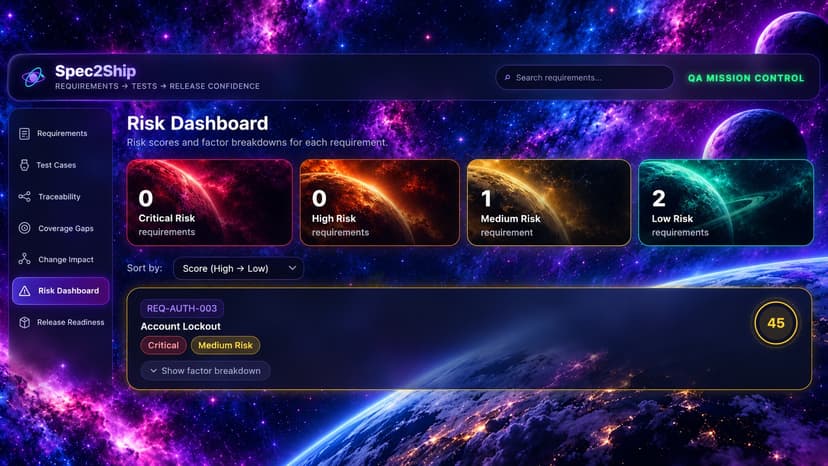
Spec2Ship is a QA traceability and release-readiness platform designed to help software teams understand whether a product is truly ready to ship. Instead of treating requirements, test cases, coverage, changes, and risk as separate pieces of information, Spec2Ship connects them into one explainable workflow: Requirements → Tests → Traceability → Coverage Gaps → Change Impact → Risk → Release Readiness The platform allows teams to see which requirements are covered by tests, where gaps exist, how changes may affect existing coverage, and which requirements carry the highest risk. Spec2Ship uses a deterministic weighted risk model based on requirement criticality, coverage gaps, test execution completeness, and change impact. This makes each risk score transparent and explainable rather than relying on a black-box result. The final Release Readiness view brings those signals together into a clear status such as Ready, Review Required, or Not Ready, helping teams understand what still needs attention before release. Business Value: Spec2Ship is designed for QA engineers, QA leads, release managers, engineering managers, and software teams that need to make release decisions using evidence spread across multiple tools. In many development environments, teams must manually connect requirements, test coverage, execution results, recent changes, and risk information before determining whether a release is safe to move forward. Spec2Ship centralizes that information into one traceable workflow, helping teams identify coverage gaps earlier, focus testing on higher-risk requirements, reduce manual release-review effort, and make release decisions that are easier to explain and audit. As a commercial product, Spec2Ship could evolve into a release-intelligence platform offered to software teams as a SaaS solution. Future integrations with issue trackers, source-control platforms, CI/CD pipelines, and test-management systems could allow Spec2Ship to automatically update traceability, change impact, risk, and release-readiness information as a product changes. IBM Bob was used as a core development tool throughout the project, supporting architecture planning, project scaffolding, backend API implementation, frontend functionality, traceability features, coverage-gap analysis, change-impact logic, risk analysis, release-readiness development, debugging, and final end-to-end validation. The application was built with React, TypeScript, Vite, Express, Node.js, Vitest, and Playwright, and is deployed as a working public prototype on Render. IBM Bob task summaries and screenshots are preserved in the public repository to document how Bob was used throughout development. The visual layout and styling were created separately from IBM Bob to preserve Spec2Ship’s own creative identity and originality, while Bob was focused on implementation, functionality, testing, and validation.
27 Sep 2026

