Muhammad Yaseen@my5757980
9
Events attended
9
Submissions made
Pakistan
1 year of experience
About me
I am an experienced AI Developer with a strong hands-on background in building intelligent systems and AI-powered applications. Currently, I am actively developing AI projects that focus on solving real-world problems using machine learning, deep learning, and generative AI technologies. My work involves end-to-end development — from data collection and model training to deployment and optimization of AI solutions. I have practical experience in: Building and fine-tuning Large Language Models (LLMs) Developing computer vision and NLP-based applications Creating AI agents and automation tools Working with frameworks like LangChain, TensorFlow, PyTorch, and Hugging Face I am passionate about leveraging AI to create scalable, efficient, and impactful products. I continuously experiment with the latest advancements in AI to deliver high-quality solutions. I am very excited to bring my expertise and contribute to innovative AI initiatives.
🤓 Latest Submissions
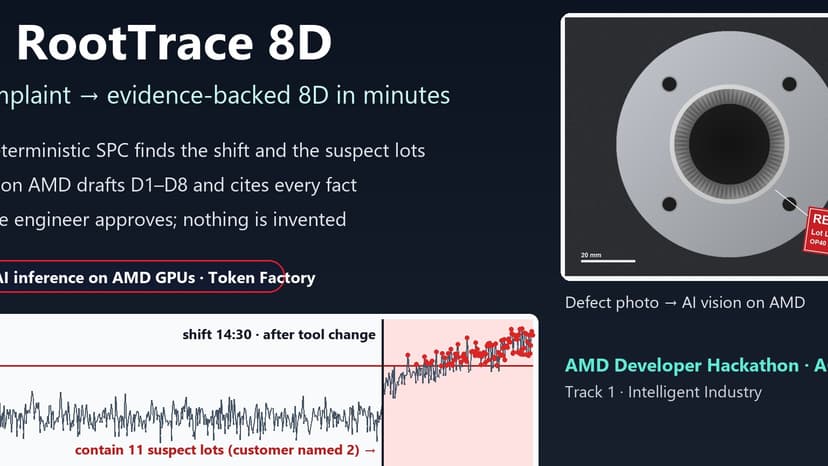
RootTrace 8D: Complaint to 8D Report on AMD
When an automotive customer rejects parts, the supplier's quality engineer must contain suspect stock within 24 hours and deliver an 8D report. Today that means hours to days of collecting the complaint, photos, SPC data and maintenance logs by hand. Containment is often a guess based on the lots the customer happened to name. RootTrace 8D does the evidence work in one click. Deterministic statistics compute control limits, Western Electric rules, Cp/Cpk and the exact moment the process shifted, then turn that into a containment range and the suspect lots. AI models served on AMD GPUs through AMD Token Factory read the complaint, classify the defect photo, rank root-cause hypotheses across the 6M categories and draft all eight 8D sections. Every claim cites an evidence ID, and a number-trace check flags any figure the AI did not get from the data. The engineer edits and approves each section and exports a printable report with unapproved sections marked DRAFT. In the sample case the customer names 2 lots. RootTrace finds the shift 10 minutes after a boring-bar change with a visual-only first-piece check, and asks the engineer to contain 11 lots, 9 of which the customer has not reported yet. It is built for supplier quality engineers in automotive and industrial manufacturing. Every AI step shows its AMD provider, model, latency and tokens.
18 Oct 2026
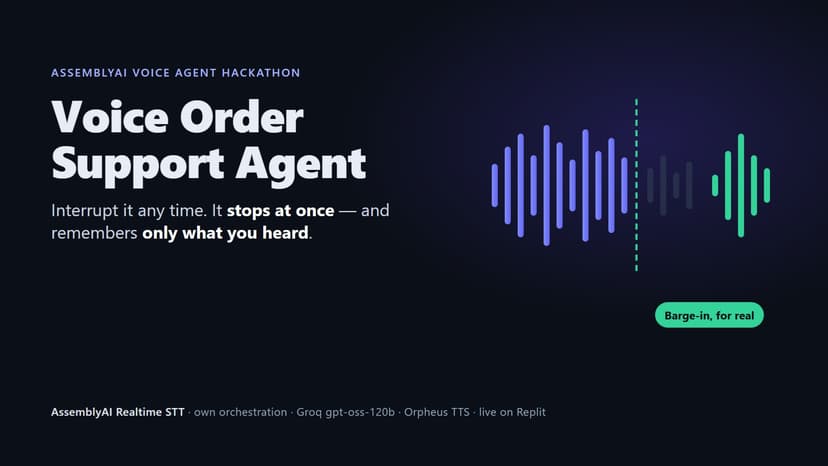
Voice Order Support Agent — interrupt it any time
The problem: "Where is my order?" is the most common post-purchase question in e-commerce, and the business can already answer it from its own data. Shoppers still wait for a human, fight an IVR menu, or type order numbers into a chatbot that breaks on the first follow-up. It is a voice problem, and most voice agents make it worse because they cannot be interrupted. What it does: the shopper opens the page and talks. The agent looks up their orders before asking anything, answers in two sentences, and puts tracking numbers on screen instead of reading them aloud. It can start a return, cancel an unshipped order or change an address. For anything that changes data it checks the action is possible, reads it back, and waits for an explicit yes. What makes it different: we took the Realtime STT path and own turn-taking. When the shopper talks over the agent, the browser's playback buffer is cleared at once; barge-in fires on the first real word of a streaming partial, while backchannels like "mhm" are ignored; and memory keeps only the words the shopper actually heard, computed from the audio the browser played. Built to be trusted: state-changing tools are gated in code, not in the prompt. An unknown tool, invalid arguments, a speculative turn or a missing confirmation stops the call. Returns are idempotent, and the agent never claims a success the tool did not report. Measured and shown: every turn draws a live latency waterfall. On the deployed app the agent went silent 1.14 s after being interrupted and answered in 3.0 s (median). On Groq's free tier the live demo serves one conversation at a time. Stack: AssemblyAI Universal-Streaming, Groq gpt-oss-120b with a manual tool loop, Orpheus TTS, FastAPI + asyncio, TypeScript AudioWorklets, SQLite. 288 tests.
30 Sep 2026

Maya — CS Health Radar
THE PROBLEM A CSM carrying 60-120 accounts can actively manage about 15 a week. Churn is decided in the other 85 - and it is usually visible months before anyone notices. Signals sit scattered across support, product analytics, CRM and billing, so assembling one account's picture by hand takes ~20 minutes. Detection is calendar-driven, not signal-driven. And knowing is not acting: a credible outreach takes 15-25 minutes to write, so at 6pm the at-risk account gets a generic check-in, or nothing. TARGET USER An individual-contributor CSM at a growth-stage B2B SaaS company. Accounts are $8k-$60k ACV: too small for a named account team, too large to ignore. Paid partly on renewals, so churn is personally expensive. THE COMPLETE WORKFLOW Signal recorded, health recomputed, grounded risk explanation generated, action chosen and outreach drafted, human approves or rejects with a reason, decision written to the account timeline. WHAT MAKES IT DIFFERENT Most CS tooling outputs a score and stops - the CSM still does the thinking and the writing. Maya delivers the drafted action, not the number. The health score is deterministic TypeScript, never a model. Same signals, same score, always - so cause and effect can be verified live rather than trusted. Every account shows the breakdown behind its number: Blue Ridge Partners reads 27 because -34.01 -19.94 -13.57 -5.59. The model only does what rules cannot: turn signals into a narrative, pick an action, write the message. Grounding is enforced in code and schema, not the prompt. A Postgres CHECK makes an explanation citing fewer than two signals impossible to save. Citation ids are validated server-side against the supplied context, so an invented citation is rejected. Actions are bounded to a six-value enum. Nothing is ever sent. Approval records the decision and final text. No outbound sender exists anywhere in the code - enforced by absence, not a flag. IMPACT Assessing one account drops from ~20 min to under 30 sec.
10 Aug 2026
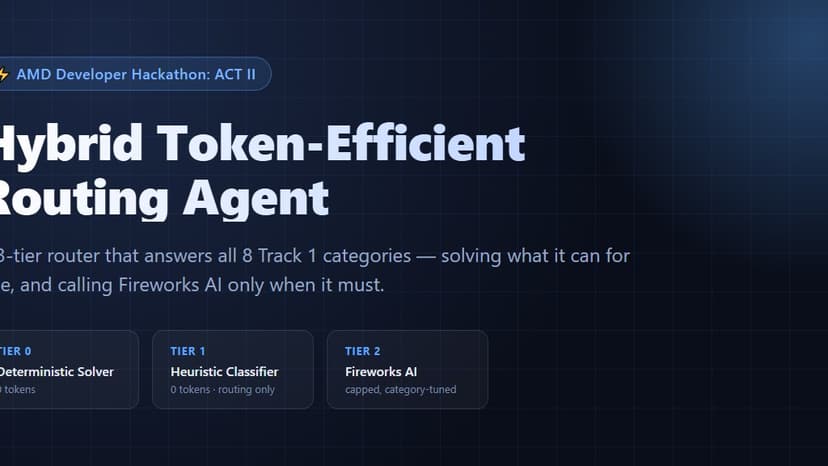
Hybrid Token-Efficient Routing Agent
Track 1 asks for a general-purpose agent that handles 8 capability categories - factual knowledge, math reasoning, sentiment classification, summarisation, named entity recognition, code debugging, logical reasoning, and code generation - while minimizing scored tokens spent through Fireworks AI. My approach is a 3-tier router. Tier 0 is a deterministic solver that handles pattern-matched arithmetic and percentage word problems in pure Python - zero tokens - and only fires when the pattern is confidently recognized, otherwise falling through safely to Tier 2 rather than risking a wrong guess. Tier 1 is a zero-token heuristic classifier (regex/keyword based) that infers which of the 8 categories a task belongs to, purely to select the right prompt template - it never answers the task itself. Tier 2 calls Fireworks AI with a concise, category-tuned prompt and a capped max_tokens, using the cheapest model available in ALLOWED_MODELS. The container reads /input/tasks.json and writes /output/results.json per the hackathon's I/O contract, is ready within seconds, and completes well under the 10-minute cap. It is built with Python 3.11 and uv, tested with 38 unit tests plus a 24-task local eval harness (16/16 correctness checks passing, all 8 categories covered), and shipped through a full Spec-Driven Development pipeline (Constitution to Specify to Plan to Tasks to Implement) via SpecKit Plus. The published GHCR image was pulled fresh and re-verified against the container I/O contract before submission.
13 Jul 2026
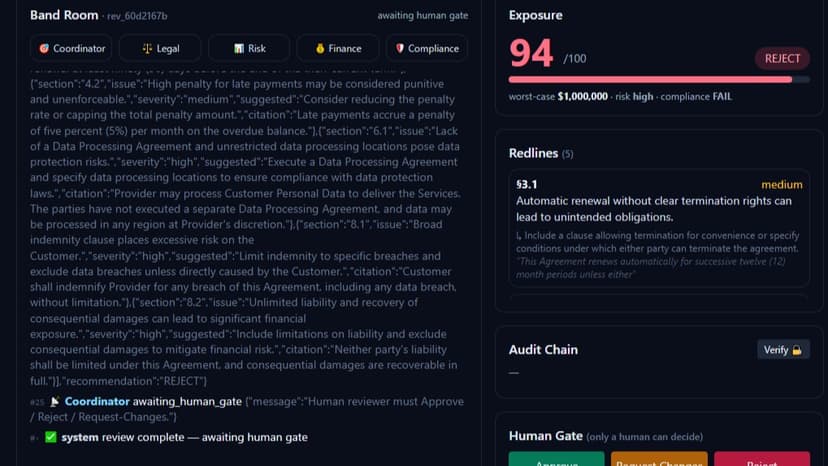
Contract Redline War Room
Contract Redline War Room is a regulated, multi-agent contract review desk where five specialized AI agents - Coordinator, Legal, Risk, Finance, and Compliance - collaborate through Band to redline a contract, quantify financial exposure, and assemble an approval packet that no single agent can sign off on alone. The Coordinator opens a Band room, discovers its peers with band_lookup_peers, and recruits the specialists with band_add_participant. Legal redlines clauses and cites the exact source text. Risk scores severity and dollar exposure. Finance computes worst-case financial impact. Compliance runs a policy check using Featherless AI's open-source inference and can VETO the recommendation, forcing a visible Coordinator re-plan loop - this is real coordination, not a fixed pipeline. Every agent-to-agent handoff, finding, state change, and discovery is a genuine Band primitive (band_send_message with @mentions, band_send_event, band_lookup_peers, band_add_participant, band_create_chatroom) driven through the real Band SDK, with each agent authenticating with its own API key. Once the agents converge on an aggregated exposure score and redline packet, a human reviewer holds the only key: Approve, Reject, or Request Changes. The decision seals a SHA-256 hash-chained audit trail; GET /api/verify/{id} recomputes the entire chain so any later edit is detectable, giving regulators a defensible record of exactly how the recommendation was reached. AI/ML API powers the primary reasoning for Coordinator, Legal, Risk, and Finance, while Featherless AI serves the Compliance agent's open-source policy-classification model - both partner technologies are exercised live and tallied at /api/health. This turns days of cross-functional contract review into minutes, with a tamper-evident sign-off record built for Track 3: Regulated and High-Stakes Workflows.
19 Jun 2026
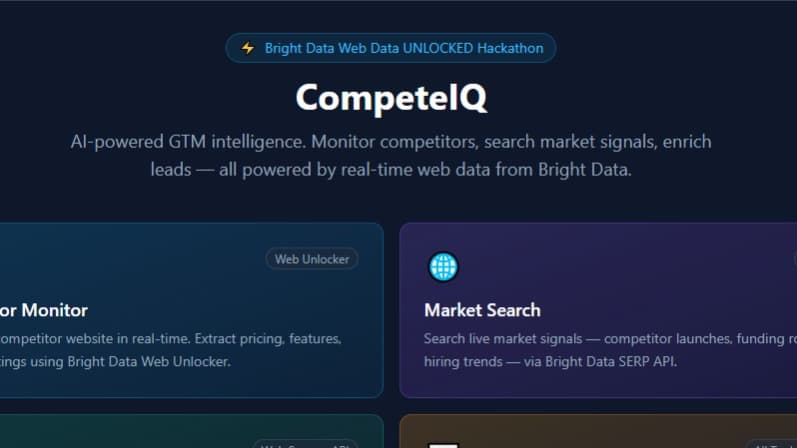
CompeteIQ — GTM Intelligence AI Agent
CompeteIQ is a full-stack AI-powered GTM Intelligence Agent built with Next.js 15 and powered by Bright Data's web data infrastructure. The platform delivers four core intelligence capabilities for go-to-market teams: 1. Competitor Monitor — Paste any competitor URL and CompeteIQ uses Bright Data's Web Unlocker API to fetch live web content, extract structured data with cheerio, and generate an AI-powered summary using Groq's llama-3.3-70b model. Sales teams instantly understand pricing changes, product updates, and positioning shifts. 2. Market Search — Run natural language market intelligence queries powered by Bright Data's SERP API. Results are surfaced with AI-generated insights, giving GTM teams a real-time pulse on the competitive landscape without manual research. 3. Lead Enrichment — Enter any company name to trigger Bright Data's Web Scraper API, which extracts firmographic data including industry classification, tech stack signals, and company profile information in seconds. 4. Intelligence Report — The flagship feature: a 4-agent SSE-streaming pipeline that generates a comprehensive competitive intelligence report with sections covering Market Position, Technology Stack, Growth Signals, Competitive Landscape, and Strategic Recommendations. The report streams live to the browser using ReadableStream, giving users a real-time agentic experience. Tech Stack: Next.js 15 App Router (full-stack, no separate backend needed), TypeScript, Tailwind CSS, Groq SDK with llama-3.3-70b-versatile, Bright Data Web Unlocker + SERP API + Web Scraper API, cheerio for HTML parsing, deployed on Vercel. CompeteIQ turns hours of manual competitive research into a 30-second automated intelligence workflow — built entirely on Bright Data's live web access infrastructure.
31 May 2026
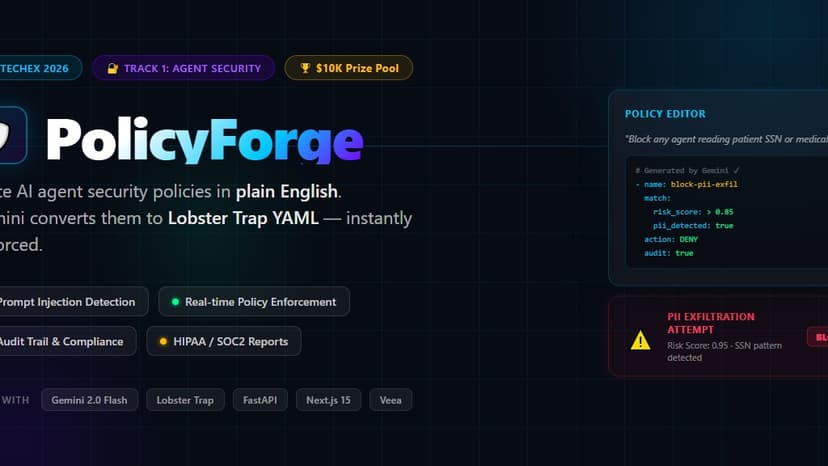
PolicyForge — AI Agent Security Policy Platform
PolicyForge is an enterprise AI agent security platform that solves a critical gap: security teams cannot write or manage AI agent policies because existing tools require deep YAML expertise. With PolicyForge, any CISO or compliance officer can type a security intent in plain English and have it enforced in seconds. How it works: The user types a natural language policy such as "Block any agent that reads patient SSN or medical records." Gemini 2.0 Flash instantly converts this into a Lobster Trap YAML enforcement rule. The rule is activated and enforced immediately by the Veea Lobster Trap deep prompt inspection proxy — a MIT-licensed tool that sits between AI agents and LLM backends. Key features include a real-time security dashboard showing blocked threats, active policies, and risk scores. An attack simulator lets teams fire 10 real adversarial attacks — prompt injection, PII exfiltration, credential theft, SQL injection, jailbreak attempts — and watch them get blocked live. One-click compliance reports generate HIPAA, SOC2, and finance audit documents directly from the audit trail. PolicyForge directly addresses every Track 1 focus area: guardrails and safety layers, monitoring and observability, access control, audit trails with explainability for regulated industries, and red-teaming frameworks. The tech stack uses Gemini 2.0 Flash for policy generation, Veea Lobster Trap for DPI enforcement, FastAPI for the backend, and Next.js 15 for the frontend — deployed on Railway and Vercel.
19 May 2026

DocuMind AI — Multi-Modal Document Intelligence
DocuMind AI is a multi-modal, multi-agent document intelligence platform built on AMD MI300X GPU infrastructure via Fireworks AI's OpenAI-compatible inference API. The Problem: Professionals spend hours manually extracting insights from complex documents containing both text and visual content (charts, diagrams, figures). Existing tools handle text OR images, not both together. The Solution: DocuMind AI runs a sequential 4-agent CrewAI pipeline on AMD Instinct MI300X GPUs: 1. Vision Agent — uses Kimi K2.5 to analyze every image, chart, and diagram embedded in the document 2. Reader Agent — uses DeepSeek V3.1 to extract text, identify entities, classify document type, and extract key facts 3. Analyst Agent — synthesizes visual AND textual findings into cross-modal insights 4. Reporter Agent — produces a structured intelligence report: Executive Summary, Key Entities, Categorized Insights, and Actionable Recommendations AMD Technology Used: AMD Instinct MI300X GPUs via Fireworks AI with OpenAI-compatible API — zero-friction integration with CrewAI and Python AI ecosystem. Kimi K2.5 vision-language model + DeepSeek V3.1 open-source frontier text model, both running on AMD hardware. Why This Matters: Covers Track 1 (AI Agents) AND Track 3 (Vision/Multimodal). Real business value for researchers, analysts, and professionals. Live demo on Hugging Face Spaces with zero setup required for judges. MIT open-source with full documentation.
10 May 2026
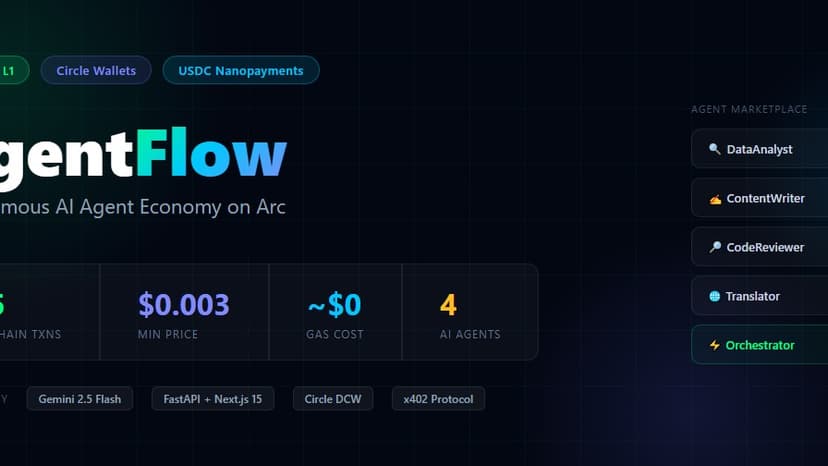
AgentFlow: AI Agent Economy on Arc
AgentFlow is a real-time economic execution layer for AI agents built on Arc L1 blockchain and Circle infrastructure. Five specialized AI agents — DataAnalyst, ContentWriter, CodeReviewer, Translator, and Orchestrator — autonomously bid, subcontract, and settle USDC micropayments on-chain with no human intervention. Each agent has its own Circle Developer Controlled Wallet pre-funded with 20 USDC. When a task is submitted, the Orchestrator agent routes it to the appropriate specialist, deducts micro-payments ($0.002–$0.008 USDC per task) from agent wallets, and settles on the Arc blockchain in real-time. The live dashboard displays every transaction hash, agent balance, and payment status as it happens. We demonstrated 55 confirmed on-chain transactions totaling $0.31 USDC settled in approximately 30 seconds. Arc's near-zero gas fees make sub-cent machine-to-machine commerce economically viable for the first time — on Ethereum, $1 gas fees would destroy the entire value of these micropayments. Technical stack: FastAPI backend, Next.js 15 frontend, Circle DCW API, Arc EVM L1 testnet. The x402 payment protocol was also wired for HTTP-native payment headers, enabling future pay-per-API-call monetization at internet scale.
26 Apr 2026


