

🤓 Latest Submissions
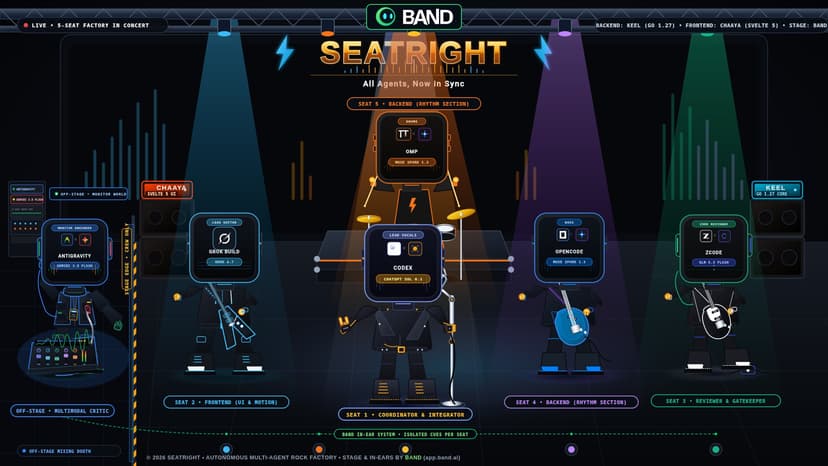
Seatright: A five-seat rock band of AI agents
Seatright is a software factory built on Band. Five AI agents share one Band room, set up like a rock band. Codex sings lead as the coordinator. OpenCode on bass and OMP on drums build the backend. Grok Build plays lead guitar and owns the interface. ZCode plays rhythm guitar as the independent reviewer. Inside ZCode's sandbox, Antigravity on Gemini 3.8 Flash acts as its private design critic. The video is best viewed with sound on! The owner sent one dispatch with the task, the four specifications and the stack. The band delivered all four Tablekeeper stages in 28 hours. The isolated harness passes 178 of 178 supplied checks and claims stage 4. Review changed the product. Antigravity flagged five design problems in stages 1 and 2. ZCode measured each one in a real browser before blocking on it, and Grok fixed them. Antigravity's wrong guesses never reached the room. Every coding seat runs in its own Docker Sandboxes VM, and the reviewer can read the code but never change it. We built the glue to run five different agent tools as Band seats. That includes our own launchers, a patched ZCode bridge and a health watch for dropped seats. The factory itself is generic. Only the dispatch changes from one problem to the next. Repository: https://github.com/nrynss/seatright
6 Oct 2026
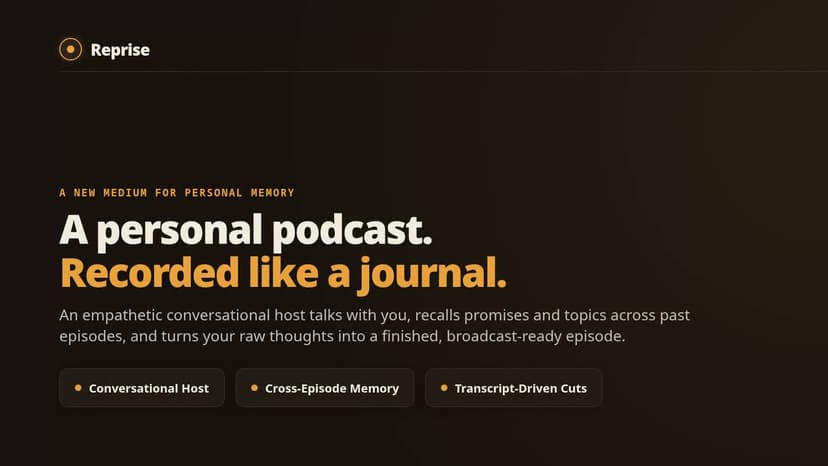
Reprise: A Podcast That Remembers You
Journals are lonely and easy to abandon. Podcasts need an audience and hours of audio editing. Reprise sits between the two: a private podcast you record by talking with an AI host that actually remembers you. Each take is a live, full-duplex conversation on AssemblyAI's Voice Agent API, with natural turn-taking and barge-in. The guest picks the host's voice. The host opens by recalling something you said in an earlier episode, quoted word for word from that episode's stored transcript. It never invents a memory. Names, places and callbacks come only from stored data. When you end the take, Reprise records both sides as separate stems and builds a draft. Gemini suggests cuts, a cold open, a title and show notes. You review the suggestions in the transcript and accept or revert each cut, so the model proposes and you decide. A pinned static FFmpeg renders the cuts. Speech understanding then runs on the finished file, not the raw take, so every timestamp matches what you hear. Universal-3.5 Pro with entity detection and key phrases produces chapters and the people and topics the host brings back next time. Episodes are private by default. Publishing gives one share link. Every paid call reserves budget first, and every session ends explicitly with a token cap. Reprise is live at reprise.nryn.dev, built in Go and Svelte 5.
30 Sep 2026
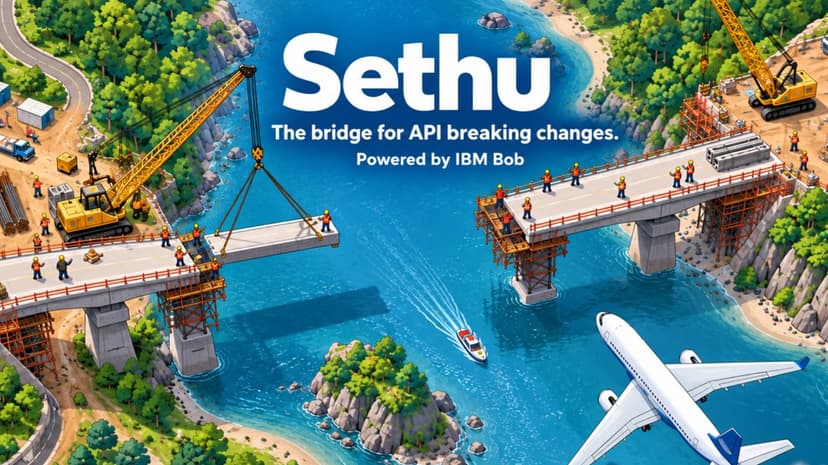
Sethu: The Bridge for API Breaking Changes
An API upgrade can break applications in places that are difficult to find. A specification diff identifies what changed, but developers still need to locate affected code, understand the impact, repair integrations, and test the result. That work becomes harder when several changes arrive together. Sethu bridges the gap between detecting a breaking change and proving that a consumer application has adapted. It combines a Rust CLI with an IBM Bob pack to bring a structured API upgrade workflow into the developer’s workspace. The workflow starts with /api-upgrade OLD NEW in IBM Bob. Sethu uses Vimanam to compare OpenAPI specifications, then helps trace the reported changes into the consumer application. Bob supports the repair workflow, while Sethu records evidence that an independent checker validates. Sethu targets developers who maintain API clients, service integrations, and applications that depend on evolving APIs. Instead of manually connecting a specification report to scattered application code, they work through the upgrade within their development environment. Its distinctive feature is the separation between making a repair and verifying it. An assistant’s explanation does not count as proof. Verification requires matching execution evidence, and unsupported cases block a verification claim. Sethu also preserves Vimanam’s original change identifiers and severities, keeping each repair connected to the change that prompted it. This approach makes API migration more traceable and reviewable. Vimanam supplies the API change analysis, IBM Bob provides the developer interaction, and Sethu connects the workflow to recorded evidence. The aim is to reduce repetitive investigation while giving developers a stronger basis for deciding whether an upgrade is ready.
27 Sep 2026
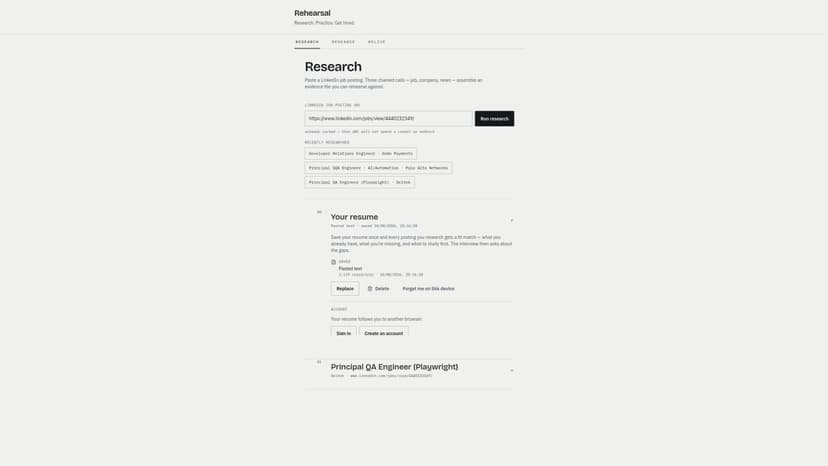
Rehearsal - Research. Practice. Get Hired.
The problem Candidates rehearse “tell me about yourself” and “greatest weakness,” then walk into a room where the conversation is about this posting, this stack, and what the company shipped last month. The gap between generic prep and a real interview is where people lose. Those specifics are public — the posting, the company page, the news — but almost nobody works through them systematically the night before. What we built Rehearsal is a three-tab workspace: Research · Rehearse · Relive. 1. Research — Paste a job link. Three live scrapes land as cards (job, company, news) with source domain and timestamp. A prep brief and optional resume-based fit match sit inside the same dossier. 2. Rehearse — Choose Voice or Text. An interviewer (named, role-framed) asks questions grounded in that dossier — e.g. Deltek Playwright/LLM-as-judge QA, or Dodo Payments developer onboarding — not recycled bank questions. Source labels show where each question came from. 3. Relive — Answers are scored with missed points and model answers so practice produces a verdict, not just a feeling. Why it is different Every question is meant to be traceable to scraped evidence. A generic tool asks about test pyramids; Rehearsal asks how you would build an LLM-as-judge pipeline because that sentence is in the posting, and it can show you the line. Design Institutional dossier aesthetic — paper and ink, mono for facts, signal red only when the mic is live. Not a chat UI. Not a SaaS dashboard. A file being assembled on a candidate. Scope One job at a time, night-before practice: research → rehearse → review. Not job search, not mass apply, not a career LMS. Demo / status End-to-end research and interview paths run against live services. Demo film uses product stills + music-led cards (screenshot cut under time). Live product: https://rehearsal.nryn.dev Made by Narayan SS · nryn.dev
10 Aug 2026


