
🤓 Latest Submissions

NarraFlow: Tell It, See It, Change It
People tell stories far better than they draw them, but today's visual AI tools usually make you write prompts, manage images and assemble scenes by hand. NarraFlow removes that friction. You press one microphone button and tell a story naturally. AssemblyAI's Voice Agent API handles real-time speech recognition, turn-taking, barge-in and spoken replies, and calls structured tools that turn what you said into a real story: characters, locations and scenes. Each scene is illustrated in the background while the conversation keeps going. Every character's visual traits are stored once and reused in every illustration, so the same girl in a yellow dress in scene one is still her in scene five. The story then becomes editable by voice. Say "make the tree blue," "change her dress to green," or "regenerate scene two," and only the affected scenes repaint - nothing else is touched. Say "play the story" and it becomes an animated storybook with captions and narration, exportable as an MP4. This build was tested against the real AssemblyAI service, not just mocks: real speech, real transcription, real barge-in and real tool calls into the real story engine, all confirmed live. Tool-call reliability turn-to-turn is still a work in progress and documented honestly in the README rather than overclaimed. Built with FastAPI, WebSockets, plain JavaScript, SQLite, ffmpeg, the AssemblyAI Voice Agent API and a Pillow-based illustration engine. Ideas for where this goes: bedtime stories, classroom storytelling, language practice, accessibility and creative writing.
30 Sep 2026
Narraflow
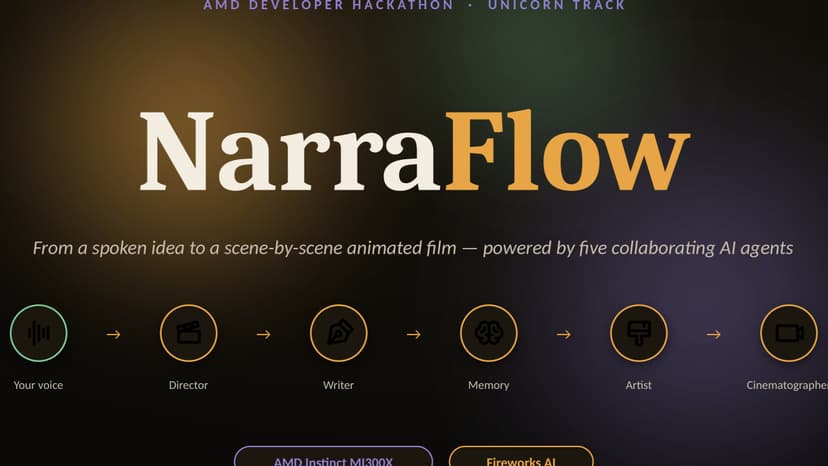
NarraFlow is a multi-agent AI storytelling platform that breaks story generation into specialized stages instead of relying on one model. A Director Agent takes a user prompt and builds a blueprint (title, genre, tone, pacing, key events), and a Writer Agent turns that blueprint into full scenes, dialogue, and narration. This modular setup makes the system extensible — future agents could handle character consistency, world-building, memory, editing, illustrations, voice narration, translation, and interactivity, all without needing to redesign the core system. The Director Agent is kept lightweight for efficiency, keeping generation fast while still giving reliable structure to guide the Writer Agent. Potential uses span creative writing, education, game dialogue, screenplay drafts, role-playing campaigns, and personalized or AI-assisted content creation more broadly. Long-term, the goal is a fuller storytelling ecosystem with persistent character memory, illustrations, branching plots, multilingual support, collaborative writing, and stronger consistency checks — using this multi-agent, structured-planning approach as a template for how modular AI systems can scale creative tasks better than a single monolithic model
13 Jul 2026

