
Divine Okechukwu@okechukwudivine7687775
3
Events attended
2
Submissions made
Nigeria
4+ years of experience
About me
I’m a Computer Science student and a builder who enjoys turning ideas into things people can actually use. I’m really interested in AI, software, and the possibilities that come from combining the two to solve real problems. I spend a lot of my time building, experimenting, joining hackathons, and learning by actually making things. I’ve worked on projects in areas like education, automation, fintech, and AI, and I’m always looking for the next problem worth solving. Right now, I’m building TradePilot AI, an AI-powered trading platform that explores how AI agents can help with market analysis, risk management, and trading decisions. I’m still learning, but I genuinely enjoy the process of building, breaking things, fixing them, and seeing an idea slowly become something real.
🤝 Top Collaborators


🤓 Latest Submissions
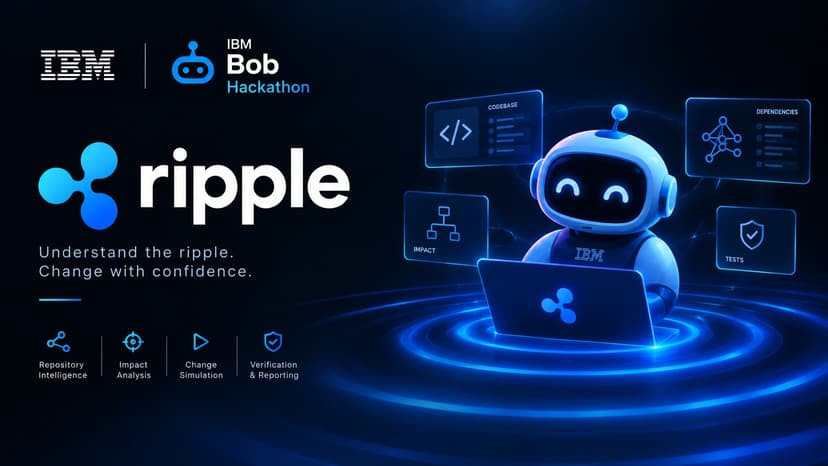
Ripple - Predict Code Change Impact
Changing one file can unexpectedly affect functions, modules, dependencies, tests, and other parts of a software project. Developers often manually trace references, inspect imports, understand call relationships, and determine which tests may need rerunning. This slows development and increases the risk of missed dependencies and regressions. Ripple is a developer workflow that helps teams understand the potential consequences of a code change before implementation. A developer connects or uploads a repository, and Ripple scans it to build a code intelligence graph containing imports, function calls, references, modules, classes, dependencies, and tests. Developers can simulate proposed changes, including modifying, deleting, renaming, or adding files, functions, or modules. Ripple traverses the repository graph to identify the potential blast radius and organizes evidence into direct impact, indirect impact, potentially broken areas, and tests to rerun. This gives developers a structured view of what may be affected before a change and what should be verified afterward. Ripple integrates IBM Bob 2.0 through the Model Context Protocol (MCP). Bob provides the AI development interface, while Ripple provides specialized repository intelligence. Through the Ripple MCP server, Bob can access Ripple's analysis capabilities and use repository-grounded results to explain the consequences of proposed changes. Ripple is designed for software developers, engineering teams, code reviewers, and teams working with unfamiliar or complex repositories. Its key distinction is the separation between AI reasoning and code intelligence: Ripple does not rely on an LLM to guess the blast radius. Its core analysis is grounded in actual repository relationships and graph traversal, while Bob provides an interactive AI interface for understanding those results. IBM Bob 2.0 is a core component of both Ripple's development process and its developer-facing workflow. We used Bob throughout development to design, implement, debug, refine, and iterate on Ripple's architecture, frontend, backend, UI, APIs, repository analysis, and features. More importantly, Ripple exposes an MCP server that IBM Bob can connect to. In our development environment, Bob connects to Ripple using a Streamable HTTP MCP connection. This enables Bob to interact with Ripple's specialized repository-analysis capabilities rather than relying only on general coding knowledge. The workflow is: IBM Bob → Ripple MCP → Ripple Code Intelligence → Structured Analysis → Bob. When a developer asks Bob about the potential impact of a proposed code change, Bob can use Ripple's MCP capabilities to obtain repository-grounded information. Ripple analyzes the repository's code graph and returns structured information about affected relationships and potential consequences. Bob can then reason over those results and explain them to the developer. This creates a clear separation of responsibilities: Bob provides the AI interface and reasoning layer, while Ripple provides specialized, repository-grounded code intelligence and blast-radius analysis. Ripple is not simply a chatbot wrapped around an LLM; its core impact analysis is based on the structural relationships within the connected repository. IBM Bob acts as both a development partner and an intelligent interface for Ripple through MCP. IBM Bob task-session screenshots are included in the project's bob_sessions directory as submission evidence.
27 Sep 2026

TradePilot AI - Autonomous AI Trading Agent
TradePilot AI TradePilot AI is an autonomous AI-powered trading platform that transforms real-time market intelligence into disciplined, executable trading decisions. Unlike traditional trading platforms that leave users to monitor markets, interpret signals, manage risk, and execute trades manually, TradePilot AI combines these processes through a multi-agent architecture. The Market Agent analyzes live market data and identifies market conditions and opportunities. The Strategy Agent interprets this analysis and generates BUY, SELL, or HOLD decisions. The Risk Agent evaluates proposed trades against predefined risk and exposure limits. The Supervisor and Autonomous Agent coordinate the entire trading cycle, while the Execution Layer connects directly to Alpaca for order submission and monitoring. TradePilot is designed with risk aware autonomous execution. Each trade is subject to deterministic controls, including a maximum 5% allocation of account equity per trade and 50% maximum portfolio exposure. Once a position is opened, automated position management can apply stop-loss, take-profit, and breakeven protection while monitoring order and position states. Built with Alpaca, TradePilot connects AI reasoning directly to real trading infrastructure, including market data, account information, positions, and order execution. The complete pipeline is: Market Data → AI Analysis → Strategy Decision → Risk Evaluation → Alpaca Execution → Position Management Our goal is not simply to build another trading dashboard or market prediction tool. TradePilot AI is designed as an autonomous trading agent that can continuously observe markets, reason about opportunities, make decisions, execute when conditions are met, and actively manage positions while remaining constrained by predefined risk controls.
4 Sep 2026


