
🤓 Latest Submissions
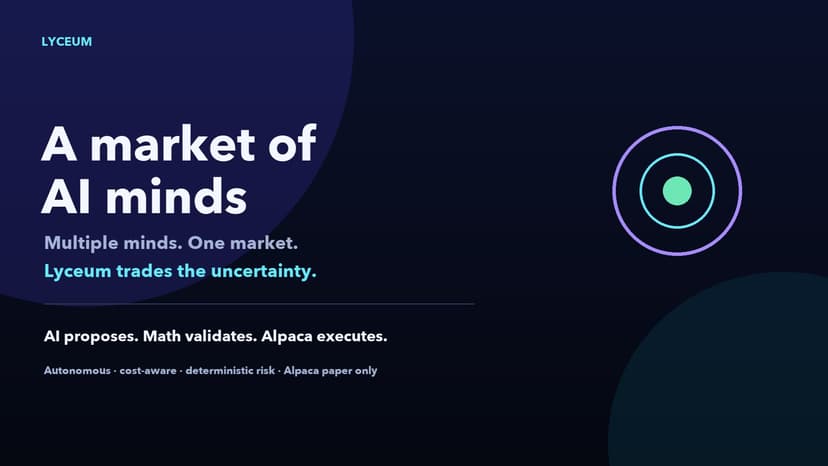
Lyceum — A Market of AI Minds
Lyceum is an autonomous AI options research and trading system built on Alpaca. Five specialized market agents independently analyze technical signals, options markets, news, and opposing market theses, producing probability distributions rather than simple BUY/SELL votes. Their uncertainty is quantified using entropy and Jensen–Shannon disagreement, while deterministic models evaluate market signals, volatility, liquidity, execution costs, and portfolio risk before any order can be submitted. Lyceum was tested across 33.58 years of SPY history, 361,000+ five-minute observations, and 9,600+ recent option observations. The research found statistically persistent market effects and predictable volatility—but also showed that predictability does not automatically create executable options alpha: for ordinary states, expected price movement was often far smaller than the cost hurdle imposed by option spreads and execution. That finding became part of the system itself. Lyceum defaults to NO_TRADE when expected economics do not justify risk, records decisions and rejected hypotheses for auditability, and uses fail-closed validation to prevent incomplete data from becoming trading evidence. AI proposes. Math validates. Alpaca executes.
4 Sep 2026

TokenTriage Agent
TokenTriage Agent is a runtime-driven AI routing system developed for the AMD Developer Hackathon Track 1. Instead of relying on a fixed model configuration, the agent dynamically discovers the models available through the runtime ALLOWED_MODELS environment and assigns them to the most suitable roles, including direct answering, semantic parsing, verification, and fallback. The final A2 architecture combines semantic parsing with deterministic execution and verification. Structured tasks such as mathematics, code analysis, formatting, logical reasoning, entity extraction, and other deterministic operations are handled through specialized local execution whenever possible, while complex natural-language tasks are delegated to Fireworks models only when required. This significantly reduces unnecessary remote inference while maintaining high answer quality. The system was designed specifically for constrained evaluation environments. It runs as a lightweight Linux/amd64 Docker container, automatically adapts to runtime-injected model allowlists, avoids hardcoded model identifiers, and remains compatible with future model families without code changes. Development emphasized engineering reliability as much as model quality. The project includes dynamic runtime model discovery, capability-based routing, deterministic validation, comprehensive automated testing, Docker portability, and strict output-contract verification to ensure every task produces a valid response. The final submission focuses on maximizing answer quality while minimizing Fireworks token usage through intelligent runtime model selection rather than static routing rules, making the system both efficient and robust under the competition’s resource constraints.
13 Jul 2026


