
Omar Babayev@omar_babayev885
2
Events attended
2
Submissions made
Azerbaijan
1 year of experience
About me
I am a second-year Information Technology student at Mingachevir State University with a strong interest in Artificial Intelligence, Python, networking, and backend development. I have gained practical experience through internships, volunteering, hackathons, and personal projects, including AI-powered and web-based solutions. I am passionate about learning new technologies, developing practical skills, and contributing to innovative projects.
🤓 Latest Submissions

ReleaseGuard AI
Before every production release, developers manually verify tests, environment variables, security settings, database migrations, API compatibility, documentation, and deployment configuration. This process is slow, repetitive, and easy to get wrong. A missed configuration or breaking API change can cause downtime, production bugs, and expensive rework. ReleaseGuard AI is a developer-focused pre-release verification platform that turns these checks into one clear release decision. A user selects a demo repository, enters a repository URL, or uploads a project archive. ReleaseGuard runs eight repository-aware checks in parallel: repository structure, tests, environment variables, security, database migrations, API compatibility, documentation, and deployment readiness. The result is classified as READY FOR RELEASE, NEEDS ATTENTION, or BLOCKED. Every finding includes severity, affected files, an explanation, an estimated effort, and an actionable fix recommendation. The platform also creates a prioritized fix plan and supports JSON and Markdown report export. The demo shows a realistic before-and-after workflow: the first analysis identifies critical blockers and returns BLOCKED with a high risk score; after the fixes are applied, a second analysis returns READY FOR RELEASE with no blockers and a lower risk score. The target users are solo developers, startups, student teams, and engineering or DevOps teams that want a faster and more reliable release process. What makes ReleaseGuard AI unique is that it does not stop at code generation or a chat response. It coordinates multiple specialized verification tasks and converts repository findings into an operational release decision. This reduces manual effort, makes risks visible before deployment, and gives developers a concrete path from problem discovery to a safer release.
27 Sep 2026
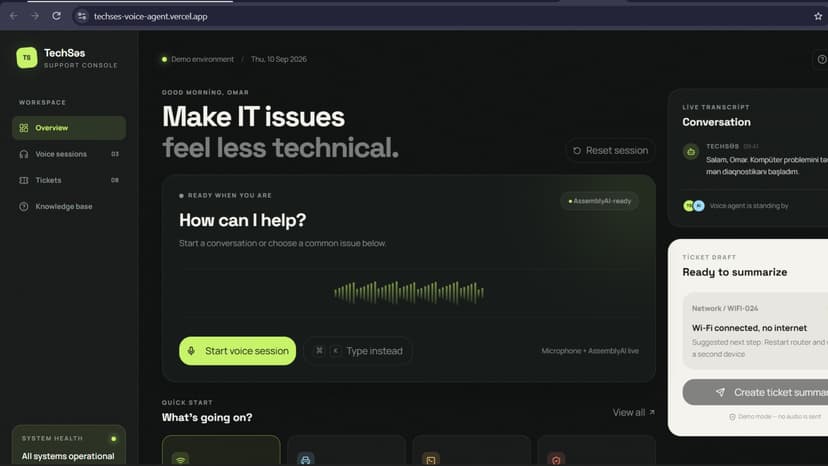
TechSəs: Voice IT Help Desk
TechSəs is a voice-first IT help desk built for the AssemblyAI Voice Agent Hackathon. Users can describe technical problems naturally through their microphone, while the agent listens in real time, responds with spoken guidance, and keeps a live transcript visible in the support console. The MVP includes focused flows for Wi-Fi, printer, Windows, and account issues, plus a ticket-summary experience that turns a conversation into a structured escalation draft. AssemblyAI Voice Agent WebSocket provides real-time audio, transcript, and agent events. A Vercel serverless function creates short-lived AssemblyAI tokens so the permanent API key never reaches the browser. The interface is designed for fast support work: current session state, suggested action, conversation history, issue priority, and ticket status stay visible together. If microphone access is unavailable, the issue shortcuts still demonstrate the troubleshooting and escalation workflow. The project is deployed on Vercel and the source is available on GitHub.
30 Sep 2026


