

🤓 Latest Submissions
MajorTom
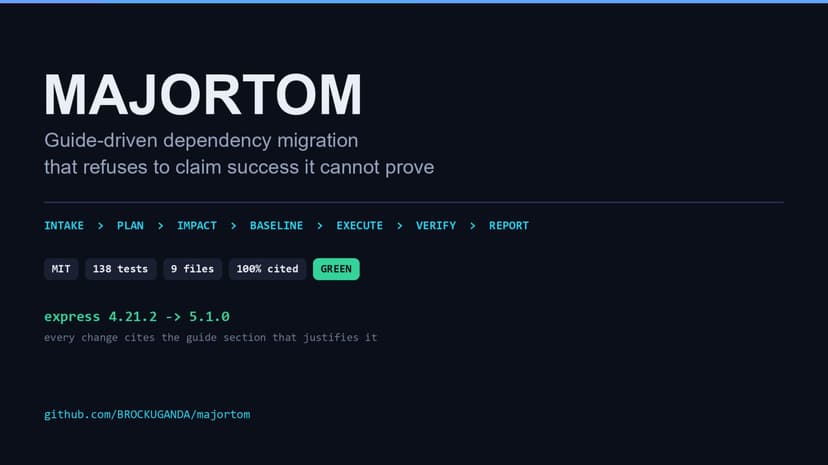
A major-version dependency upgrade is one of the most feared tasks in software maintenance, and the reason is not the size of the diff — it is that **the diff looks right and the software is still broken.** Express 5 is a concrete case. `app.del()` was removed. `res.send(status)` was removed. `res.send(body, status)` was removed. Wildcard routes must be named. Optional route parameters must be rewritten with braces. Regex-style paths no longer compile. A developer who searches for each removed symbol finds them all, edits them mechanically, and ships — then discovers at runtime that `/:format?` became required, that `/*` throws at registration, and that the route table silently matches nothing. Existing tools do not solve this. Documentation says what changed, not which lines in *this* repository are affected. Search-and-replace finds tokens without knowing whether an occurrence is a call, a comment, a string, or a same-named variable. An LLM asked to "upgrade this project" produces a plausible diff, cites nothing, and cannot say which of its changes were guesses. Manual review catches mistakes only after they are written. **Our solution.** MajorTom is a CLI-first agent that performs the migration from the vendor's own guide and refuses to claim success it cannot prove. It takes four inputs — a repository, one dependency, a target version, and that dependency's official guide as PDF, Markdown, or URL — then runs seven ledgered stages. **PLAN** turns the guide into a structured plan where every item carries a verbatim quote. **IMPACT** scans the repository and partitions affected files into disjoint queues. **BASELINE** captures a pre-edit test result; with no tests the run is fatal, because nothing can be claimed without them. **EXECUTE** applies edits through a filesystem facade that physically confines each worker to its own queue, validates every result by parsing it, rolls back failures, then bumps the manifest and reinstalls. **VERIFY** re-runs the suite and classifies each failure. **REPORT** emits a Markdown report tracing every change to its justifying guide section. Three invariants make the output trustworthy. **I1:** work happens on `majortom/<runId>`; `main` and `master` are refused and no force-push or merge path exists. **I2:** an edit is applied only when a plan item authorises it, and citation coverage is computed from real edit records, never declared by the caller. **I3:** the guide is treated strictly as data — instructions found inside a migration document are ignored, so a malicious or confused document cannot redirect the tool. **Target users** are teams on frameworks and libraries — the engineers who own upgrades and currently dread them, and the security teams waiting on the CVE fix behind one. **What makes it creative** is the trust mechanism. Citation coverage is a computed number, not a promise: an edit with no guide quote behind it is refused and flagged `HUMAN REVIEW` rather than applied. The property that distinguishes it is **honest accounting**. A test that failed before the migration is recorded and excluded; a test that fails because of the migration is reported as such; and when the run is not green, MajorTom says NOT GREEN and exits non-zero. A passing run and a failing run are equally easy to produce, because the tool has no incentive to prefer either. **Efficiency, measured on a real run:** Express 4.21.2 → 5.1.0, nine files changed, 16 of 16 applied edits cited (100% coverage), 19.5 seconds wall clock, one pre-existing failure correctly excluded. The project ships 138 tests and `npm audit --omit=dev` reports zero vulnerabilities.
27 Sep 2026

voicebridgeai
VoiceBridge AI is a voice‑first accessibility companion designed to give blind, low‑vision, and motor‑impaired users full, independent control over a live web dashboard using speech alone. Instead of relying on mouse, keyboard, or touch, users interact entirely through natural conversation: they can open and switch between dashboard views, filter and sort data, adjust theme and font settings, toggle notifications, and start/stop sessions—all by speaking. Under the hood, the system is powered by AssemblyAI’s Voice Agent API, which handles real‑time speech‑to‑text, intent recognition, and contextual dialogue so commands like “show me today’s error rate” or “increase contrast and enlarge text” are understood and executed immediately. To ensure reliability even when connectivity is poor or services are unavailable, VoiceBridge AI includes a multi‑engine offline fallback stack. If the cloud Voice Agent becomes unreachable or latency spikes, the interface gracefully degrades to on‑device speech recognition and local command parsing engines, preserving core navigation and settings controls without requiring an internet connection. This hybrid design balances the sophistication of cloud AI with the resilience of local processing, so users aren’t locked out of critical functionality during outages or on metered connections. Beyond basic navigation, VoiceBridge AI exposes session metrics and accessibility telemetry through voice. Users can ask for summaries like “how many sessions did I complete today?”, “what’s my average task time this week?”, or “read my last three errors,” and the system responds with concise, screen‑reader‑friendly spoken summaries while also updating the dashboard visually for sighted collaborators. Settings such as speech rate, voice profile, language, and command verbosity are all adjustable by voice, enabling a personalized experience that adapts to different abilities and preferences without requiring visual configuration screens.
30 Sep 2026

Alpacaruns
Alpacaruns is a safety-first autonomous trading system that combines LLM-powered agents with a deterministic mixture-of-experts strategy engine. It analyzes market data through technical, sentiment, trend, momentum, volatility, volume, pairs-trading, breakout, and seasonality signals, then aggregates specialist decisions using performance-weighted voting and volatility-regime awareness. Every proposed trade passes through a shared fail-closed risk validator, regardless of whether it originates from an AI agent, automated strategy, or manual command. The system enforces position and portfolio limits, confidence and factor thresholds, trading-session rules, options constraints, and daily, weekly, and total drawdown kill switches. Orders execute through Alpaca’s paper-trading API, with the AI execution agent using the official Alpaca MCP server. All fills are streamed, deduplicated, and recorded in a JSONL trade journal for reliable P&L reporting. Model providers are pluggable, supporting local llama.cpp-compatible models, Gemini, and Oxlo.ai without code changes. Alpacaruns is intentionally paper-only and prioritizes transparent controls, explainable decisions, adaptive expert weighting, and safe failure over aggressive automation. Its options overlay gracefully falls back to equities when unavailable on free-tier market data plans.
4 Sep 2026


