
🤓 Latest Submissions
Padayon Factory: Tablekeeper built to stage 4
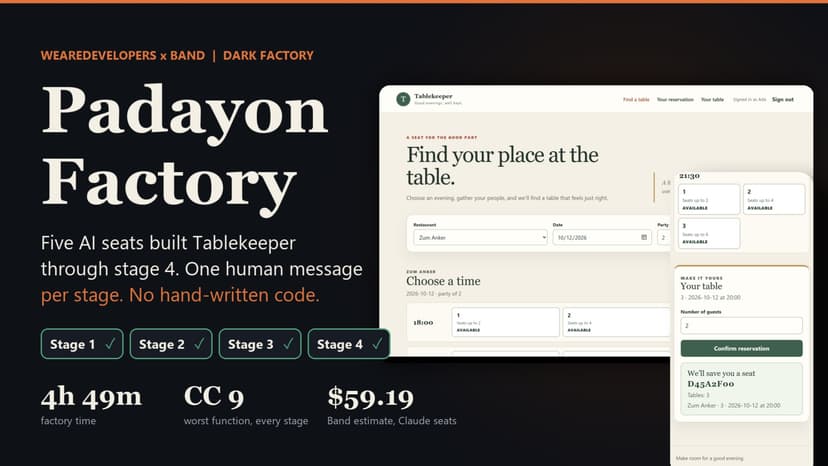
Padayon is a BAND factory of five seats that built the Tablekeeper reservation system through stage 4 in one room (PADAYON RUN V6). Coordinator, core-builder and interface-builder run on Codex; tester and reviewer run on Claude Code. The only human input was one dispatch per stage: no hints, approvals, nudges or reruns. Every file under stage-*/ was written by a seat. RESULT All four stage folders claim their stage in the isolated harness (highest contiguous stage 4) from a clean container with no network, 2 CPU and 2 GiB. Factory time: 4h 49m (38m, 1h25m, 1h11m, 1h34m). WHAT WE ARE PROUDEST OF - Quality did not decay: worst function complexity is 9 at every stage, no function above 10, largest file 132 lines, 0% duplication. - The reviewer rejects with evidence. At stage 4 every test passed, yet it refused a maintainability regression (mean complexity 3.146 to 3.429). Two real refactors later it re-measured and accepted, 28m 50s on. Other rejections: fixture passwords (stage 1), seven defects in the tester's own checks (stage 2), a legacy-upgrade break (stage 3). - Independent audit: after the freeze we wrote a separate suite from the four specs. 506 checks pass on stage 4, and 3,600 random operations kept every invariant. - Honest evidence: failing and superseded checks are disclosed, not hidden. - Shared work: no seat made more than 24% of tool calls; the coordinator made 18%. - Measured cost: Band estimates $59.19 for the two Claude seats; Codex seats ran on a flat plan (about 200M tokens). - Generic mandates that name nothing from the track, plus FACTORY.md on standing the factory up for a different problem. VERIFY README.md, FACTORY.md and EVIDENCE.md in the repo map each claim to a room message id or commit. room.json is the unedited 6,570-event export.
6 Oct 2026
AcuityVoice: Hear the Call Before You Hire
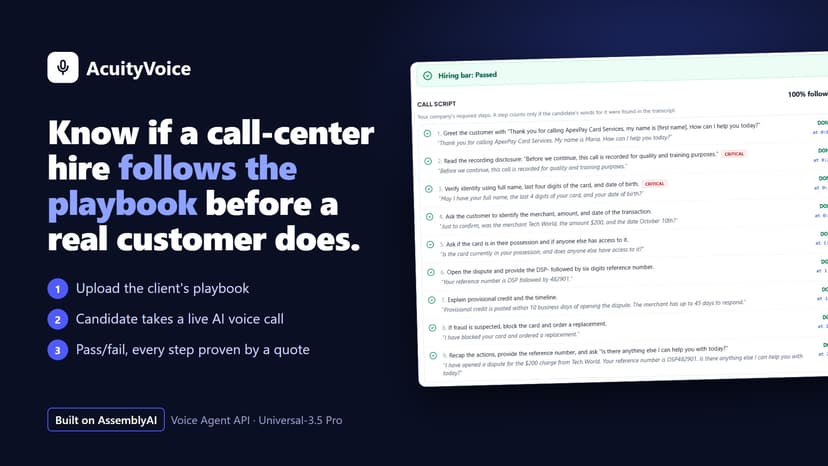
When a bank outsources its customer calls, it hands the call center (BPO) a playbook: greet like this, read this disclosure word for word, verify every caller, never promise an instant refund. The BPO must hire and certify hundreds of agents to follow it, and today that means a trainer, one mock call and a gut feeling. The first real test is a live customer, where a skipped disclosure is a compliance failure for the client. AcuityVoice closes that gap in three steps: 1. Upload the client's playbook (.docx or .pdf). In about 15 seconds the AssemblyAI Voice Agent API finds every call type, with its call flow, auto-fail steps, policies and objections. Each call type gets three levels: practice, the hiring bar (a frustrated caller) and the certification bar (a hostile one). 2. Put the candidate on a live voice call. A Voice Agent plays the customer in real time, in character, and pushes back like real callers do. 3. Get a pass/fail verdict with evidence. Universal-3.5 Pro transcribes every word, um and pause. A playbook step counts only if the candidate's exact words for it are found in the transcript, with a timestamp. Pass/fail is computed in code from the client's bar, never guessed by a model. In the demo, the same angry caller meets two candidates: one passes with 100% of the playbook, the other fails for promising the money back "by Friday", which the playbook forbids, and the report quotes the line. Under the hood, all AssemblyAI with one API key: Voice Agent tool calls turn the playbook into scenarios and the call into a scorecard. The customer agent has no tools, so it never goes silent mid-call. Playbook keyterms feed both the live agent and Universal-3.5 Pro. In the AI demo, two Voice Agents share one line with real-time pacing, which cut cross-talk from 3.5 s to 0 s. 27 test assertions cover speech metrics, quote matching and the pass/fail bars. Try it with no mic: "Try the sample playbook", then "AI demo call". MIT licensed.
30 Sep 2026
Duet 2 : Bimanual VLA Manipulation
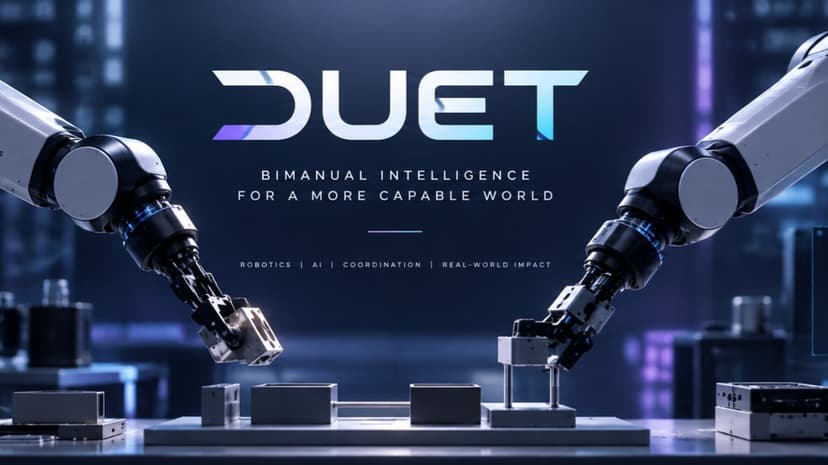
Duet 2 explores how two low-cost SO-101 robot arms can coordinate as one bimanual Physical AI system. In a MuJoCo dinner-table environment, the arms work together to pick, transfer, place, and manipulate everyday objects such as a plate, mug, bottle, fork, and spoon across randomized scene layouts. The project has two clearly separated layers. First, a verified expert-teacher policy demonstrates the complete physical workflow using contact and placement checks, producing reproducible trajectories and training data. Second, a real SmolVLA vision-language-action model is fine-tuned on those demonstrations and runs from camera images, natural-language instructions, and robot state. The live VLA is intentionally presented as an experimental research result rather than a scripted fallback. Duet 2 also focuses on practical AI infrastructure. The model pipeline uses LeRobot and Hugging Face, while the vision tower is accelerated with Intel OpenVINO on CPU. On an Intel Core i5-8265U baseline, optimization improved end-to-end real-time factor from 0.05 to 0.49, a 10.3× speedup, while preserving parity for the OpenVINO vision path. The project includes deterministic seeds, recorded demonstrations, replayable evidence, a judge-facing web dashboard, and a reproducible open-source pipeline for data collection, training, benchmarking, and deployment.
16 Sep 2026
PADAYON: AI Multilingual Learning Partner
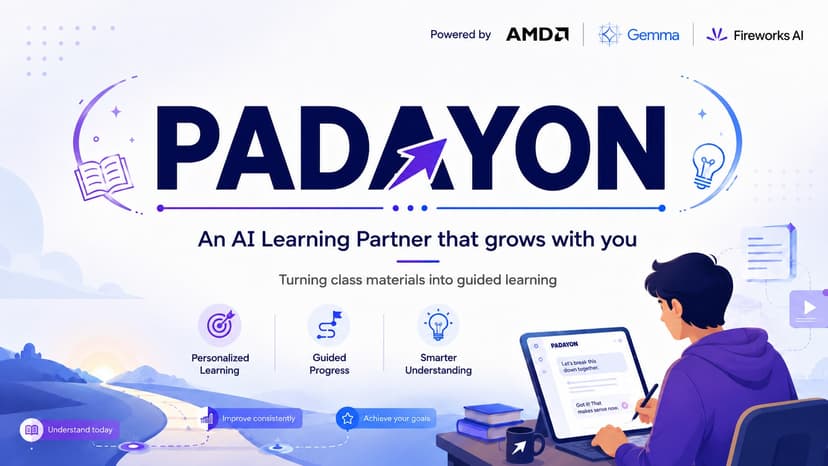
PADAYON is an AI learning partner built for Filipino students who struggle with academic English, messy notes, and last-minute studying. Instead of simply giving answers, PADAYON organizes what the student provides, aligns it with Grade 9 curriculum topics, and turns it into useful learning materials such as clean notes, reviewers, flashcards, quizzes, summaries, stories, and visual guides. The app supports photo and PDF note uploads, automatically extracts text, saves the source material, and lets students ask what they want to do next. It also remembers each learner’s language confidence, learning style, strengths, weaknesses, quiz scores, and topic progress across sessions. PADAYON uses a multi-agent backend with specialized agents for classification, curriculum alignment, material creation, teaching, assessment, memory, and retrieval. The chat can run through Gemma 4 via Fireworks AI on AMD-backed infrastructure, with a fallback model for reliability when Gemma is unavailable. A live backend monitor shows which major agent is working and which runtime served the response. The goal is to redirect student AI use away from shortcut answers and toward structured, personalized learning that helps them understand lessons in the language they learn best.
13 Jul 2026


