
Qais Amro@qaisamro
2
Events attended
2
Submissions made
Palestinian Territory, Occupied
1 year of experience
About me
My name is Qais Amro, a passionate Full-Stack Software Developer and technology enthusiast based in Palestine. I specialize in building modern web and mobile applications using cutting-edge technologies. I have hands-on experience working with React, Ionic, Tailwind CSS, Node.js, Express, PostgreSQL, and Drizzle ORM, and I use VS Code as my primary development environment. I enjoy designing scalable backend systems and creating clean, responsive frontend interfaces. Currently, I am continuously expanding my expertise in cloud computing, system architecture, and data analysis, while working on real-world projects like WaitlistWizard. I am driven by problem-solving, innovation, and the desire to build impactful digital solutions.
🤝 Top Collaborators



🤓 Latest Submissions
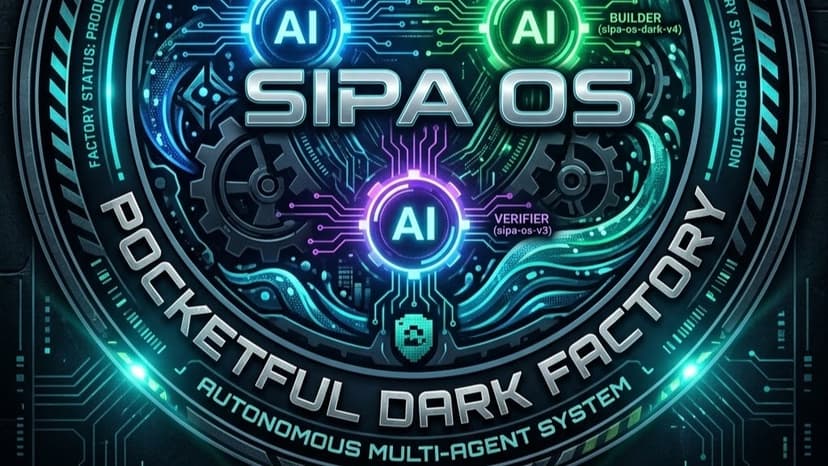
SIPA OS: Pocketful Dark Factory
SIPA OS — Dark Factory is an autonomous multi-agent software engineering system designed to architect, implement, and rigorously verify production-grade microservices without human intervention during development. For the WeAreDevelopers x BAND Dark Factory Hackathon, our team (Aelin AquaSoul) deployed this factory against the Pocketful track to build a secure, high-concurrency financial wallet and payment processing service. Multi-Agent Architecture: The factory operates via three specialized, non-overlapping seats governed by strict system mandates: sipa-os-core (Planner/Architect): Analyzes project specifications, breaks down requirements into sequential work items with explicit done criteria, and coordinates task distribution. sipa-os-dark-v4 (Builder/Implementer): Implements code using the exact mandated tech stack and executes baseline checks. sipa-os-v3 (Verifier/Reviewer): Independently runs container builds and executes rigorous security and invariant attack suites without trusting builder claims. Technical & Security Highlights: Thread-Safe In-Memory Storage: Custom state management backed entirely by Python dictionaries guarded by threading.Lock(). Strict Balance Invariants (I1 & I2): Enforces money conservation (sum of balances always equals the seeded total) and prohibits negative balances/overdrafts, returning a 422 error on violations. Cryptographic Security: Secure password hashing using pre-hashed SHA-256 wrapped into salted bcrypt digests to prevent silent 72-byte truncation vulnerabilities. Idempotency & Validation: User-scoped idempotency keys across all mutating financial endpoints and strict regex-based handle derivation (^[a-z0-9_]{1,20}$). Dockerized Containerization: Fully containerized with dynamic $PORT support and verified using automated pre-flight testing harnesses.
6 Oct 2026
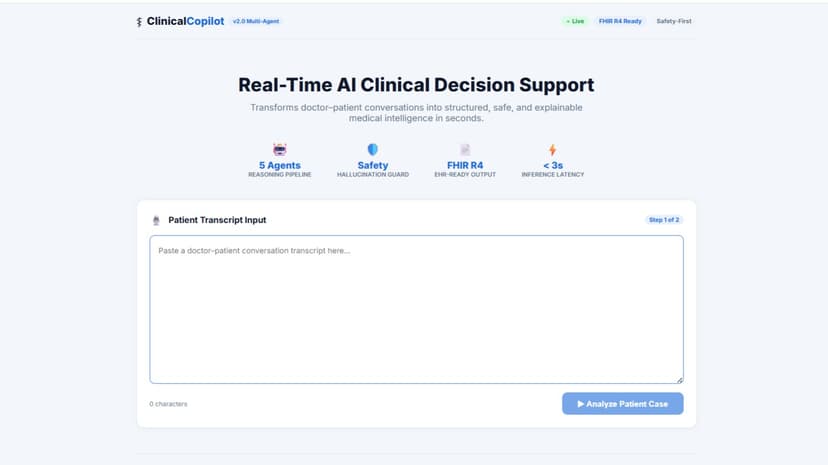
Clinical Copilot - AI Clinical Decision Support
Clinical Copilot is a real-time, multi-agent AI system designed to solve one of healthcare's most pressing problems: diagnostic errors and documentation burden. The system ingests a raw doctor–patient conversation and, within seconds, runs a 5-stage intelligent pipeline: entity extraction, clinical reasoning, safety validation, documentation generation, and confidence calibration. Unlike generic chatbots, Clinical Copilot operates as a specialized medical reasoning engine. Each stage is handled by a dedicated AI agent with a specific clinical role: - The Extraction Agent identifies symptoms, vitals, medications, and patient history from the conversation. - The Reasoning Agent generates a ranked differential diagnosis list and flags emergency red flags. - The Safety Agent performs drug interaction checks, hallucination detection, and generates automated clinical warnings. - The Output Agent produces professional SOAP notes and ICD-10 diagnostic codes with clinical reasoning. - The Validator calibrates a confidence score based on available evidence quality. All outputs are formatted as FHIR R4-compatible JSON, making the system directly integrable with hospital EHR platforms like Epic or Cerner. The frontend is a hospital-grade React dashboard that showcases the live agent pipeline, structured clinical cards (Diagnosis, SOAP, Safety, ICD-10, FHIR), and a real-time confidence meter. Clinical Copilot targets two core healthcare problems: reducing diagnostic errors and accelerating documentation. Physicians spend up to 50% of their time on paperwork. This system cuts that to seconds while adding a safety validation layer that reduces missed diagnoses. The system is designed as a step toward autonomous, explainable, and safe AI assistance embedded directly inside real healthcare workflows.
10 May 2026


