
🤓 Latest Submissions

Edict Work Mode: Proof Before Apply
Students and early-career builders often face noisy opportunity pipelines: freelance jobs, internships, automation tasks, and remote roles. A listing can look attractive because it matches their technical skills, yet still contain unsafe conditions such as unpaid test work, off-platform payment, or credential sharing. Applying indiscriminately wastes time, proposal credits, and reputation. Edict Work Mode turns this decision into a transparent workflow. A user pastes an opportunity, and Edict extracts common fields, scores fit, speed, trust, money, and risk, then returns apply, watch, or veto with reasons. A Connects gate checks whether the user has enough proposal credits, while every application, message, and spend remains under human approval. The interface makes the decision visible before action instead of automating a risky submission. The project is designed for students and early-career AI builders who need a practical filter, not another generic task manager. Its key differentiator is reproducibility: twelve synthetic cases are stored in the repository with baseline and post-change reports. The baseline found three false negatives. One shared hard-veto rule raised exact agreement from 75% to 100% and veto recall from 57.14% to 100% while veto precision remained 100%. These are fixture results, not production or model-accuracy claims.
27 Sep 2026
SignalRoom - Voice-Led SOC Incident Training
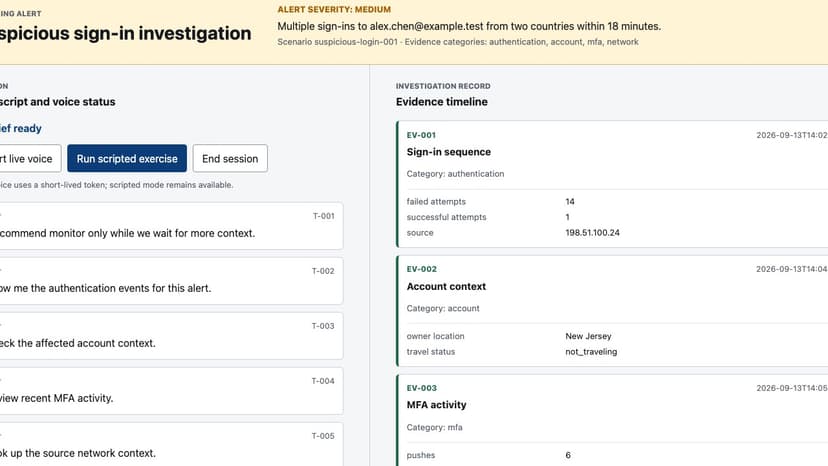
Junior analysts need more than static quizzes: they need to practice asking for evidence before making a security decision. SignalRoom presents a synthetic suspicious sign-in and lets the learner investigate it by voice. AssemblyAI's Voice Agent API handles live speech, turn-taking, and tool-call requests. The app exposes only six constrained scenario tools: four read-only evidence lookups, one simulated decision recorder, and one investigation finisher. Evidence appears progressively with stable IDs. After the learner records a finding, severity, and proposed action, a deterministic local evaluator checks those decisions against the evidence actually revealed. The debrief labels claims Observed, Inferred, or Unsupported and shows missed evidence categories. A scripted offline replay is available for reproducibility; it is not a substitute for a live provider demonstration. SignalRoom uses one fully synthetic scenario. It does not connect to a production SIEM or EDR and never disables a real account. A controlled local end-to-end AssemblyAI voice session was verified on September 26, 2026. The current server still runs on localhost and is not a public multi-user deployment.
30 Sep 2026

