🤓 Latest Submissions
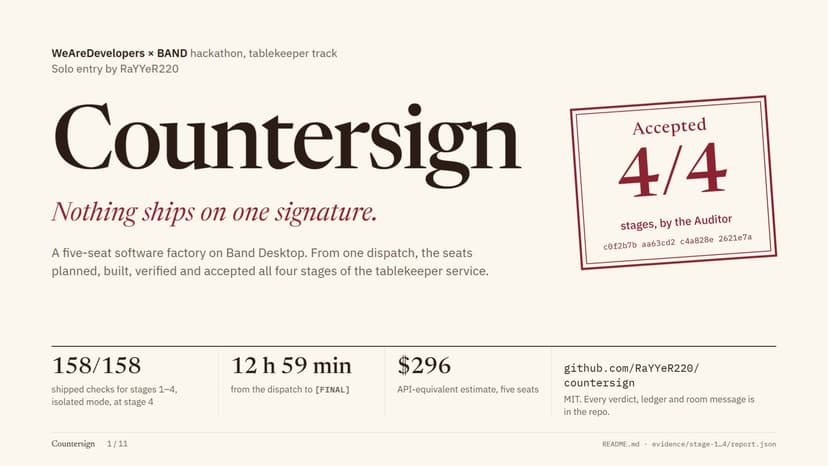
Countersign: nothing ships on one signature
A band of coding agents that plans, builds and accepts its own work can sign off on a misread spec, a test suite that cannot fail, or a race it never exercised. The challenge asks for a dark factory: one dispatch in, accepted stages out, no human steering in between. The hard part is knowing when to trust the result. Countersign derives every artifact twice and ships only when both agree. Two seats read the spec blind and reconcile their clause ledgers. An Oracle that never sees the code writes a reference model and acceptance suites, and the service is differential-tested against the model. The tests are tested: a mutation kill-rate gate, and a race proof per concurrency guard that must fail with the guard removed. The shipped checks run last, and only the Auditor, which may not write fixes, can accept a stage. Five BAND Desktop seats share one room, each a Claude Code agent with its own git worktree and identity: Foreman, Builder, Stylist and Auditor on claude-opus-5-5, the Oracle on claude-fable-5-1, a different model for less correlated mistakes. @mentions wake only the seat that must act, and handoffs carry the full requirement text. A guard hook enforces seat boundaries in code; no mandate names anything from the track. One dispatch covered all four tablekeeper stages, and the Auditor accepted all four; the run took 12 h 59 min. The final stage passed all 158 shipped checks for stages 1 to 4 in isolated mode, killed 34 of 38 mutants (81 to 90 percent across stages), and proved all 10 concurrency guards red without them and green with them. Of 11 rejections, 8 changed the work; the one holdout escape, at stage 1, came from a ruling that was withdrawn and fixed before acceptance. Estimated spend: about $296 API-equivalent. Honest limit: at stage 4 the seats deadlocked, each waiting on another, and the operator sent one liveness note, disclosed in FACTORY.md; kit v1.1 adds the missing rule.
6 Oct 2026
Carryover: Phone Calls You Can See
Many of the 50+ million Americans with hearing loss can't make a phone call alone. Today's relay services put a human operator in the middle, and in FCC-commissioned MITRE tests human-typed captions lagged 4.8 to 6.8 seconds behind speech. Carryover joins an ordinary call, so the other side can be any phone: a pharmacy, a clinic, a bank. It speaks for you with a spoken disclosure, you read the other person as live captions, and whatever you type is said word for word. You pick how much it does alone. Relay only speaks your words. Assist also presses menu keys, waits on hold, flashes the screen when a person picks up and answers routine questions from facts you chose to share. Auto also works toward a goal you set. When asked for something you didn't share, it says "one moment" and asks you on screen instead of guessing. After the call you get a summary, the commitments made and the transcript. Your profile stays on your device. The AssemblyAI Voice Agent API is the agent's ears and mouth, with our own Relay Brain plugged in as a bring-your-own LLM. For each turn the Brain picks your words verbatim, silence, or a model reply, and every reply sentence passes a fabrication gate written in code that blocks any date, ID or number about you that you didn't share. Tool calls press keys, ask you and end the call. Universal-3.5 Pro Realtime streaming produces the captions, with speaker labels that catch transfers and key terms from your profile. A second Voice Agent session plays the reps of five simulated businesses. Try it with no account: a sample call, live calls to simulated businesses, or a practice line where your own phone becomes the pharmacy. It is backed by 856 automated tests. A graded evaluation with hidden answer keys found zero fabrications, and when the bank asked for a member ID the user never shared, Carryover asked instead of guessing. It is not FCC-certified, and calls to real phone numbers are designed but not shipped in this build.
30 Sep 2026

Tandem: the bimanual VLA that knows to refuse
Tandem is a bimanual manipulation stack: two simulated SO-101 arms in MuJoCo set a dinner table from a spoken instruction. Speechmatics transcribes the voice live. A Qwen2.5-1.5B model, quantized to INT4 and run locally through OpenVINO GenAI, only parses the intent; deterministic code turns that into a plan from the live scene state. Before either arm moves, a ~200-line deterministic gate checks every step for reachability, gripper state, object presence and collision, then allows it, repairs it, or refuses it with a sentence saying why. No model takes part in that decision. Neither arm can reach both the props and the place setting, so objects pass from one arm to the other through a shared zone. Grasps close on measured contact, not a preset width. Every episode is seeded and domain-randomized. Every number is regenerated by scripts in the repo. The gate scores 24/24 on a set that includes 8 must-allow cases, so refusing everything would fail. Over 20 randomized seeds: drawer opened 100%, plate placed 90%, fork 90%, spoon 65%, mug 55%. Live speech: 922 ms median final-transcript latency, with barge-in that aborts a running plan. A learned perception net replaces simulator state at 23.8 mm median error, and the gate reaches the same verdict from it as from ground truth on 94.1% of 456 steps. The nets export to OpenVINO at FP32, FP16 and NNCF INT8, benchmarked. What does not work is published too. Water lands in the cup in 0 of 20 seeds: the carton empties in 55%, but the stream misses. The distilled visuomotor policy makes 0 of 18 picks against the scripted expert's 14. Benchmarks ran on an AMD CPU, not Intel hardware, and every report says so. MOCKS.md and CLAIMS.md draw the line between measured and simulated. Reviewer path: JUDGES.md grades the gate in about a second, with no API key, GPU or model download.
16 Sep 2026
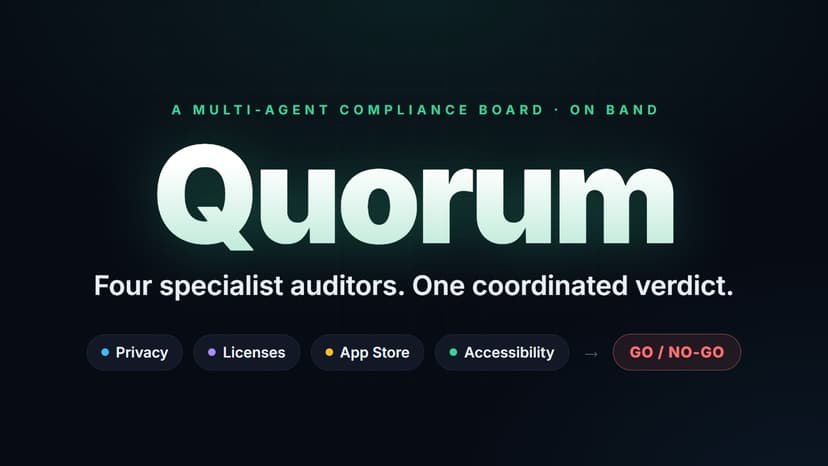
Quorum — Multi-Agent Compliance Board on Band
Shipping software means clearing a gauntlet of compliance checks — data-privacy law, open-source licenses, app-store rules, accessibility. Today those are four separate, manual, late-stage reviews, and problems slip through. Quorum replaces them with a board of specialist AI auditors that review a release together and reach one verdict. Each agent owns a domain — Legal (GDPR/CCPA and data security), License (open-source and copyleft risk), Mobile (App Store / Google Play), and Accessibility (WCAG 2.2) — and they coordinate directly over Band. A human kicks it off with one message; the Coordinator @mentions the four specialists, each reads the codebase and reports back, and the Coordinator reconciles everything into a single go/no-go Release Gate. The reconciliation is the point, and what a single agent can't do. The same AGPL session-replay library gets flagged by Legal (it captures passwords), License (a copyleft violation), and Mobile (tracking without consent); Quorum merges all three into one top-priority blocker, with a severity rollup and a prioritized fix plan. We demo it against "Snaptab", a deliberately broken receipt-scanning app: Quorum returns NO-GO with 19 critical issues across seven cross-domain blockers — every planted problem caught. Built on Band's agent-coordination layer — agents talk via @mentions over WebSocket, with Band operations exposed to them as native tools — running OpenCode agents on Gemini through OpenRouter. Quorum turns release compliance from a checklist into a conversation: the gate, before your users hit it.
19 Jun 2026


