
🤝 Top Collaborators




🤓 Latest Submissions

Multilönd AI
A missing charger is easy to add while a box is open. Once the lid closes, the same mistake becomes rework or a customer return. In hand assembly and packing, the next step often hides the last one. Multilönd AI checks work at those visible moments. A station camera watches the bench; when the scene is steady, one frame goes to an open vision model with a checklist question that describes what correct looks like. Fixed rules, not the model, decide the result: Pass moves on, Fix it marks the problem with a red box, Retake asks for a clearer view. A step that covers earlier work (closing a lid or panel) stays locked until its checks pass or a person writes an override reason. Every attempt is saved with its photo, unit ID and time. The web app runs live on a camera or on a recorded video, and anyone can write their own checklist in plain lines, so a new product is a new checklist, not a new machine. Our demo is an accessory-box pack-out; the same engine also checks a PC build. AMD: inspections run on DeepSeek V4.1 Flash, an open-weight model, on AMD Token Factory. Because the model is open, it can run on a factory's own AMD GPU so product photos never leave the site. Results: on 34 MVTec AD cable photos (earlier run, Gemma 4 on AMD Token Factory), a generic question caught 2/24 defects; a question describing the correct cable caught 14/24, with zero false alarms on 10 clean photos and about 5.7 s per check. Ten defects still escaped, so broader validation is our next step.
18 Oct 2026
BobGuard
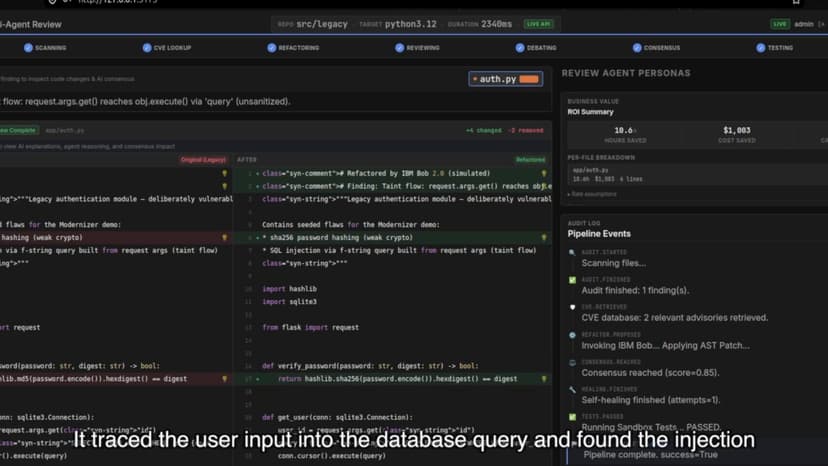
In large organizations, updating legacy systems is terrifying because a minor change can break decades of interconnected infrastructure. This fear paralyzes engineering teams, turning a simple 5-line security patch into a 9-month administrative nightmare of manual review committees and slow regression testing cycles. Consequently, companies often ignore critical vulnerabilities because doing nothing feels safer than touching old code. To solve this specific challenge, we built BobGuard, an autonomous legacy modernization and security remediation engine powered by IBM Bob 2.0. Target users include enterprise DevSecOps teams, legacy system maintainers, and platform engineers who need to ship securely at startup speed. Engineers interact with BobGuard through a streamlined, human-in-the-loop Terminal User Interface (TUI). The user submits a local repository path to the CLI, prompting BobGuard to scan the codebase, orchestrate an AI-driven fix, and test it. Finally, the user is presented with a color-coded, side-by-side diff and a risk report, allowing them to simply type 'y' or 'n' to approve the deployment and maintain absolute executive control. What makes our solution creative and unique is that, unlike standard LLM coding assistants that blindly generate text, BobGuard utilizes a zero-trust, multi-layered verification architecture. This includes a Multi-Agent Consensus where three distinct IBM Bob personas (Security Expert, Performance Guru, and Legacy Maintainer) debate the proposed code, a custom Abstract Syntax Tree (AST) parser that structurally guarantees no dangerous functions were hallucinated, and an isolated sandbox that executes the patch against existing unit tests. If a test fails, a self-healing loop feeds the stack trace back to IBM Bob to fix the error autonomously. This effectively and efficiently addresses the stated issue by completely eliminating the manual bottleneck of software maintenance. By automating static analysis, consensus review, and test execution, BobGuard compresses 9 months of enterprise caution into 90 seconds of verified safety, complete with a built-in Business ROI Engine that instantly calculates the financial cost, human hours, and computing resources saved on every run.
27 Sep 2026

APEX - Anti-Overfitting Research Pipeline + agent
APEX is an autonomous trading agent built on Alpaca's paper environment whose core product is a scientific pipeline, not a single strategy. Every hypothesis is explicit code that must pass pre-registered defenses before trading: three unseen walk-forward windows, an 18-perturbation sensitivity plateau, and hard deployment gates (OOS Sharpe ≥ 0.5, all folds positive, IS→OOS degradation < 50%, maxDD < 20%). The live system runs three sleeves: (1) a momentum core ranked by our own intraday-flow momentum signal (institutional accumulation shows up intraday; validated OOS at Sharpe 1.20 vs 1.11 for classic momentum); (2) an RSI(2) pullback sleeve on momentum leaders; (3) an options wheel — cash-secured puts on validated dip signals and covered calls on 100+ share positions, with resting 50% profit-take orders. A SPY 200-day regime gate and a −2.5% daily kill switch bound the downside. Everything is auditable: identical code in backtest / validation / live, an order ledger where every trade carries its signal reason, an official-SDK reconciliation pass each cycle, and a self-updating public journal (LIVE.md). Tech: Alpaca Trading API (hand-rolled REST + official alpaca-py), Market Data API (IEX), OPRA option snapshots with greeks, cron-scheduled autonomous operation.
4 Sep 2026
FormFit
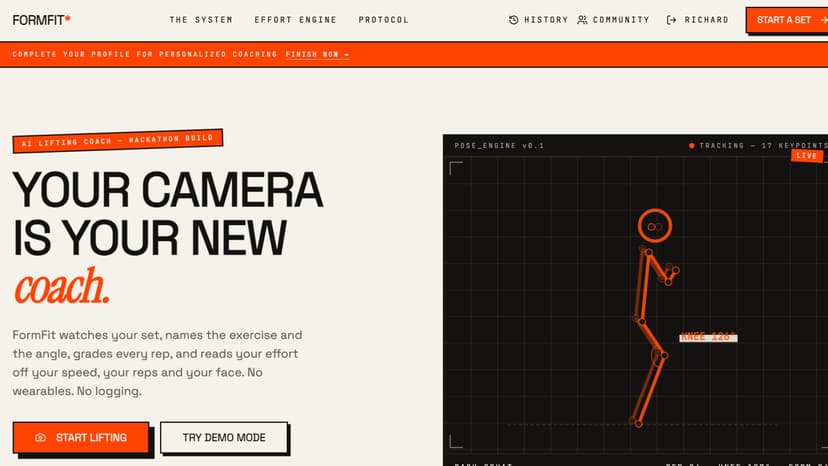
Lifting alone is how people get hurt. Fatigue breaks your form rep by rep — knees cave, backs round — and nobody's there to call it. A personal trainer fixes that, at $100 an hour. FORMFIT does it from the camera you already own. Point your phone at your set and the app tracks your skeleton live at 25fps. It counts every rep (and refuses to count walking around or fixing your hair), scores your knee, hip and back angles against exercise-specific targets, and fuses rep-velocity decay with form loss into a single effort score — so you know when the set is actually done, not just when it feels done. Coaching cues land mid-set, when they still matter. When you end the workout, an AI coach reads the whole set's telemetry and writes your debrief: what held up, what broke, what to change next session. Every claim traces back to a number in the rep table — proof, not vibes. Then it goes social. Every set becomes a post with your form and effort scores, so friends can follow your training and compete on quality, not just weight. Strava, for lifting. Frontend hand-built in React by a team of five in seven days; backend and database on Natively AI with Supabase.
10 Aug 2026
AlphaStream Omni
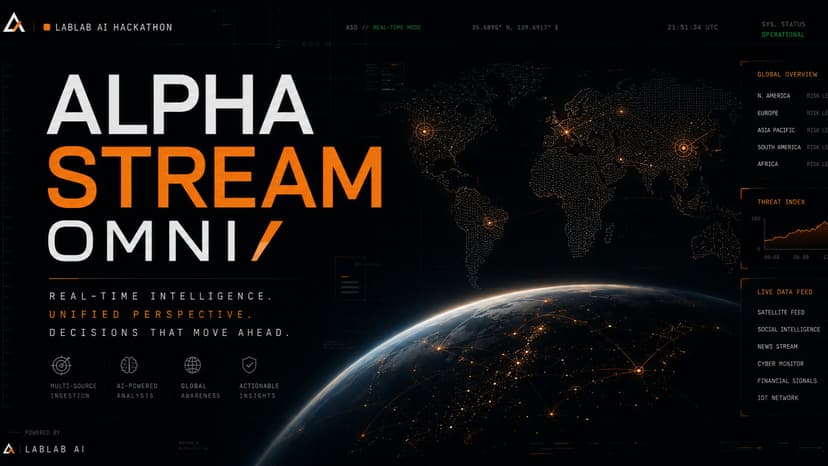
Our platform is a unified financial intelligence terminal built for the Fireworks AI hackathon, combining three independent systems into a single trading workflow: spot a macro risk, check a company's exposure, verify leadership sentiment, then ask a cross cutting question, all without leaving the terminal. Apex Quant acts as the entry point, a global macro intelligence map that surfaces emerging risks by region and industry. Once a risk is flagged, SupplyGraph pulls SEC EDGAR data to build a live supplier and competitor graph, filtered by industry category using official SIC codes, so a trader can instantly see which companies are exposed to that risk and through which relationships. From there, AlphaStream Omni analyzes the actual earnings call audio of the affected company. Using Whisper for transcription, FinBERT for text sentiment, librosa for vocal prosody analysis, and Gemma 3 12B running on Fireworks for reasoning, it evaluates not just what executives said but how they said it, catching vocal stress and tone shifts that raw transcripts miss. The result is a buy, sell, or hold signal backed by cited evidence from the actual call. Tying all three together is an Omni Assistant that lets users query across every layer at once, whether that means asking about a specific company's supply chain, a sector wide sentiment trend, or a single moment in an earnings call. The impact is real. Institutional grade financial intelligence has historically been locked behind expensive terminals. By combining macro data, supply chain graphs, and voice driven sentiment analysis into one accessible, AI powered product, we are giving retail traders and smaller funds the same kind of edge that used to require a six figure subscription.
13 Jul 2026


