
🤓 Latest Submissions
MotherTongue — one ad, every audience
In Uttar Pradesh every ad I saw was in Hindi. I moved to Bengal, and now they're in Bengali. Big brands pay agencies for that. Everyone else runs one ad that half their audience doesn't feel. MotherTongue is a web app for brands and their marketers. Upload one finished ad, pick who it's for (Kolkata in Bengali, Lucknow in Hindi, Milan in Italian, a global English one) and lock your brand facts: price, offer, dates, website. Each audience gets a new ad, not a translation: its own script, tone and local touch, its own voice in its language, its own on-screen text and subtitles. The marketer stays in charge. Every version waits for review: each line with its English meaning and why it changed, plus a facts check. Approve, edit a line, or ask for changes in plain words: you get v2 with "how I understood it" and only the lines that changed. Every correction becomes an editable rule in Brand memory, used for every next version. The model never writes a fact. It writes around locked slots; code and Gemma check every price, offer and date in the voiced script, and Gemma vision checks the finished frames. A version that fails can't be approved. All AI runs on AMD Token Factory: Gemma 4 (31B) sees the ad, writes each script, checks facts and pictures, understands requests and learns rules; OmniVoice speaks every language. Measured (result files in evidence/): 16 of 16 planted wrong prices, discounts, dates and claims caught in four languages, 0 of 4 false alarms. About 10 AI calls and 2 minutes per version. Who pays: brands that sell in more than one language, and their agencies, paying only for versions they approve.
18 Oct 2026
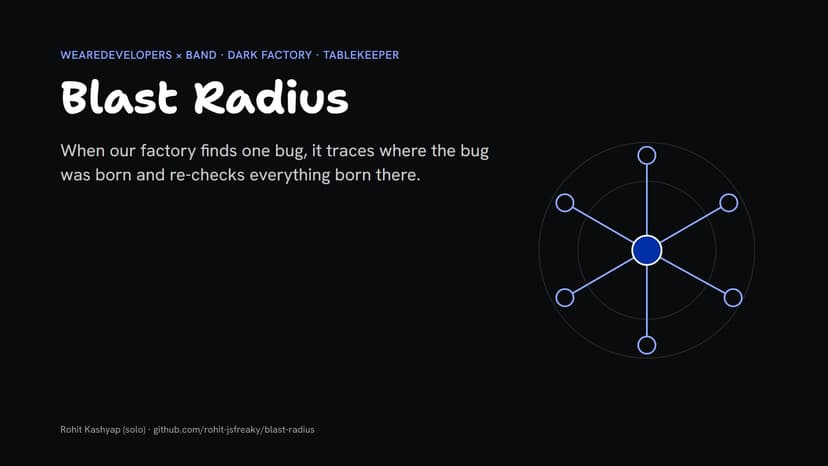
Blast Radius: fix the whole family
Every factory in this hackathon has a reviewer. When it finds a bug, the bug gets fixed. But a bug is usually born somewhere: one spec sentence, one handoff, one decision or one shared function. Everything else born there has the same mistake, and nobody checks it until a hidden test does. Blast Radius adds a fifth seat for exactly that: the investigator. Five seats run in BAND Desktop: a coordinator, two builders, a verifier and the investigator. Every builder commit must say which work item and spec lines it came from (a git hook refuses it otherwise). When any defect is found, the investigator walks git blame back to its origin, names the family born there, and checks every sibling with a probe it first saw failing on a known-bad version. A failing sibling becomes a REJECT to its owner. The family then goes forward as a risk for later stages. The judged run: one dispatch built all four stages of tablekeeper in 2 hours 16 minutes, and the official harness claims stage 4. At stage 1 the verifier rejected one bad booking reference accepted on reset. The investigator traced it to spec line L1.41: data entering through reset or import never went through the API's checks. It swept 9 siblings and found 5 more that nobody had reported. The same family caught two more defects at stages 2 and 3. In total 8 defects, 7 found by the sweep, all from one origin, all fixed. A sealed exam written before the run (169 checks the band never saw) passes 168. In Band a seat wakes only when a message names it; twice a seat ended its turn early, so we sent two short wake-up messages. Room log, cards, probes and the script behind every number are in the repo.
6 Oct 2026
Longtake: the whole form, in one take
You already know every answer a form asks for. Typing them in, box after box, is where people give up: about one in three people who start an online form don't finish it, and 52% of Gen Z job seekers have quit an application halfway (Indeed, September 2026). US federal paperwork alone takes 10.5 billion hours of the public's time a year. Longtake is a voice layer for other people's forms. Open a form, talk for a minute in English, Hindi or both, and every field you spoke to fills at once. It then asks out loud for what is still empty, a few short questions together. When you say something the form doesn't offer, it suggests the closest option and waits for your yes. Long answers stay in your words; if you ask it to polish one, every drafted sentence has to trace back to something you said. The next form arrives half filled, from memory kept only in your browser. Three rules are enforced in code: it never writes an answer you didn't give (every answer carries a quote that is checked against the transcript), it never presses submit, and it checks its own claims against the page and corrects itself out loud. Built on AssemblyAI: the Voice Agent API runs the conversation and calls a tool generated from each form at runtime, Dictation keeps your exact words for long answers, and the LLM Gateway reads what each question means and checks the agent's claims. We measured it on 21 real forms (Greenhouse, Lever, Ashby, Google Forms, Typeform, Jotform, GOV.UK and more): 314 questions read correctly, 0 fields filled that nobody spoke to, 12 of 13 false claims caught. Try it at longtake-web.vercel.app. The Chrome extension runs the same code on any site.
30 Sep 2026


