
🤝 Top Collaborators


🤓 Latest Submissions
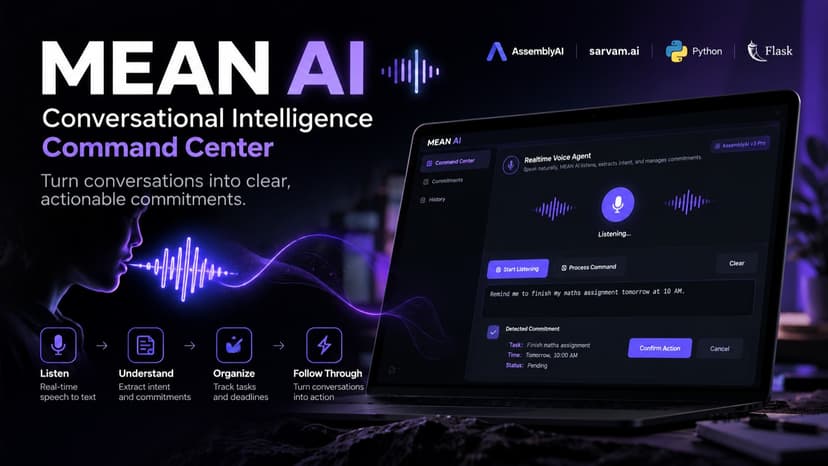
MEAN AI — Voice-Powered Commitment Intelligence
MEAN AI — Conversational Intelligence Command Center Conversations are full of promises, tasks, deadlines, and decisions that are easy to forget. MEAN AI turns spoken conversations into actionable commitments. How it works - Real-time voice input: Uses AssemblyAI's real-time speech-to-text API to transcribe spoken input. - Conversational intelligence: Uses Sarvam AI to analyze conversations and extract meaningful information. - Commitment tracking: Identifies tasks, responsible people, and deadlines, then organizes them in a centralized dashboard. - Voice-driven actions: Users can create or complete commitments using natural language. - Confirmation safeguards: Actions that modify commitments require explicit confirmation before changes are saved. - History and persistence: Stores conversation records and commitment status using SQLite. Technology stack: Python, Flask, AssemblyAI Realtime STT, Sarvam AI, JavaScript, HTML/CSS, and SQLite. Vision: Help people move from conversations to clear actions, with fewer forgotten commitments and better follow-through. MEAN AI is being developed as a conversational intelligence layer that connects what people say with what they need to do next.
30 Sep 2026
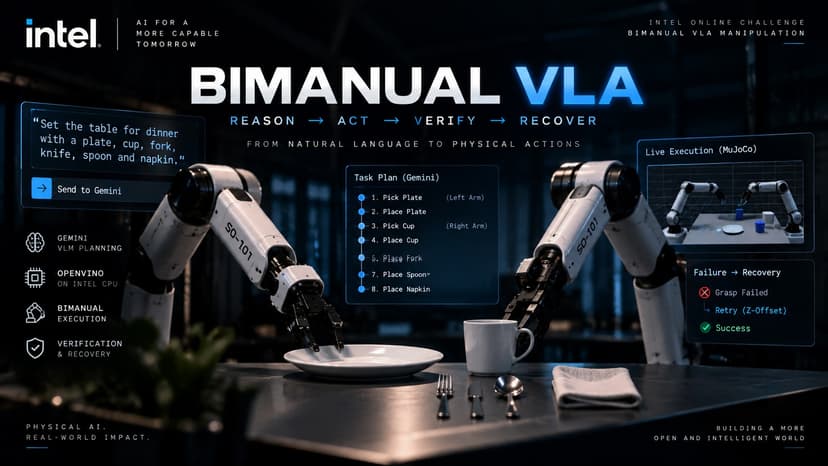
Bimanual VLA: Reason, Act & Recover
Bimanual VLA: Reason. Act. Verify. Recover. is an end-to-end Physical AI system that transforms a natural-language dinner-table instruction into coordinated actions for two simulated SO-101 robotic arms in MuJoCo. The system uses Gemini as the cognitive planner to decompose a high-level instruction into structured manipulation tasks, dependencies, and workspace-aware left/right arm assignments. A dependency-aware bimanual scheduler then determines which tasks can be batched in parallel and which must execute sequentially. The selected actions are executed through numerical DLS inverse kinematics and reusable manipulation primitives including approach, grasp, lift, placement, and release. The system operates as a closed loop rather than a one-shot motion script. After manipulation, visual verification checks the resulting simulation state. When an action fails, the Recovery Engine diagnoses the failure, selects a recovery strategy, retries the action, and verifies the result again. Intel OpenVINO provides CPU-accelerated visual perception for edge-oriented inference. The system also includes a live observability dashboard showing the MuJoCo camera, cognitive task graph, bimanual scheduler, recovery telemetry, and hardware performance measurements. In the final end-to-end test, a real Gemini-generated six-task dinner-table plan was executed in MuJoCo with 6/6 tasks successfully completed. Two manipulation failures were detected and automatically recovered on the second attempt. On the target Intel Core i3-N305 system, the latest controlled benchmark measured 28.14 ms OpenVINO model-only inference and 37.72 ms for the complete perception pipeline, compared with 147.59 ms for the PyTorch CPU baseline, corresponding to a 3.91× speedup for the complete pipeline. The result is a reproducible closed-loop Physical AI architecture connecting language reasoning, bimanual planning, robotic control, Intel-accelerated perception, verification, and autonomous recovery.
16 Sep 2026


