
Saira Asghar@saira_asghar737
🤝 Top Collaborators



🤓 Latest Submissions
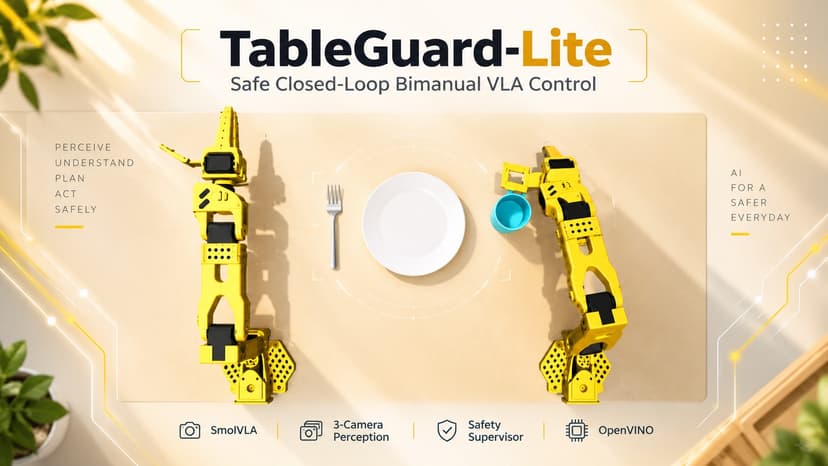
TableGuard-Lite: Safe Bimanual VLA Control
TableGuard-Lite is a safety-aware closed-loop Vision-Language-Action (VLA) system for bimanual robotic table setting. It combines natural-language instructions, three RGB camera views, and a 12-joint robot state to generate coordinated actions for two SO-101 robot arms using SmolVLA. Instead of executing long open-loop trajectories, the system predicts short action chunks, executes only a small portion, and then replans from fresh observations. A runtime safety supervisor checks joint-rate limits, unexpected contacts, collisions, and scene preservation, stopping unsafe behavior before it can propagate. TableGuard-Lite also introduces recovery-oriented learning: states encountered during failed closed-loop execution are captured and reused for targeted fine-tuning. The project includes a successful full reference manipulation sequence, learned closed-loop control experiments, failure-driven recovery training, three-camera perception, and safety-supervised execution. OpenVINO export, numerical-parity verification, and Intel CPU inference were also successfully demonstrated. TableGuard-Lite shows how Physical AI systems can combine VLA intelligence with safety, recovery, and deployment verification for more reliable real-world robotic manipulation.
16 Sep 2026

DuDe Talk
Communicating with deaf individuals can be challenging due to the language barrier. While they are proficient in sign language, not everyone is familiar with this form of communication. Additionally, when they do speak, their speech may differ from that of a typical person. Conversely, deaf individuals may face difficulties understanding spoken language, leading to emotional distance and, unfortunately, making them targets for ridicule. Consequently, these challenges hinder their ability to play a significant role in society, emphasizing the importance of fostering understanding and inclusivity for the deaf community. We aim to facilitate seamless communication between the deaf and normal individuals, empowering deaf individuals to fully utilize their capabilities in society. Leveraging the technologies provided by Clarfai , we propose a solution that provides easy understanding between both the deaf and hearing communities.
22 Jan 2024

MakkerAI
We used streamlit for the frontend, and the chatgpt API for the backend. The app takes the user's personal and work information, as well as the desired tone of voice, the skill to emphatize on and a template to based on if desired. The app uses the user's input and some prompt engineering to create a prompt for the AI. then, it creates a document whether it's a bio, a cover letter or a CV. Reduces the effort of writing with a nice UI that guides you step by step. We will use affiliate marketing as income, then we will use the collected data from the user to personalize their experience and refine the service.
7 Apr 2023

Youtube Navigator
One of the most popular resources for obtaining information is video. When the time resource for watching one or more videos is limited, the question arises, why is there no short summary of the video like in the book? Even further, when the video is suitable, why is there no ability to extract information in the form of text from several videos to further work with the document? Have you ever had such pain while working with video? Our solution: Youtube Navigator 1. Chrome extension that provides personalised summaries for users directly on YouTube. 2. Our extension has seamless integration with YouTube providing a distraction-free viewing experience 3. The extension uses generative AI technologies to generate summaries customised to each user's preferences and interests
24 Feb 2023


