DALL-E 2

DALL-E 2 is a new version of DALL-E, a generative language model that creates corresponding original images from sentences. DALL-E 2 has 3.5B parameters, making it large but not nearly as large as GPT-3. Interestingly, it is smaller than its predecessor, which had 12B parameters. Despite its size, DALL-E 2 generates images 4 times better in resolution than DALL-E. Additionally, human judges prefer DALL-E 2 over DALL-E 70% of the time in caption matching and photorealism.

General
Relese dateApril 6, 2022
AuthorOpenAI
Repository-
TypeAutoregressive, Transformer, Image generation model

Start building with DALL-E 2

We have collected the best DALL-E 2 libraries and resources to help you get started to build with DALL-E 2 today. To see what others are building with DALL-E 2, check out the community built DALL-E 2 Use Cases and Applications.

OpenAI DALL-E 2 Tutorials


Libraries

A curated list of libraries and technologies to help you build great projects with DALL-E 2.

  • Blog Open AI's blog post about DALL-E 2 API
  • Documentation DALL-E 2 Documentation
  • API DALL-E 2 API Documentation
DALL-E-2 top builders

Explore the top contributors showcasing the highest number of DALL-E-2 app submissions within our community.

OpenAI DALL-E-2 AI technology Hackathon projects

Discover innovative solutions crafted with DALL-E-2, developed by our community members during our engaging hackathons.

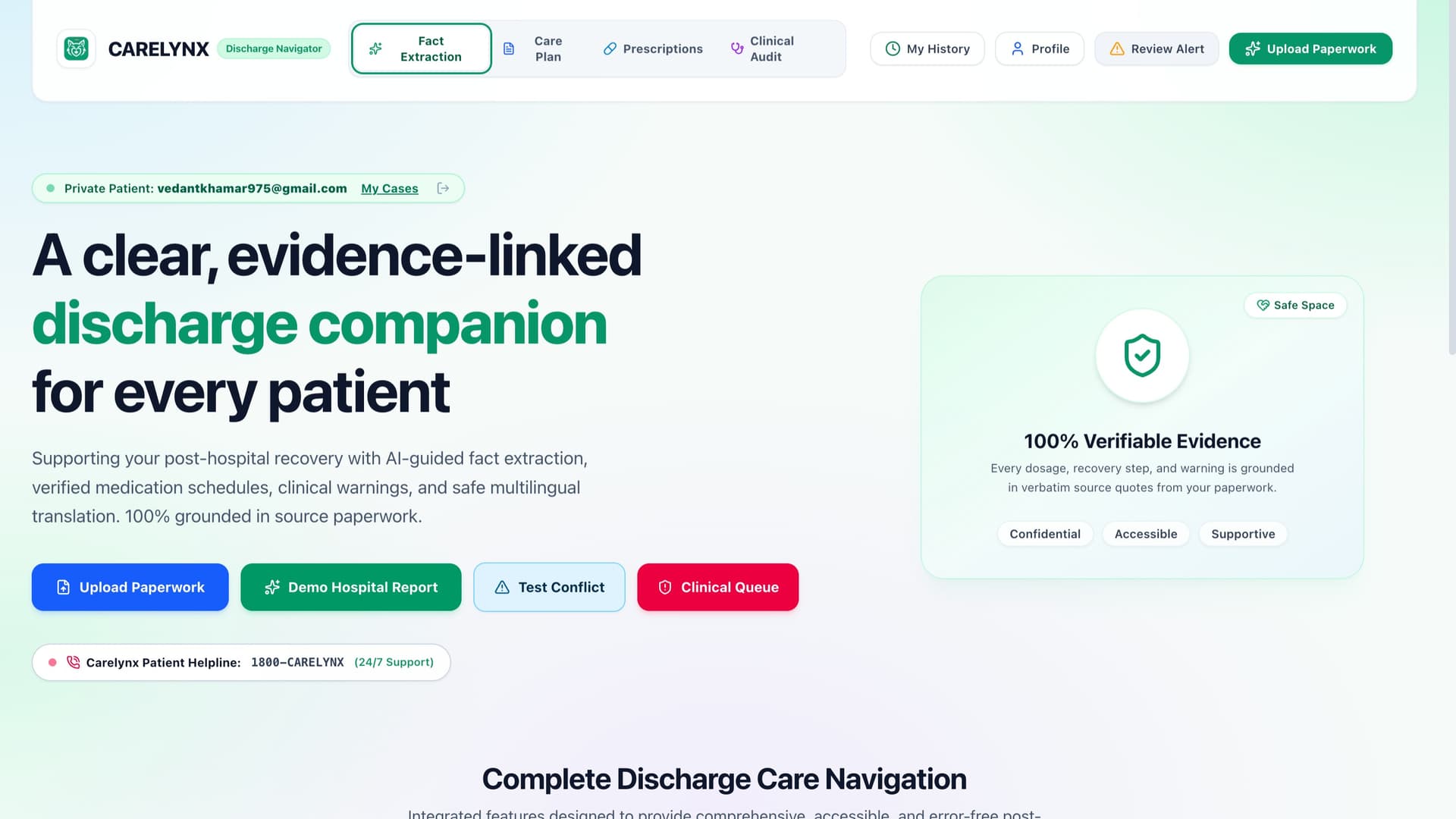
CARELYNX: Evidence-Linked Discharge Companion

CARELYNX: Evidence-Linked Discharge Companion

# The Problem Every year, millions of discharged hospital patients face dense, fragmented paperwork filled with medical jargon, abbreviations, and contradictory instructions. Over 19% of patients experience post-discharge adverse events, frequently caused by medication confusion, missing follow-up dates, or language barriers. # The CARELYNX Solution CARELYNX is an intelligent, safety-first clinical discharge companion. Patients or caregivers simply upload discharge summaries, prescriptions, or lab sheets (PDFs/scans). CARELYNX ingests and structures these documents into a clear, interactive care plan: - Verbatim Grounding: Every extracted medication, dose, allergy, and follow-up appointment links directly to line-by-line evidence in the original hospital records. - Clinical Conflict Detection: Identifies contradictory instructions across multiple discharge documents (e.g., conflicting dosages or appointment dates) and flags them for safety. - Human-in-the-Loop Review Queue: Ambiguous or conflicting facts are immediately routed to a clinical review workspace before reaching the patient. - Multilingual Care Navigation: Provides verified translations into 6 languages (Hindi, Gujarati, Marathi, Tamil, Telugu, English) with strict preservation of drug names and quantities. # Accelerated by AMD ROCm CARELYNX leverages open-source LLMs (Qwen2.5-7B-Instruct) accelerated by AMD ROCm and vLLM. High-throughput GPU inference on AMD hardware enables near-instant, private extraction while maintaining zero-hallucination guardrails and strict JSON schema enforcement. # Safety & Privacy Built with HIPAA-aligned RBAC, end-to-end data sanitization, and strict medical non-goals: CARELYNX navigates information without diagnosing or prescribing, empowering patients to recover safely at home.

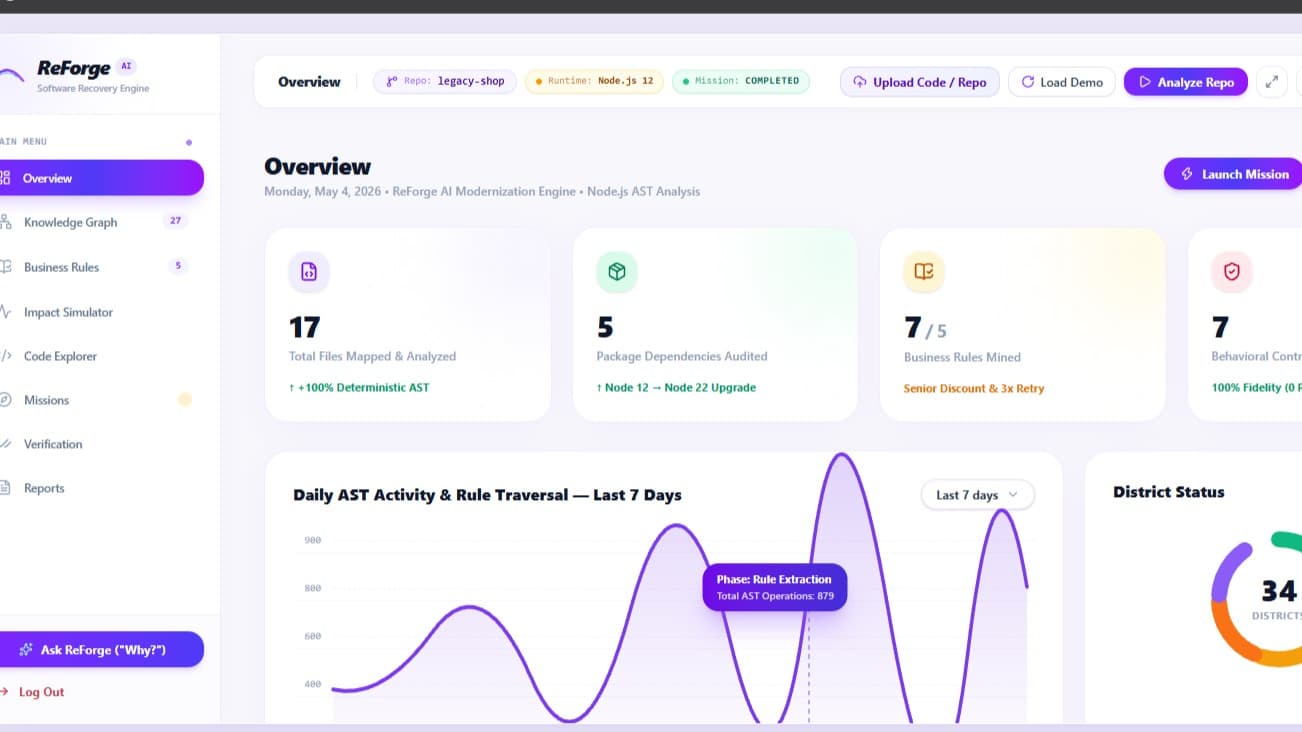
Reforge

Reforge

The Problem: The Legacy Knowledge Void Trillions of dollars of global enterprise infrastructure—spanning banking, logistics, retail, and healthcare—run on aging legacy codebases. When the original engineers depart, this software becomes an impenetrable black box. Development teams face a critical dilemma: Undocumented Architecture: Microservice routes, database operations, and external dependencies are untracked. Hidden Business Rules: Vital domain rules (e.g., custom discount thresholds, idempotent settlement checks, retry fallbacks) are buried deep inside undocumented conditional branches. High Regression Anxiety: Touching legacy code risks catastrophic breaking changes across unmapped callers. The AI Rewrite Trap: Modern generative AI tools attempt blind syntactic rewrites without understanding domain semantics, frequently stripping critical edge-case logic and introducing silent production bugs. The Solution: ReForge ReForge is an AI Software Recovery & Evolution Engine built on a fundamental principle: "Don't just rewrite legacy code; recover the institutional knowledge trapped inside it." ReForge flips modernization from a risky code replacement into a structured, knowledge-first recovery lifecycle: Understand (AST Grounded Graph): Parses codebase Abstract Syntax Trees (AST) deterministically to reconstruct an interactive Knowledge Graph mapping microservices, endpoints, database queries, and security vulnerabilities without hallucinations. Mine Institutional Memory: Automatically extracts undocumented domain rules from conditional branches, surfacing them as verified business logic with exact file and line coordinates. Simulate Blast Radius: An interactive Impact Simulator models upstream callers and downstream dependencies to calculate risk levels before making code changes. Software Archaeology ("Ask Why"): An AI reasoning agent answers architectural inquiries citing ground-truth source code citations. Human-in-the-Loop Decision Gates: An autonomous 9-phase mission workflow pauses at critical architectural junctures, requiring human approval before legacy behaviors are modernized or deprecated. Behavioral Contract Verification: Live test execution and zero-regression behavioral contracts verify input/output parity between legacy and modernized systems. Target Users & Interaction Designed for enterprise software engineers, modernization architects, tech leads, and technical auditors. Users interact through a high-fidelity visual dashboard where they can upload repository ZIPs or source files, inspect dependencies in an interactive React Flow blueprint, confirm discovered business rules, trigger human-gated migrations, and download audit-ready compliance reports in Markdown and JSON. Creativity, Uniqueness & Impact Unlike generic AI coding assistants that generate untrusted code in isolation, ReForge enforces deterministic static analysis as an anchor for LLM reasoning, combines autonomous agents with mandatory Human Decision Gates, and validates migrations through empirical test execution. It cuts legacy onboarding and modernization time from months to minutes while guaranteeing zero functional regression.

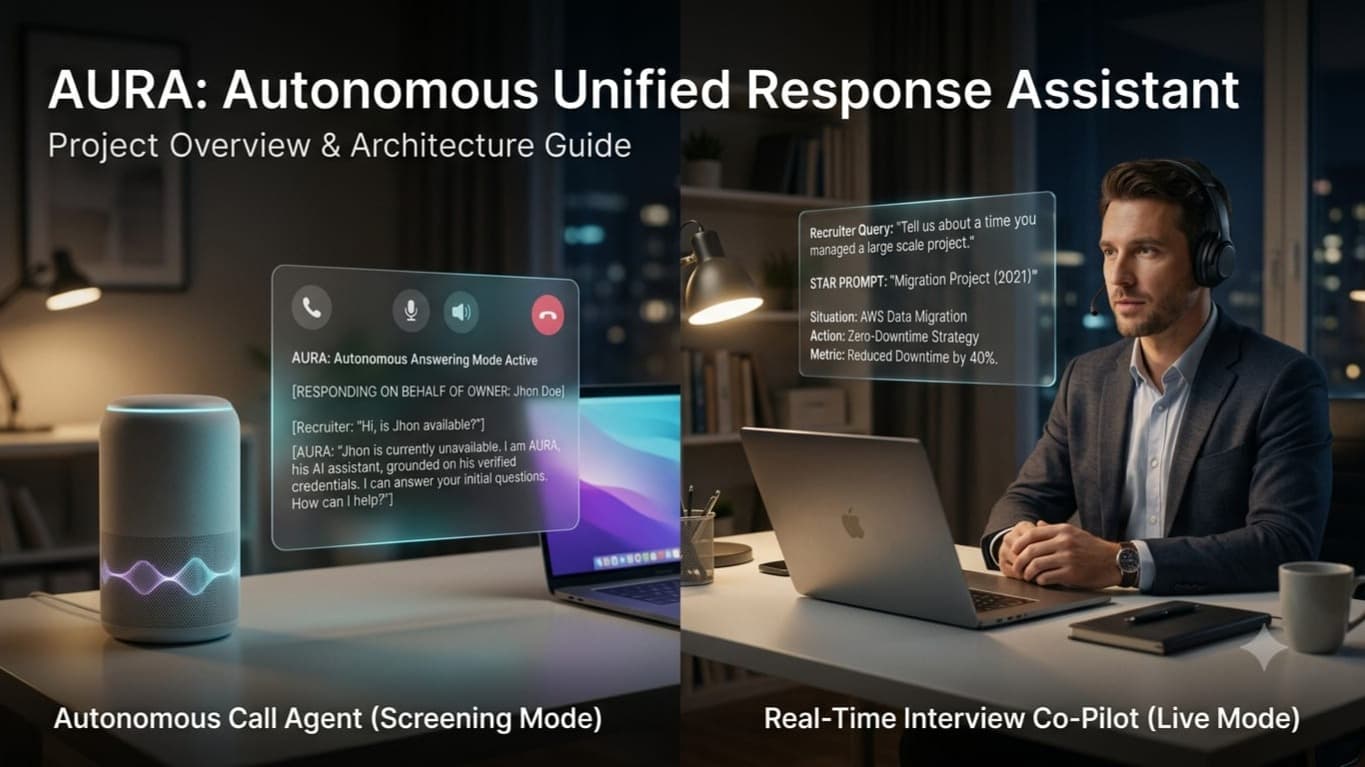
AURA - Autonomous Unified Response Assistance

AURA - Autonomous Unified Response Assistance

The Problem Modern professionals, job seekers, and on-call workers face a persistent dilemma: answering unexpected phone calls disrupts deep work and critical meetings, yet ignoring them risks missing life-changing recruiter screenings, client inquiries, or urgent family emergencies. Traditional voicemail is an outdated, passive medium—over 80% of callers hang up without leaving a message, and those who do leave unstructured audio that requires tedious listening. Meanwhile, rampant spam and aggressive robocalls force users to keep phones on Do-Not-Disturb (DND), creating a dangerous blind spot where genuine emergencies are missed and valuable career opportunities vanish. The Solution: AURA AURA (Autonomous Unified Representative Agent) is a full-stack, real-time AI personal call assistant that represents users when they are unavailable. Operating with bidirectional speech recognition (STT) and natural voice synthesis (TTS), AURA actively engages callers in dynamic, context-aware spoken conversations. It classifies call intent across seven categories (Interview, Emergency, Business, Personal, Spam, Normal, Unknown), addresses inquiries using verified facts, filters spam, and compiles executive summaries with actionable next steps. Target Users Job Seekers & Software Engineers: Candidates needing an articulate representative to answer recruiter questions based on their exact qualifications. Busy Professionals & Executives: Individuals who need uninterrupted focus without dropping business leads or client communications. On-Call Personnel & Families: Users requiring an intelligent filter that silences noise while guaranteeing genuine emergencies break through. How Users Interact With It Profile Grounding: Users upload their resume or professional bio (.txt, .md). AURA automatically sanitizes PII and indexes skills, projects, and work history. Call Handling: Callers speak naturally with AURA. A reactive orbital avatar visually reflects listening, thinking, and speaking states alongside live audio waveform metering. Dashboard & Daily Intelligence: Users review searchable call logs, categorized sentiment, auto-extracted action items, and executive daily digests. Emergency PIN Verification: When a critical crisis is detected, AURA flags high-urgency alerts requiring a secure PIN (1234) to dismiss. What Makes AURA Creative & Unique Zero-Hallucination Resume Grounding: AURA never fabricates qualifications. If a recruiter inquires about an unlisted skill (e.g., Rust or Quantum Computing), AURA politely declines: "I don't have that information listed in their verified resume, so I’ll have them follow up directly." Built-in Zero-Trust PII Shield: Real-time redaction blocks private phone numbers, home addresses, government IDs, and confidential compensation details before grounding. Smart Emergency Escalation: Distinguishes true medical or safety emergencies from routine calls, alerting active devices while safeguarding against false alarms. Zero Cloud Lock-In: Operates out-of-the-box with a sub-second offline deterministic engine, with pluggable support for OpenAI, Gemini, and Claude. Effectiveness and Efficiency AURA converts chaotic, disruptive phone calls into structured, prioritized intelligence. It eliminates phone anxiety, safeguards personal privacy, ensures zero missed career opportunities, and guarantees rapid response to true emergencies—saving hours of manual follow-up every week.

Fresno LUX: A Living City

Fresno LUX: A Living City

Fresno LUX is a prototype for a living intelligence layer across an entire city. Fresno already contains enormous amounts of intelligence: residents know where problems exist, nonprofits know where help is needed, businesses know where opportunities exist, educators understand gaps in learning, researchers generate knowledge, and government maintains critical infrastructure and data. The problem is that much of this intelligence is fragmented across disconnected systems. Fresno LUX connects those pieces. The platform creates a shared city graph where people, organizations, resources, needs, projects, observations, experiments, and outcomes become connected nodes. Instead of simply collecting data, LUX continuously asks: What is happening? What do we know? What is missing? What can we test? What changed? A community problem can become an observable signal. That signal can become an experiment. The experiment produces evidence. Evidence changes the system's understanding. That updated understanding informs the next action. Observe → Connect → Understand → Act → Measure → Learn → Converge. The goal is to move Fresno from disconnected information toward collective intelligence—a system where knowledge can travel across boundaries and successful solutions can be discovered, tested, measured, and replicated. LUX is designed to make the invisible connections visible: the relationship between a neighborhood and its resources, between a student and educational opportunity, between a business and workforce capacity, between environmental conditions and community health, and between an idea and measurable real-world impact. This hackathon prototype demonstrates the beginning of a Living Fresno Graph: a city that can observe itself, learn from evidence, and coordinate toward better outcomes.

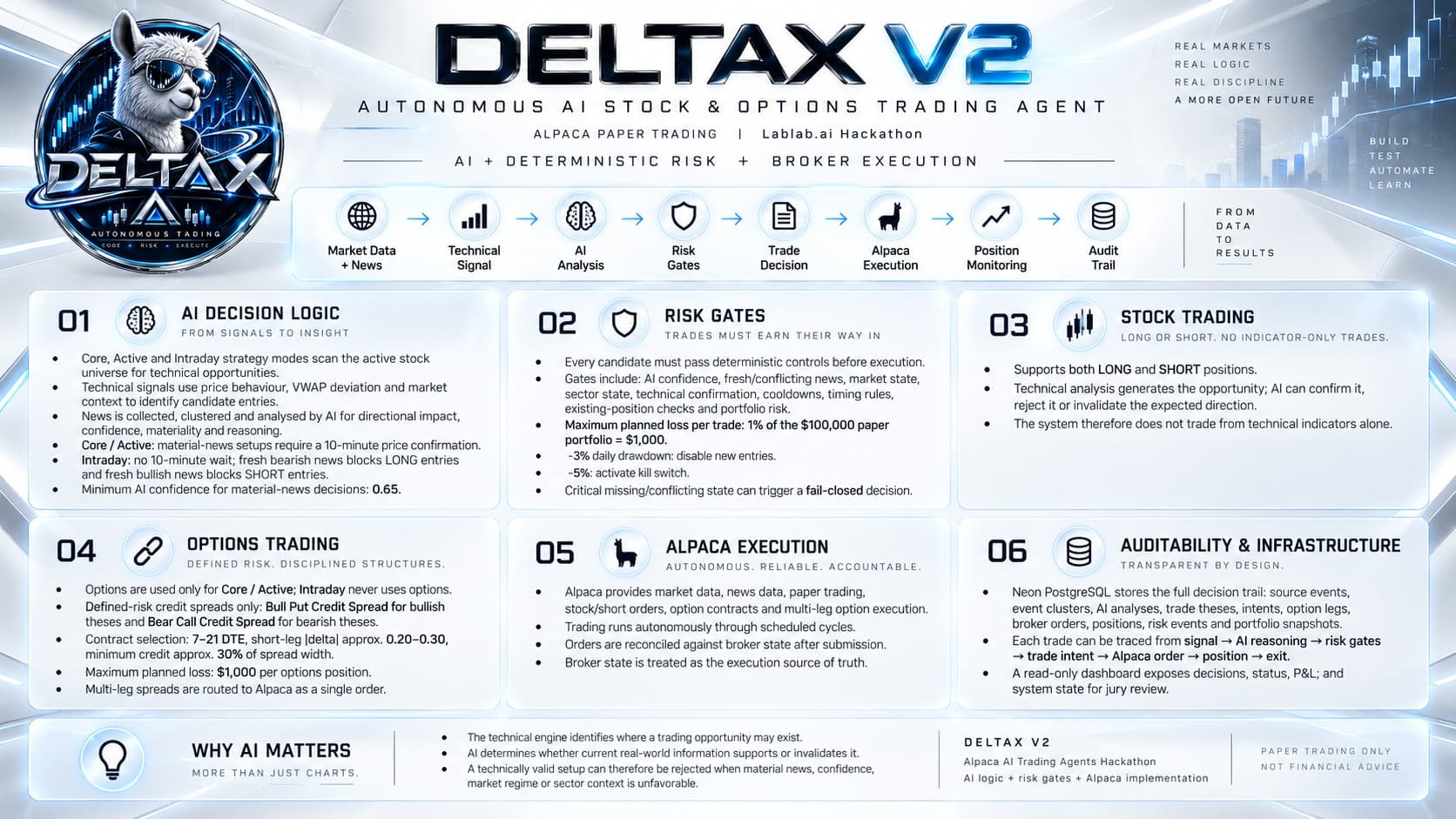
DELTAX V2 — Autonomous AI Trading Agent

DELTAX V2 — Autonomous AI Trading Agent

DELTAX V2 is an autonomous AI trading system built for the Alpaca AI Trading Agents Hackathon. It combines technical market analysis, real-world news intelligence, deterministic risk controls, automated broker execution, and end-to-end auditability into a single trading architecture. The system operates through three distinct trading strategies: Core, Active, and Intraday. Technical analysis identifies potential opportunities first, while AI evaluates whether current news, market conditions, confidence, and directional context support or invalidate the trade thesis. Before execution, every candidate must pass deterministic risk gates covering AI confidence, conflicting news, market and sector conditions, technical confirmation, timing rules, existing positions, and portfolio exposure. DELTAX limits planned loss to 1% of a $100,000 paper portfolio per trade, disables new entries at a 3% daily drawdown, and activates a kill switch at 5%. For options, DELTAX uses defined-risk credit spreads with systematic contract-selection rules. Orders are executed through Alpaca Paper Trading, reconciled against broker state, and continuously monitored. Every decision is recorded in PostgreSQL, creating a traceable path from technical signal → AI confirmation → risk gates → trade intent → Alpaca order → position → exit. A read-only dashboard exposes decisions, P&L, system state, and execution history for transparent review. DELTAX V2 demonstrates how AI can go beyond generating trading signals by acting as a disciplined validation, risk, execution, and auditing layer around an autonomous trading system.