
🤓 Latest Submissions
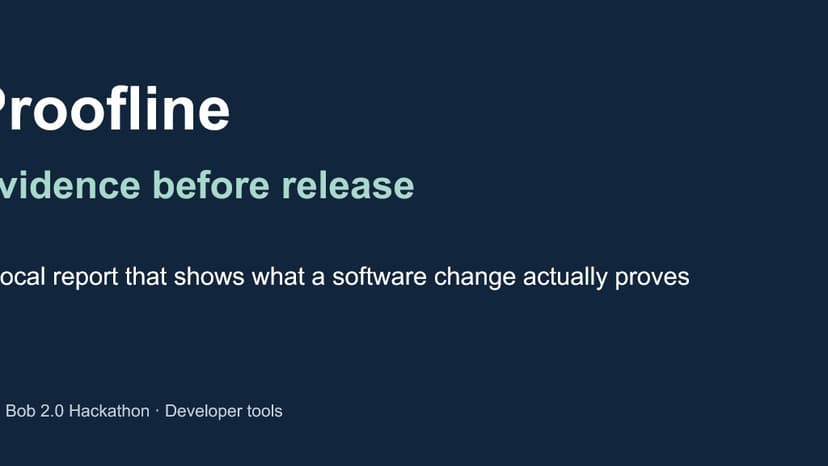
Proofline: Evidence Before Release
AI-assisted development can produce changes faster than teams can verify release claims. A green local test does not establish a browser flow, hosted service, provider integration, or production behavior; simulated telemetry can also be mistaken for real evidence. Proofline helps solo developers and small AI teams assemble a bounded evidence manifest for one change request and see exactly what each claim proves. It validates the manifest, derives statuses—proven, conditional, simulated, unverified, or blocked—and shows the evidence source, provenance, observation time, limitation, and next check. A declared pass remains conditional until the explicit, code-owned local runner observes an allowlisted check pass. The reporting paths do not execute commands. Users can explore synthetic pass, simulation, and missing-hosted-evidence scenarios and export JSON, Markdown, or self-contained HTML. A local loopback browser interface and a separate Vercel static/API adapter are included in the repository; the adapter analyzes bounded manifests only. The live public demo is deployed to Vercel Production at https://project-sa6e1.vercel.app. It is a demonstration build from `codex/proofline-product-improvements` (commit `1ed650b`) and uses synthetic/public-safe content only. The page does not save manifest contents; Vercel may process request metadata. No provider-backed AI behavior or production-readiness claims are made.
27 Sep 2026
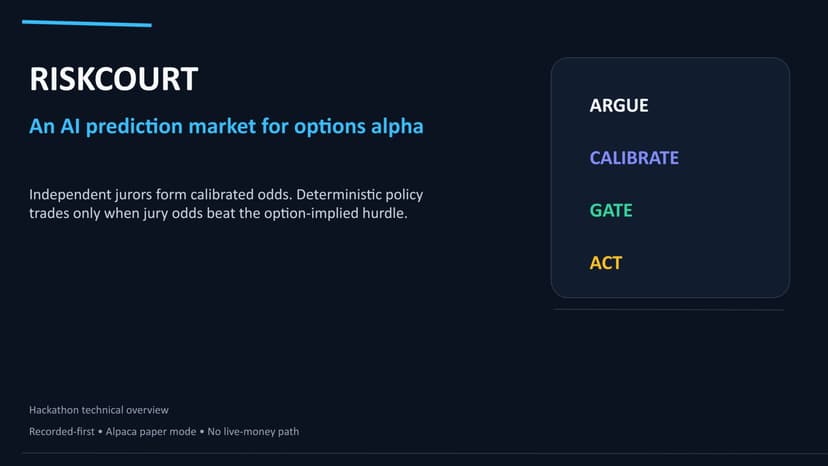
RiskCourt: Options Alpha Jury
RiskCourt is an autonomous, paper-only options agent built as an AI prediction market. Independent jurors study market structure, catalysts, and volatility/options structure, then return evidence-bound probability forecasts and confidence stakes. A deterministic calibration layer aggregates those forecasts and compares the result with a defined-risk spread's option-payoff break-even proxy. The risk court trades only when the jury probability clears the hurdle by a configured margin and every freshness, liquidity, account, drawdown, approval, and idempotency gate passes. The MVP allows one contract and caps loss at 0.5% of account equity. Recorded mode replays twelve credential-free cases, including trade, abstain, veto, provider failure, stale data, disagreement, and prompt-injection paths. Alpaca Trading API adapters provide paper account, market-data, option-chain, order-mapping, lifecycle, and P&L boundaries. Paper performance is simulated, not live performance or investment advice; options involve substantial risk.
4 Sep 2026
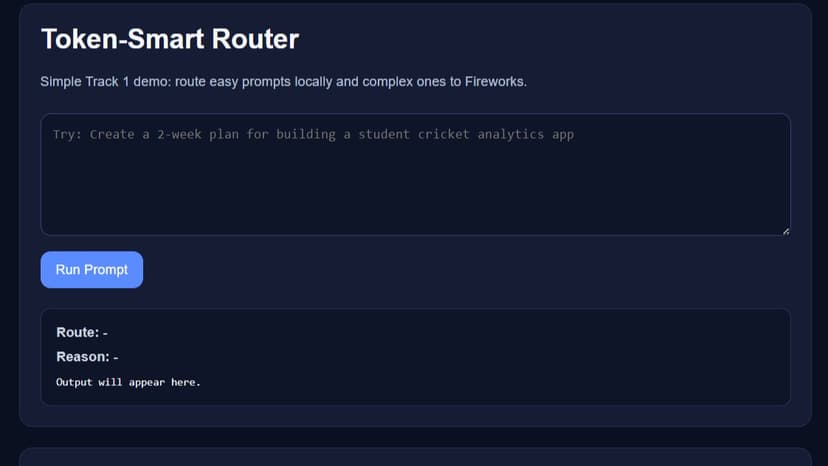
token-smart-router
Token-Smart Router is a beginner-track hybrid AI agent built for the AMD Developer Hackathon Track 1 challenge: minimize Fireworks AI token usage without dropping answer accuracy. The app uses a lightweight React + Vite frontend and an Express backend that first classifies each incoming prompt with a fast, zero-cost local router. Simple formatting requests, short definitional questions, and list-style prompts are answered instantly by a local handler at zero token cost. Anything more complex — reasoning, planning, or open-ended generation — is routed to the Fireworks AI API via an OpenAI-compatible client, using a tiered model selection so cheaper models are tried before falling back to stronger ones. The goal is to demonstrate that meaningful token savings are possible with a simple, interpretable routing layer rather than always calling the largest available model. This submission also includes basic hardening on the API layer (restricted CORS, request validation, and rate limiting) to keep the routing endpoint safe from abuse. Next steps include a standardized task harness for automated benchmark scoring and execution-based accuracy verification for math and code tasks.
13 Jul 2026


