Sebastien Henry@sebastien_henry7
6
Events attended
5
Submissions made
United States
2+ years of experience
About me
Senior data & AI engineer based in Austin, TX, with deep roots in the modern data stack — Snowflake, dbt, Python, and AWS — and a growing obsession with agentic AI systems built on LangChain and LangGraph. By day I architect data platforms and analytics pipelines. On the side, I'm building AI-powered applications, exploring multi-agent workflows, and looking for hackathons where I can ship something real with people who care about what they're building. My sweet spot is the intersection of structured data and generative AI — think RAG pipelines over warehouse data, AI agents that actually do something useful, and automation workflows that replace hours of manual work. Always up to team with engineers, product thinkers, and builders who move fast and build things worth showing. Stack: Python · Snowflake · dbt · LangGraph · n8n · AWS · Tableau
🤓 Latest Submissions

Ledger-First Dark Factory
Ledger-First Dark Factory is a generic five-seat software factory for Band Desktop. We did not write the app: we built the factory, then sent the band one task message per stage and nothing else. How it works. The Lead plans each stage and cuts work items with one owner each. The Analyst turns every sentence of the specification into a numbered requirements ledger before any code exists, then writes acceptance tests from it, because most judged tests are hidden but all of them come from the spec. The Builder and the Designer build in parallel, test first. The Verifier never fixes anything: it rebuilds each revision in a clean worktree, re-runs every check, and accepts or rejects it with a reproducing command. Every handoff is a self-contained packet in the room; every commit carries its seat's name. Results on the pocketful track: four stages in 6 h 23 min of band time, 55 work items, 244 commits by five seats. Stages 1 to 3 passed the band's own stage gate; on our isolated run of the event's checks, all four stages pass. The band caught its own bad results: 14 rejections, each fixed by a new commit, including an export that grew until the service refused to import it, and an error hidden under the phone tab bar that only a screenshot revealed. Cost: $244 at API list-price equivalent, measured per seat. We kept the failures honest: stage 4 was complete but its gate never ran because a verdict named the Lead in plain text instead of a mention. FACTORY.md documents it, the recovery, and the protocol fix. The mandates contain no track vocabulary, so a different task builds a different product.
6 Oct 2026

Voice-to-Ops: field reports that write themselves
A field technician finishes an inspection — on a roof, in gloves — having found real problems: a cracked heat exchanger, a blocked drain line, a worn belt. That information exists for about thirty seconds as spoken words on site, then has to survive being remembered and typed into a form hours later. Structured intake forms lose to how people actually talk in the field, and a voice memo that just sits on a phone doesn't get anyone dispatched. Voice-to-Ops closes that gap. The technician dictates exactly as they would anyway; the app transcribes the audio with Speechmatics, then an open model (Llama-3.3-70B on Featherless) structures the transcript into a validated report: findings graded critical/major/minor, each with a verbatim evidence quote proving where it came from; action items with due windows; required materials; and an explicit "not determined on this visit" list. A dashboard tracks jobs and open actions, and a one-click follow-up email turns the report into customer communication. The pipeline is designed for restraint, not just capability: a strict JSON schema is enforced at the boundary, every finding must quote the transcript, hypotheticals and mentions of other job sites never become findings, and when the model can't determine something it says so instead of guessing. Built primarily with native.builder (Product Architect scoping, then Builder-agent generation against a specified design system). Because the generated app is client-only, both AI providers are called through Supabase Edge Functions — no API key ever reaches the browser, and the public endpoint carries per-caller rate limiting. Target users: field service technicians and inspectors in any dictation-heavy trade, demoed with an HVAC inspector persona.
10 Aug 2026
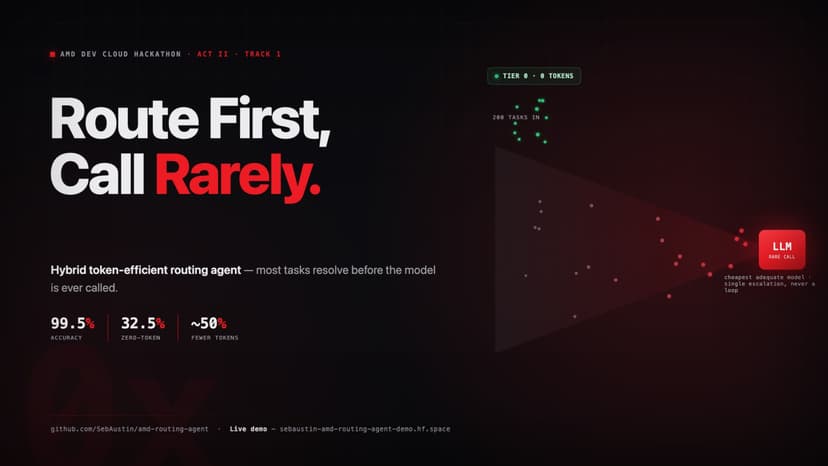
Route First, Call Rarely
Track 1 scores submissions on Fireworks tokens spent above an accuracy bar, not on feature count. The naive path — route every task to the strongest model — is the most expensive way to pass. Most tasks don't need a frontier model, and a meaningful share don't need a model at all. Route First, Call Rarely is a tiered routing cascade. A zero-token classifier (regex/heuristics) sorts each task first. Tier 0 solves arithmetic, dates, strings, units, and extraction locally with deterministic solvers — no API call, ever — and only answers when it can self-validate. Everything else goes to Tier 1: the cheapest Fireworks model that can handle the task, minimal prompts, temperature 0, and per-model reasoning suppression so models like gpt-oss-20b don't burn tokens on hidden chain-of-thought. A confidence gate (format validation + Tier-0 cross-check, logprobs secondary) accepts the answer or escalates — exactly once — to the strongest allowed model. No retry loops, no self-verification. Measured on the full 200-task live eval against the real Fireworks API: 99.5% accuracy (199/200), 32.5% of tasks (65/200) resolved with zero Fireworks tokens, ~47-51% token reduction vs. an honest naive baseline, $0.003636 total price-weighted cost, 1.45% retry rate counted in every total above. What makes it different: the comparison baseline is deliberately fair — reasoning suppression explicitly disabled, not a strawman. Routing logic sits behind an isolated adapter contract, so swapping models never touches it. The model registry already prefers gemma* models at equal price tier — unit-tested and dormant, since Gemma wasn't reachable on our Fireworks account when probed July 7. Stack: Python, FastAPI demo dashboard, Fireworks AI on AMD infrastructure, Docker, pytest, CI. Repo: github.com/SebAustin/amd-routing-agent Demo: https://sebaustin-amd-routing-agent-demo.hf.space
13 Jul 2026

HireGuard — AI Hiring Compliance Auditor
HireGuard is a multi-agent compliance auditor built on Band. A single command feeds a hiring packet — job posting, comp band, and interview scorecard — into a Band room where four specialized agents hand off work through @mentions. @Intake (LangGraph) extracts structured facts from the raw artifact and writes them to facts.md. @PolicyAgent (LangGraph) cross-references every fact against a 10-rule EEOC and pay-transparency ruleset, appends cited findings, then hands off to @RiskScorer. @RiskScorer (CrewAI) calls the AI/ML API for each finding to score legal exposure on a 0–100 scale, weighing severity, litigation likelihood, and jurisdiction attachment, then writes risk.md. @Counsel (CrewAI) adversarially validates Critical findings, bounces thin cases back to @PolicyAgent for a visible re-loop, and writes the final audit.md — a defensible memo with statute citations and a human sign-off gate. The AI/ML API is load-bearing: no finding gets a risk score until that call returns. Agents coordinate through Band @mentions; content lives in shared workspace files, keeping chat lightweight and auditable. The ruleset covers Federal EEOC law (ADEA, Title VII, ADA, disparate-impact doctrine) and state pay-transparency statutes in California (SB 1162), New York (LL 194-b), and Colorado (EPEWA). The demo packet ships with pre-planted violations — age-proxy language, a salary-history question, a missing CA pay range — producing a HIGH verdict with six cited findings on first run. EEOC charges cost U.S. employers $440M+ in 2023 and pay-transparency penalties are accelerating. HireGuard makes compliance audits fast, repeatable, and traceable.
19 Jun 2026
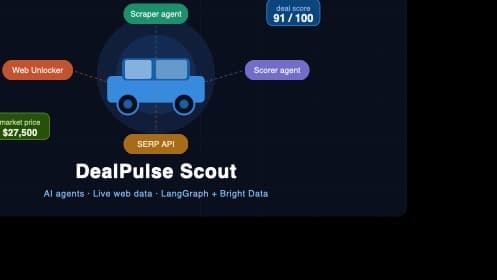
DealPulse Scout — AI Agent for Live Car Deals
Finding a genuine car deal is a manual, frustrating process. Buyers spend hours cross-referencing listings across five platforms, guessing whether a price is actually below market — and by the time they act, the deal is gone. DealPulse Scout solves this with a LangGraph multi-agent pipeline powered entirely by Bright Data's live web infrastructure. A single natural-language query ("Find me a used 2022 Tesla Model 3 under $28k in Austin TX") triggers a coordinated scraping run across CarGurus, AutoTrader, and Craigslist using Bright Data's Scraping Browser and Web Unlocker to bypass bot detection and JavaScript rendering. A parallel SERP API call pulls real-time market pricing data for that exact make, model, trim, and mileage range. A scoring agent then computes a 0–100 deal score by comparing each listing's price against the live market average, factoring in listing freshness and mileage deviation. Claude claude-sonnet-4-20250514 generates a one-line plain-English reason for every top result. The entire flow streams live in the UI — judges and users see each agent node activate in real time. A demo mode backed by SQLite cache ensures the experience is reliable under any network condition. Built solo in under 24 hours. The same infrastructure directly powers DealPulse, a live car-deals business — this is not a toy demo, it is the production intelligence layer.
31 May 2026


