🤓 Latest Submissions
Pretext: Can You Hold the Line?
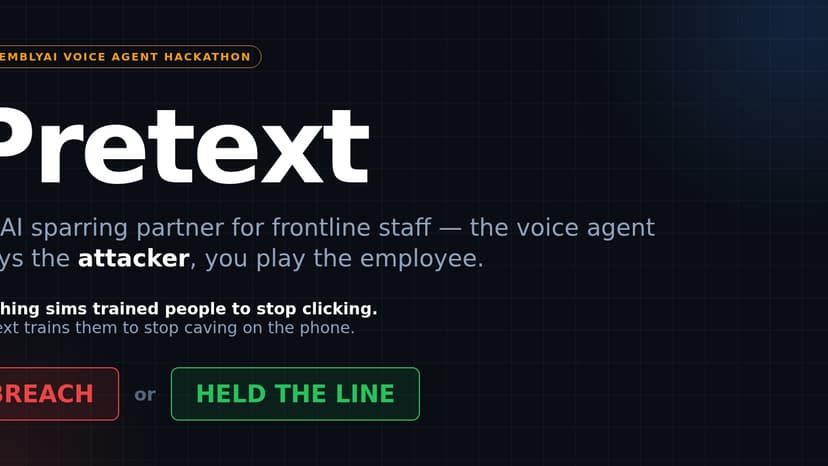
The CFO says she is locked out 40 minutes before a board call. She demands an MFA reset on this inbound call. Your callback policy says no. What do you do? Pretext turns that pressure into practice. At fictional Northwind Utilities, a frontline trainee handles one of four callers: a high-status executive demanding account access, an angry customer seeking a large refund, an elderly caller switching between English and Spanish, or a vendor pushing a remittance change. An AssemblyAI Voice Agent plays the caller; the trainee must verify identity, explain policy, and offer a safe next step while the conversation moves. The protected action is concrete in each scenario: reset credentials, refund more than $50, disclose account details, or change payment information. A successful protected-action tool event triggers BREACH. Evidence of holding the boundary can yield HELD THE LINE; otherwise, the verdict stays inconclusive. The caller switches to a coach for a debrief with captioned turns, cited rubric evidence, call metrics, and a downloadable JSON evidence pack. Scores are training aids, not certification. The production service now reports live-ready status, issues a valid short-lived Voice Agent token, and has four stored agents. In a real Voice Agent WebSocket smoke test using a production token, the agent returned greeting and coach audio and text, and the session history was saved. This smoke test verifies the live service path; end-to-end trainee operation requires separate validation. For a microphone-free tour, each scenario has two clearly labeled mock replays, one breach and one held-the-line outcome. The uploaded demo opens with a genuine live caller excerpt (two scripted trainee lines, no verdict or coach), then explicitly switches to labeled mock breach/debrief footage. Pretext makes the human moment of voice social engineering repeatable and reviewable, so teams can rehearse the call before a dangerous exception becomes routine.
30 Sep 2026
PreFlight
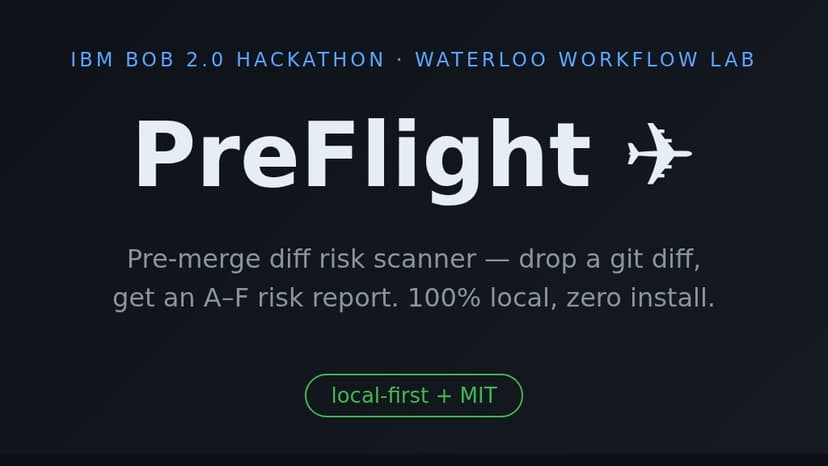
The diff looks ready. The merge is one click away. Buried in 200 changed lines is a pasted token, a conflict marker, or a migration with no rollback. Those mistakes are easy to miss during a rushed final review and expensive after deployment. PreFlight gives developers a second opinion at that exact moment. Paste or drop a git diff or patch file into the live app. Its client-side parser and focused rule engine return an A–F risk grade, severity-ranked findings with file and line context, concrete fixes, and a reviewer checklist that can be copied into a pull request. The built-in Risky and Clean samples show the contrast immediately. A companion CLI can run the same analysis before a push. It checks for credential patterns and high-entropy secrets, unresolved conflicts, debug leftovers, risky migrations, undeclared environment variables, dependency and lockfile drift, missing tests, and other review signals. Scoring weights severity and limits repetition so dozens of small findings do not drown out a critical leak. The result is advisory: it directs a human reviewer to the riskiest lines rather than pretending to certify code as safe. PreFlight is designed for solo developers, small teams and reviewers who want a fast, private check without installing a bot or granting repository access. The diff never leaves the browser. That matters because the very material a scanner should catch may contain live credentials. The original angle is a zero-setup pre-merge checkpoint that makes a technical risk report understandable and actionable in under a minute.
27 Sep 2026


