
🤓 Latest Submissions
Tablekeeper Dark Factory: 1 Message, 4 AI Agents
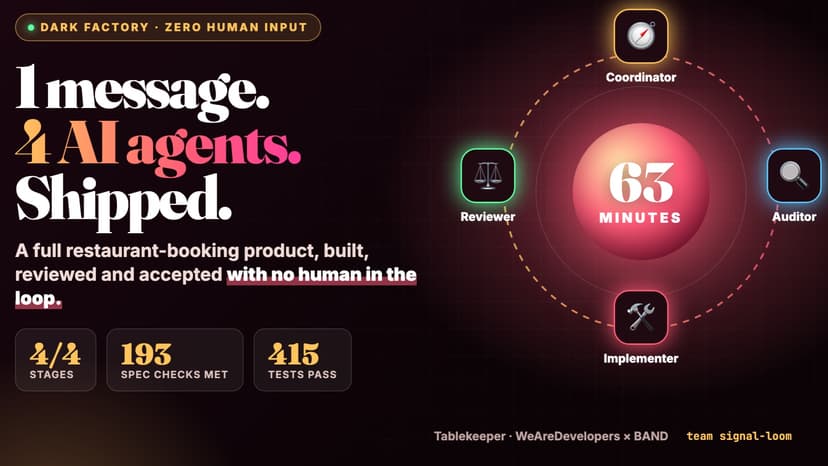
Tablekeeper Dark Factory is a four-seat AI software factory built in BAND Desktop. I sent one dispatch message. After that, four Claude Code agents took the restaurant-booking service from a JSON API to a full browser app with dated policies, recurring series and smart seating replans. They finished all four stages in 63 minutes, with no human input. The factory runs on two rules. First, no seat accepts its own work: code is built by one seat and accepted only by two others. Second, no decision rests on a claim: every verdict cites a command the seat ran itself, an exact commit hash, or a line of the spec. The four seats: - Coordinator (Sonnet): plans and routes every handoff with the full spec and exact revision. - Auditor (Sonnet): before each build, lists what the spec requires that the visible tests do not check (193 obligations in total), then marks each one met or unmet with evidence. - Implementer (Opus): builds, tests and commits. - Reviewer (Opus): tamper check, official harness in isolated mode, clean no-network container, adversarial probes and a brute-force oracle (150 random scenarios, zero mismatches). Results: 4/4 stages accepted, every stage folder claims its own stage on a fresh clone, mandate check clean, 415/415 independent spec-derived probes pass, and the measured model cost was $59.47. The mandates are fully generic, so the same factory can take any new problem. FACTORY.md documents the setup, costs, failures and how it catches bad work.
6 Oct 2026
ScamShield: Live Voice Guardian vs Phone Scams
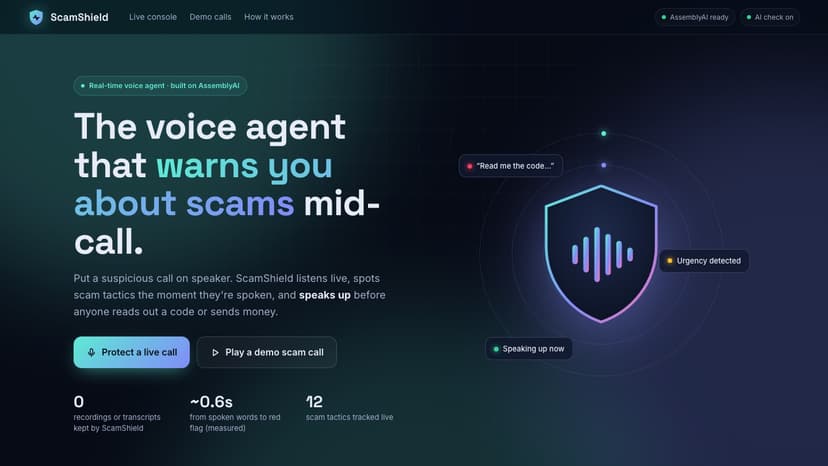
Phone scams succeed during the call: a fake bank employee, a "locked" account, a code "just sent to your phone". By the time anyone checks, the money is gone, and older people are targeted most. ScamShield runs on a phone or laptop next to the call. The call is put on speaker and streamed live to AssemblyAI Universal-Streaming. Every partial transcript is checked instantly for scam tactics: requests for a verification code, PIN, card details, remote access, gift cards or crypto, and money under pressure. An AI second opinion reads the whole call at each end of turn. When the risk becomes critical, ScamShield chimes, turns the call audio down, shows a full-screen "Stop — possible scam" alert explaining what is happening, why it is dangerous and what to do, and speaks a short warning out loud. Key features: - Words appear about 0.5 s after they are spoken; the alarm shows its measured latency - Ask "ScamShield, is this real?" during the call and it answers out loud - Urdu / Hindi support (beta) with a spoken Urdu warning - The AI can only raise risk, never lower it, so a scammer cannot talk it down - After-call report with a timeline, shareable with family on WhatsApp - Private: no recordings or transcripts are stored; the AI check can be switched off AssemblyAI features used: Universal-Streaming v3, partial transcripts, end-of-turn detection, formatted turns, speaker labels, keyterm prompting, the multilingual u3-rt-pro model, word timestamps and temporary tokens. Results: 18/18 scams caught on a blind test set (rules + AI), 0 false alarms from the rules on 63 genuine calls, and 144 automated tests passing.
30 Sep 2026
SoloTrace: Every Requirement, Proven
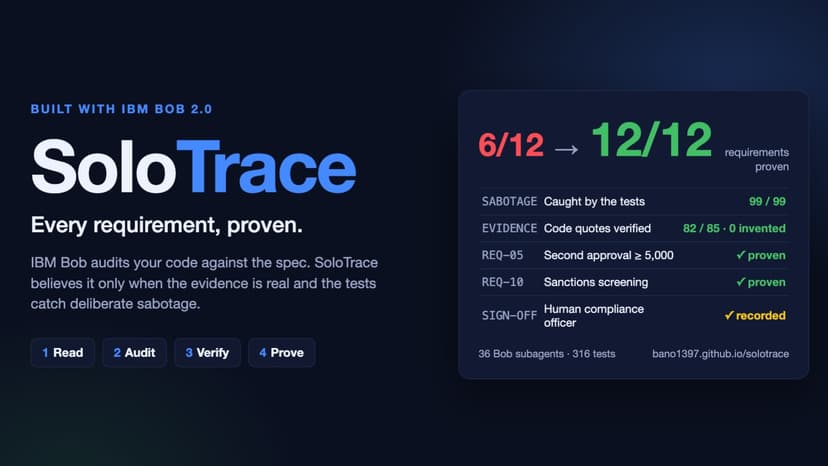
The problem. Banks, insurers and healthcare companies must show auditors that every written requirement is implemented and tested before each release. Today this traceability check is manual spreadsheet work. When a regulation changes the spec, nobody knows which parts of the code still comply. AI coding assistants add a new risk: the tests pass, the AI says "done", and the requirement is still not met. We measured this ourselves. After IBM Bob's first fix round, its own verdicts said 12 of 12 requirements were covered. SoloTrace proved only 6 of 12. The solution. SoloTrace is an audit workflow built around IBM Bob 2.0, with a strict rule: an AI verdict is a claim, not evidence. 1. Read. Bob reads the requirements PDF and extracts each requirement, its acceptance criteria and its risk level. 2. Audit. Bob runs one subagent per requirement in parallel. Each returns a verdict (covered, untested, contradicts, missing) with verbatim code quotes and the tests that check it. 3. Verify. SoloTrace finds every quote in the audited commit again. It rejects invented or paraphrased code and trivial snippets, and refuses any path outside the project. 4. Sign-off. A human compliance officer approves the fix plan before any code changes. 5. Fix. Bob writes a failing test first, then the fix, then runs the whole suite. 6. Prove. SoloTrace sabotages each requirement on purpose, for example by moving a limit by one cent or removing the sanctions check. The tests must catch every sabotage. A requirement counts as proven only if the quoted code is real, a cited test exists and passes, and every sabotage is caught. 7. Report. A traceability matrix, an audit report and a public dashboard. Demo. LedgerLite is a sample payments API built from spec v1.0, then audited against v2.0: a lower approval threshold, a daily cap, sanctions screening and account masking. - Baseline: 4 of 12 requirements covered, and 9 of Bob's 36 code quotes did not exist in the code. - Round 1: 12/12 "covered" by the AI, but only 6/12 proven, because 11 of 34 sabotages went unnoticed. - What proving exposed: PIN lockout that never persisted, money stored as floating point, a race that allowed overdrafts, and approvals anyone could make. - Independent check: an independent adversarial reviewer wrote 42 more sabotages without seeing the tests. - Final audit: Bob's own final audit wrote 11 more, and one of them found a real gap in rollback on failed approvals. That gap was fixed. - Final result: 12/12 proven, 99 of 99 sabotages caught, 82 of 85 code quotes verified with none invented, 316 tests passing, and a human sign-off tied to that exact result. Why it matters. "Tests pass" and "the AI says done" are not compliance evidence. SoloTrace makes the evidence checkable. Every number is reproducible from git history with one command, and CI blocks publishing if a citation is invented. It works on any repository with Bob's SoloTrace Auditor mode.
27 Sep 2026


