🤝 Top Collaborators



🤓 Latest Submissions
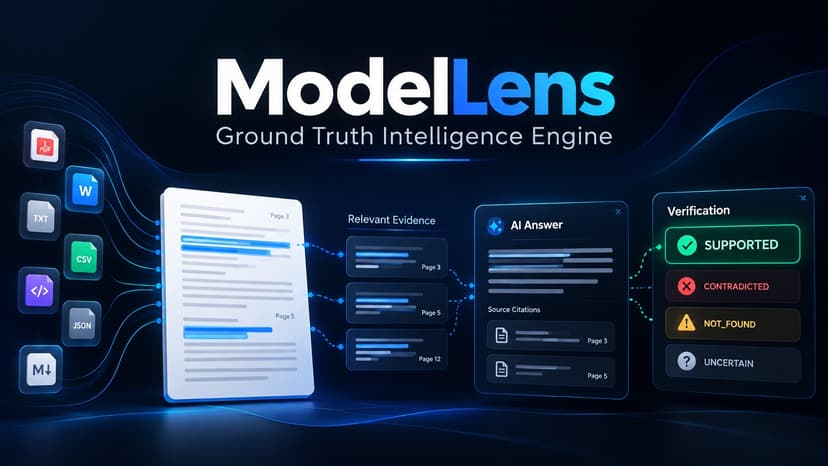
ModelLens — AI powered Truth Intelligence Engine
ModelLens addresses a key challenge with generative AI: AI-generated answers can sound convincing while being unsupported or inconsistent with the original source. This creates a reliability problem when users work with business documents, financial reports, policies, contracts, and other information where answers need to be traceable. ModelLens is an AI document intelligence and verification platform that makes AI answers easier to validate. Users upload a document and ask questions about its contents. The system extracts the document text, divides it into searchable chunks, and retrieves relevant evidence using TF-IDF and cosine similarity. The retrieved evidence is provided to an LLM to generate an answer grounded in the source document. ModelLens then verifies the generated answer against the retrieved evidence. Instead of returning only an AI response, it provides the answer together with a verification status, confidence score, explanation, and source citations showing the relevant evidence and page. The system identifies four outcomes: **SUPPORTED** when the answer is supported by the source, **CONTRADICTED** when it conflicts with the source, **NOT_FOUND** when relevant information cannot be found, and **UNCERTAIN** when the available evidence is incomplete or ambiguous. The target users include analysts, operations teams, compliance users, researchers, and organizations that need reliable answers from document-based information. The interaction is simple: upload a document, ask a question, receive an AI-generated answer, and inspect the evidence used to support or challenge it. What makes ModelLens unique is its verification layer. Traditional document Q&A focuses on retrieving information and generating an answer. ModelLens adds a separate step that evaluates whether the generated answer is actually supported by the retrieved source evidence. This creates a transparent evidence trail and helps users identify unsupported or contradictory responses instead of blindly trusting AI output. ModelLens supports PDF, DOCX, TXT, Markdown, CSV, JSON, and source-code documents. Its implementation combines a React and TypeScript frontend, Python FastAPI backend, PyMuPDF and python-docx for document processing, Scikit-Learn for retrieval, and Groq-powered LLM inference.
27 Sep 2026

Chronos AI
Most "AI decision tools" do one thing: you type a question, they write back a confident-sounding paragraph. That paragraph is a guess dressed up in good grammar. Chronos does something different. It builds a memory of your actual company first, then runs your decision through that memory instead of guessing in the dark. Here's what that looks like in practice. Chronos pulls in your GitHub repos, your documents, and live evidence from the web, and turns all of it into a memory graph: the projects, people, claims, and risks you actually have, and how they connect. Bring it a real decision, like whether to pivot, hire, or raise now versus wait, and a Multi-Agent Council of LLM agents (running on Fireworks AI's AMD-hosted infrastructure) argues it out from different angles before converging on a recommendation. Instead of just an opinion, you get a probability score and an Expected Regret number for each path, so you can actually compare options instead of trusting a gut feeling. Want to sit with it longer? Talk to a simulated future version of yourself and ask what the decision felt like six months out. That's the real difference. Most AI co-founder tools generate a plan once and move on. Chronos treats a decision as something worth simulating and scoring, grounded in evidence you actually have, not a generic playbook with your company's name pasted in. And it's not a mockup. The frontend runs on Vercel, the backend is FastAPI on Render, and everything above, the memory graph, the council, the regret scoring, is live right now, wired to real providers with safe fallbacks so it never breaks mid-demo.
13 Jul 2026


