

Ricky Sng@sngricky
7
Events attended
3
Submissions made
Singapore
5+ years of experience
About me
AI architect and AI Director at Blue River Technology, focused on building governed, secure and commercially useful AI systems. My work spans agentic AI, OT/IoT cyber resilience, financial and operational risk intelligence, AI governance, architecture assurance and enterprise automation. I design and build practical platforms that combine AI reasoning with evidence, human oversight, security controls and measurable business outcomes. I am particularly interested in responsible autonomous systems, multi-agent orchestration, cyber and infrastructure resilience, explainable decision support, and applying AI to complex real-world operational problems. Based in Singapore, I enjoy turning ambitious concepts into working products, prototypes and enterprise-ready solutions that can be tested, demonstrated and continuously improved.
🤝 Top Collaborators


🔥 Own Projects


🤓 Latest Submissions
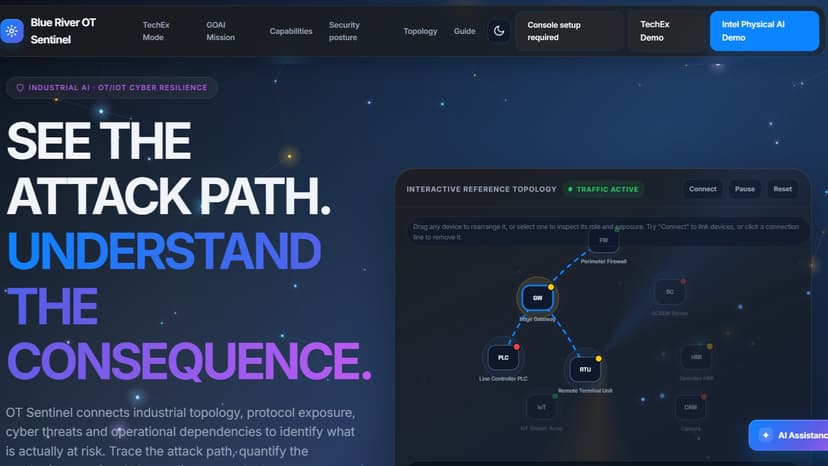
OT Sentinel Edge AI
OT Sentinel Edge AI is a cyber-physical resilience platform for industrial and operational environments. It turns live camera, video, and sensor signals into explainable operational intelligence at the edge, helping teams detect unsafe conditions, equipment anomalies, suspicious activity, and emerging incidents before they become major disruptions. The prototype uses computer-vision inference with OpenVINO and ONNX models to process real-world inputs locally, reducing latency and unnecessary cloud exposure. Detected events are correlated with operational context to estimate affected assets and blast radius. A governed decision layer then recommends containment or remediation actions, but keeps high-impact actions behind explicit human approval. The system is designed around production concerns rather than a single model demo: edge inference, evidence capture, event severity, confidence scoring, auditability, human-in-the-loop controls, and post-action verification. A web dashboard presents live detections, incident timelines, affected assets, recommended actions, and evidence. For the AI Infra Summit Hackathon, the focus is demonstrating how Intel-aligned edge AI can move from perception to a safe, explainable operational response using a standard webcam/video feed and an industrial monitoring scenario. The longer-term goal is a deployable platform for factories, utilities, data centres, logistics sites, and other environments where physical operations and cybersecurity increasingly overlap.
16 Sep 2026
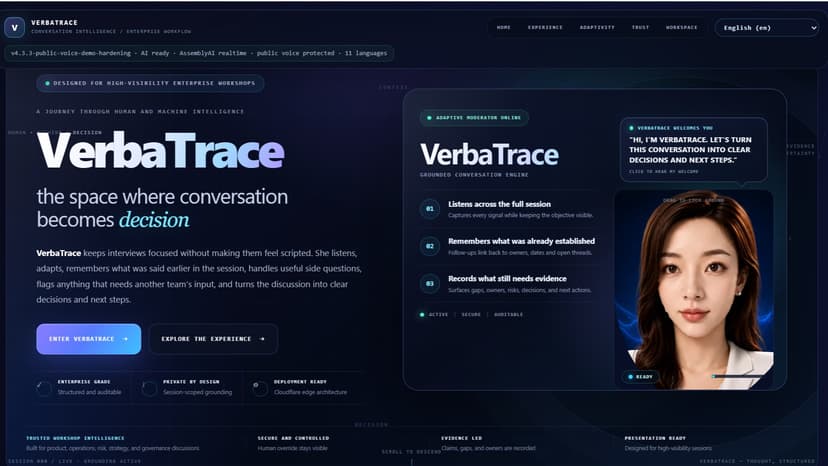
VerbaTrace AI - Voice-to-Evidence Agent
VerbaTrace AI turns enterprise conversations into accountable outcomes. Built for compliance reviews, risk assessments, due diligence, requirements workshops and structured interviews, VerbaTrace listens in real time, understands what has been said, identifies incomplete or weakly supported answers, and asks focused follow-up questions before the session moves on. For this hackathon, VerbaTraceuses AssemblyAI as the real-time voice layer for speech recognition, natural turn-taking, interruption handling, agent responses and tool-driven actions. Blue River’s workflow engine adds evidence scoring, structured findings, risks, decisions, action items and an auditable session record. Unlike a generic voice chatbot, VerbaTrace is designed to make important conversations inspectable and useful after the call ends. The result is not just a transcript: it is a structured evidence pack that shows what was said, what remains unresolved, what requires follow-up and what should happen next. This creates a practical foundation for trustworthy voice agents in regulated and enterprise workflows.
30 Sep 2026
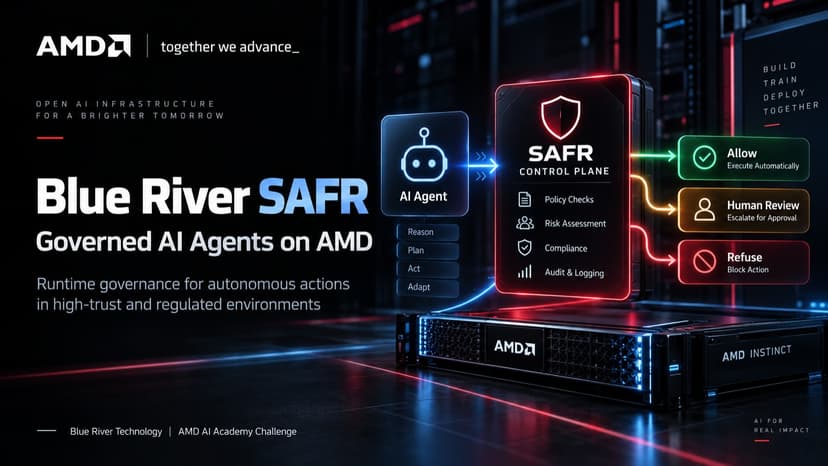
Blue River SAFR: Governed AI Agents on AMD
Blue River SAFR is a runtime governance and assurance layer for autonomous AI agents operating in high-trust and regulated environments. Instead of allowing an agent to move directly from reasoning to execution, SAFR places a control layer between the model and the action. For each proposed action, the system evaluates agent identity, permissions, policy rules, risk, spending limits, approval requirements and evidence obligations. The action can then be approved, escalated for human review, modified or refused. Every decision produces an inspectable evidence trail showing what the agent intended to do, which controls were applied and why the final decision was made. For the AMD AI Academy Challenge, the prototype will run open-model inference and evaluation workloads using AMD Developer Cloud and ROCm, with AMD GPU benchmarking used to measure latency and throughput. The demonstration will show governed agent workflows such as financial operations, supplier onboarding and controlled autonomous transactions. The goal is to demonstrate that powerful AI agents do not have to be black boxes: they can be fast, auditable, policy-aware and commercially deployable.
1 Dec 2026


