
🤝 Top Collaborators


🤓 Latest Submissions

Loop
The problem ADHD executive dysfunction rarely shows up as "not knowing what to do." It shows up as an inability to organize racing, unstructured thoughts fast enough to act on them. Someone can know they need to email their boss, pay rent, and stop worrying about a project — all in the same breath — but converting that into a clean, prioritized action plan is exactly the step that stalls. The solution Loop removes that step. Open the app, tap the mic, and talk freely — no structure required. Loop listens, transcribes live, and organizes the mess into a clear, triaged list: Tasks, Reminders, and Open Loops. It distinguishes real actionable items from vague recurring worries, so nothing gets force-fit or lost. How it works Tap to record — talk freely, with a live transcript streaming on screen as proof it's listening Tap to stop — a brief "sorting…" moment while AssemblyAI's LeMUR structures the ramble See a triaged list: Tasks / Reminders / Open Loops Act immediately, or hand the decision to Guide Me mode Guide Me — the core differentiator Most task apps stop at "here's your organized list" and leave the deciding to you — which is exactly the step that stalls an ADHD brain. Guide Me asks two quick-tap questions (how much time, how much energy you have right now), then picks one task, explains briefly why it fits, and gives a concrete first physical step to start it. It solves task-paralysis, not just organization. Built on AssemblyAI Real-time streaming transcription captures speech live, showing captions as the user talks — this is what makes capture feel immediate and trustworthy rather than a black box. LeMUR handles every structuring step: turning a raw ramble into categorized items, detecting when a new thought duplicates an existing task, and deciding when a follow-up ramble should update an existing task rather than create a new one.
30 Sep 2026
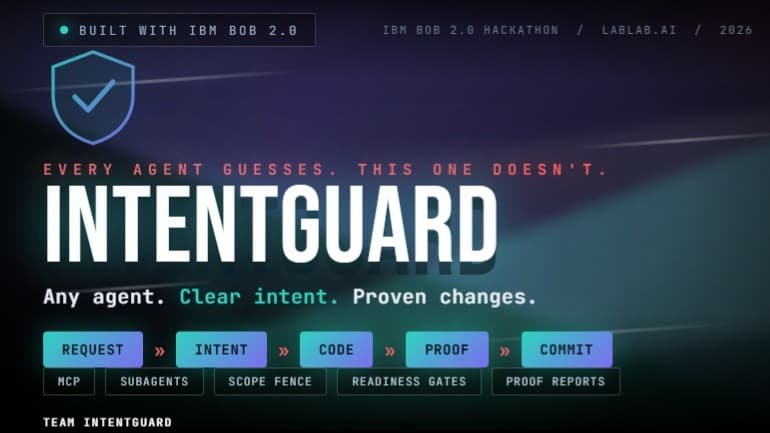
IntentGuard — Intent Layer for AI Coding Agents
AI coding agents are powerful, but they often guess at what a developer actually wants — and that guesswork breaks things: unrelated files get touched, edge cases get missed, and nobody can prove the change actually did what was asked. IntentGuard solves this by sitting between the developer and the agent as a local intent layer. When a request comes in, IntentGuard drafts a structured spec covering objective, scope, constraints, and verification criteria, then asks the developer targeted clarifying questions instead of assuming. Only once the spec is approved does the agent — in our case, IBM Bob 2.0 — start editing, and only within the approved scope. Every file touched is checked against a scope fence in real time, and every change ends with a proof report confirming what was verified, not just claimed. IntentGuard is built for developers and teams who use AI coding agents daily and want speed without losing control — from solo developers wary of AI "helpfully" breaking unrelated code, to teams enforcing review discipline at scale. It connects to any MCP-capable agent (Bob, Claude Code, Cursor, and others), runs entirely locally, and turns "the AI did something" into "the AI did exactly this, and here's the proof."
27 Sep 2026

