

🤝 Top Collaborators


🤓 Latest Submissions
EcoTrace — Android Energy Intelligence Platform
Every Android battery tool tells you what is draining the battery. Battery Historian tells you a wakelock was held for two hours. Android Profiler tells you the radio never slept. None of them tell you why. Why is not a pattern-matching problem. It is a reasoning problem: understanding how one architectural decision — a repeating alarm registered in MainActivity.onCreate() — propagates through six layers of a codebase to become a drain that only shows up on a physical device. A linter sees the last line of that chain and stops. EcoTrace is a desktop application for Android engineers that answers two questions for every source of drain: what the code is doing wrong, and which architectural decision put it there. It runs 23 energy detectors over Java and Kotlin sources — wakefulness, network, location and lifecycle patterns including unclosed WakeLocks, postDelayed polling loops, sub-30-second GPS intervals, and JobInfo constraints written but never submitted. It then builds a real cross-file call graph and walks backwards from each finding to the lifecycle entry point that caused it. A leaked wakelock in NetworkManager is reported as the symptom of a wakeup alarm in MainActivity that re-arms the path 96 times a day. The whole repository is ingested into IBM Bob 2.0, which holds every file in a single reasoning pass. Bob revises severities, corrects descriptions, and writes a fix against the specific traced chain — including for defects the local pass attributes to the wrong method. Bob proposes a patch; EcoTrace's own detectors re-run over it. A patch that silences a rule by deleting the construct is rejected. Accepted changes land on a branch for a human to merge, never straight to main. For teams with devices, adb shell dumpsys batterystats snapshots are parsed and differenced into a measured drain rate in mAh/min, attributed to the app under test rather than the whole device. Three things make it unlike the tools judges have seen: First, it reasons about cause, not symptoms — the call graph is the product. Second, it is honest about provenance — every number reports where it came from: measured, estimator-derived, or unknown. Third, it works without a key — the 23 detectors, chains, grade, history and report all run offline, deterministically and free. Bob makes the analysis sharper; it is never a prerequisite. A tool that only works when you hand it an API key is a demo, not a product. Output is a self-contained HTML or PDF report that attaches to the ticket, plus an optional one-click patch authored, verified and branched for review.
27 Sep 2026
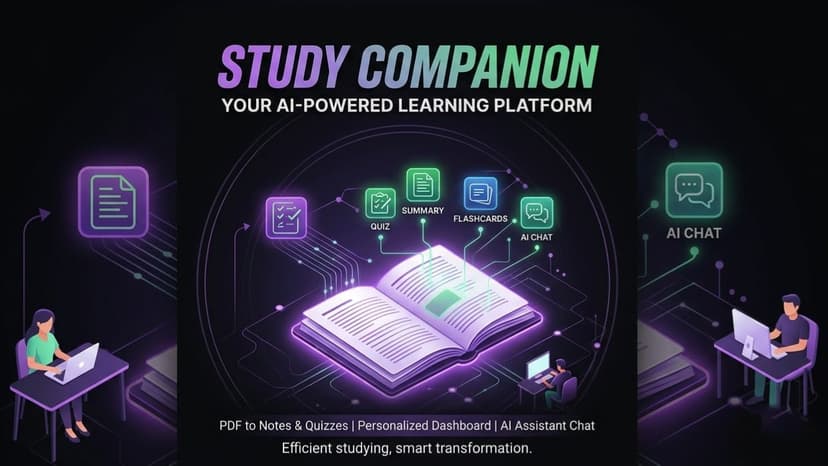
Study Companion – AI-Powered Learning Platform
Study Companion is an AI-powered learning platform that helps students study more efficiently by converting uploaded PDF documents into interactive learning resources. Instead of manually creating notes or quizzes, users can upload a PDF and instantly generate AI-powered summaries, quizzes, flashcards, and chat with their study material. The application provides secure user authentication, document management, and a personalized dashboard that displays learning statistics, recent documents, and study activity. Once a document is uploaded, its text is extracted and processed through a serverless backend. AI then generates concise summaries, interactive quizzes with Multiple Choice, True/False, and Short Answer formats, flashcards for active recall, and context-aware responses through an AI chat assistant. The project was developed using Native Builder, React, TypeScript, and Tailwind CSS for the frontend, while Supabase provides authentication, PostgreSQL database, storage, and Edge Functions. AI capabilities are powered by the AI/ML API, allowing secure and efficient communication with large language models. The platform features a responsive interface, light and dark themes, progress tracking, and a clean user experience across desktop and mobile devices. By combining document processing with AI-powered learning tools, Study Companion reduces study time, improves knowledge retention, and creates a more engaging learning experience. The project demonstrates how modern AI technologies can simplify education by transforming static documents into intelligent, interactive study resources, making learning faster, smarter, and more personalized for students.
10 Aug 2026


