🤓 Latest Submissions
Culprit
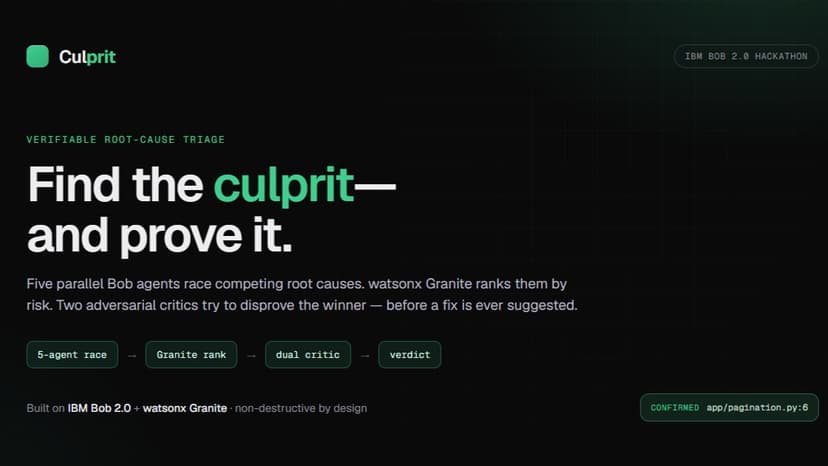
The problem When a production service breaks, the expensive part isn't writing the fix — it's the triage. An on-call engineer paged at 2 a.m. against a service they didn't write burns hours deciding which of several plausible causes is the real one: reading unfamiliar code, forming hypotheses, ruling them out. Today's AI coding tools skip straight to a patch. IBM Bob, Devin, Sweep, and Copilot Workspace will all confidently open a pull request — but a fix you can't trust is worse than no fix, and none of them make the diagnosis trustworthy first. So engineers still do the hard reasoning by hand, and MTTR (mean time to resolution) stays high. The solution Culprit is a verifiable root-cause triage engine built on IBM Bob 2.0 and watsonx Granite. It diagnoses why a failure happens — the fix is a deliberate byproduct, shown only after the diagnosis survives scrutiny. Paste a stack trace, failing CI log, or issue, and Culprit runs a four-stage pipeline: 1. Parallel hypothesis race — five independent Bob agents attack the same failure at once, each from a different angle (logic, input-validation, data/state, concurrency, interface/contract). Running in parallel and blind to each other, they surface causes a single pass would miss. 2. Granite risk-ranking — watsonx Granite scores each hypothesis by risk and blast-radius, not by the agent's self-reported confidence. 3. Dual adversarial critic — two more Bob agents try to disprove the leading hypothesis (one checks isolation, one hunts for a simpler cause) and write a disproof test. The winner survives only if neither refutes it. 4. Diagnosis card — a ranked, evidence-backed verdict: culprit file/line, the disproof test, and a suggested fix. Everything runs against a throwaway copy of the repo, so Bob's agents can never modify the real working tree — triage is non-destructive by construction. Why it's different Culprit deliberately does not re-wrap Bob's stock quick-fix/PR features. Its value is the triage reasoning and verification layer the autonomous-fixer genre skips. We proved it on unfamiliar third-party code: pointed at the open-source python-slugify repo with a real ModuleNotFoundError, Culprit correctly identified a missing declared dependency — and explicitly refused to invent a code bug, verifying the library's logic against pyproject.toml. Not hallucinating a fix is the hard part, and it passed. Impact For the on-call engineer and their team, Culprit compresses the slowest, most manual part of incident response — root-cause triage — from hours of reading unfamiliar code into a minutes-long, evidence-backed verdict, directly lowering MTTR while keeping a human in control of the fix.
27 Sep 2026


