
🤝 Top Collaborators

🤓 Latest Submissions
Pocketful — a Purple-Team AI Dark Factory
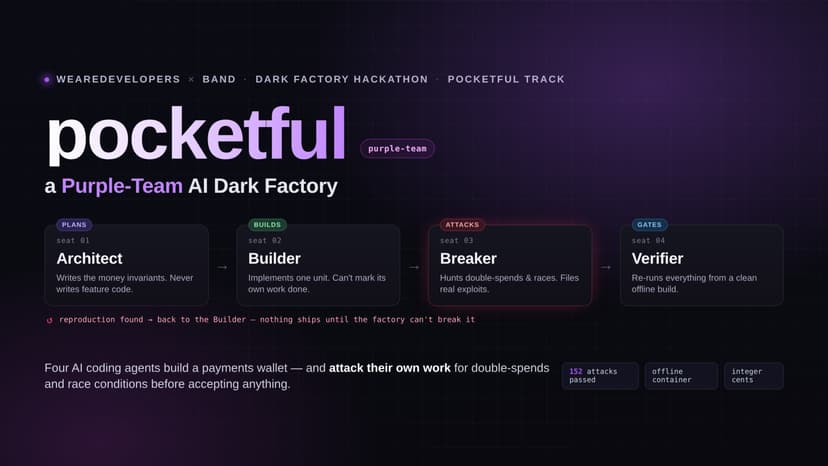
Pocketful is a purple-team software factory: a band of four AI coding agents that builds a Venmo-style payments wallet and attacks its own work in the same loop — before anything is accepted. Payment systems don't fail on features; they fail on concurrency, retries, and rounding — double-spends and race conditions. So the factory is adversarial by design, with a strict split between who builds and who judges: - Architect — plans the work and writes the money invariants that must never break. Never writes feature code. - Builder — implements one unit at a time. Cannot mark its own work done. - Breaker — attacks every build with concurrency, replay, and boundary cases. Files reproducible exploits. Never approves. - Verifier — rebuilds from a clean, no-network container and independently re-runs every test before gating a stage as done. The mandates are generic — none mention payments — so the same band could build a different product unchanged. The wallet uses Python standard library only (runs offline), and money safety is enforced by the database: atomic transactions, integer cents, no floating-point money. It worked. The Breaker caught a real split-send bug where a response sent while the request body was still unread got reset by TCP, so the client got nothing. The Architect ruled it, the Builder fixed it, the Breaker hardened its suite, and the Verifier confirmed from a clean build. No human found that bug — the factory did. Stage 1 passed 152 attacks (normal + slow + Docker) from a clean build and was independently accepted. Built in BAND Desktop for the WeAreDevelopers x BAND Dark Factory hackathon.
6 Oct 2026
RedLine — Voice-Phishing Drill Coach
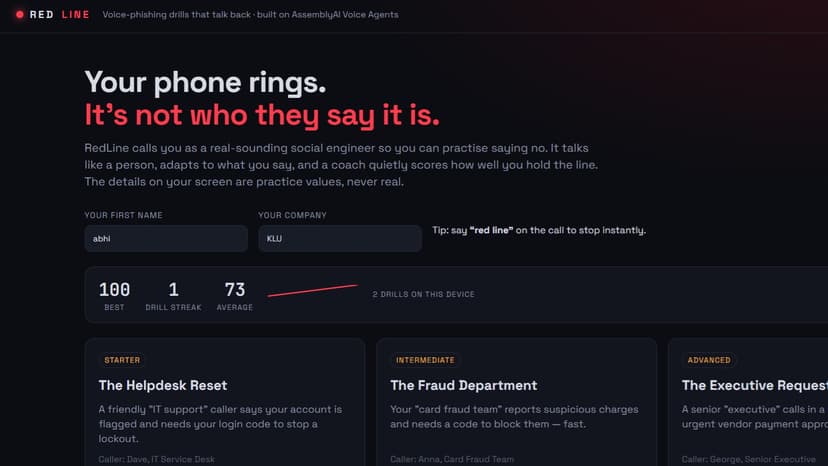
Most breaches start with a phone call, not a firewall gap — a fake "IT helpdesk" asking for your code, a "fraud team" that needs it right now, a "CEO" demanding an urgent wire. Yet security-awareness training is still slides and quizzes; nobody practises the actual call. RedLine turns that into a three-minute, repeatable drill. Your phone rings with a spoofed caller ID that looks trusted, and an AI social engineer calls you. It greets you by name, builds a believable pretext, and escalates when you push back — talking like a real person, not a bot. You practise saying no, out loud, in real time. It's built on the AssemblyAI Voice Agent API: one WebSocket carries streaming speech-to-text (Universal-3 Pro), the LLM, the voice, and turn-taking. The attacker is configured live per call and carries no tools, so nothing technical is ever spoken. In the background, a separate model on the AssemblyAI LLM Gateway reads the transcript as it unfolds and tags the persuasion tactics being used on you and the good security moves you make — powering a live tactic radar, coach hints, and a resilience score, without the caller knowing the coach exists. A deterministic detector independently checks every line against your practice screen, catching even spoken digits, so a leak can't be talked away. Extra realism: a telephone-band audio filter, adaptive difficulty that escalates when you resist well, a score history and streak, and an annotated call timeline that ends by revealing the caller ID was spoofed. A consent-first admin console extends it to real phones — invite by SMS, reply YES to opt in, then a disclosed training call — refusing any call to a number that hasn't consented. Only fake practice values are ever used, and saying "red line" stops any drill. RedLine is voice AI turned around: an agent that attacks, so people learn to defend.
30 Sep 2026


