

Abhi ram dathu@velishalalingaraju11777
4
Events attended
3
Submissions made
India
1 year of experience
About me
AI/software developer building practical AI products for real-world business problems, with a focus on demand forecasting, inventory optimization, and AI/ML systems. Currently building AptStock and exploring AMD ROCm and AMD Developer Cloud for accelerated AI workloads.
🤓 Latest Submissions
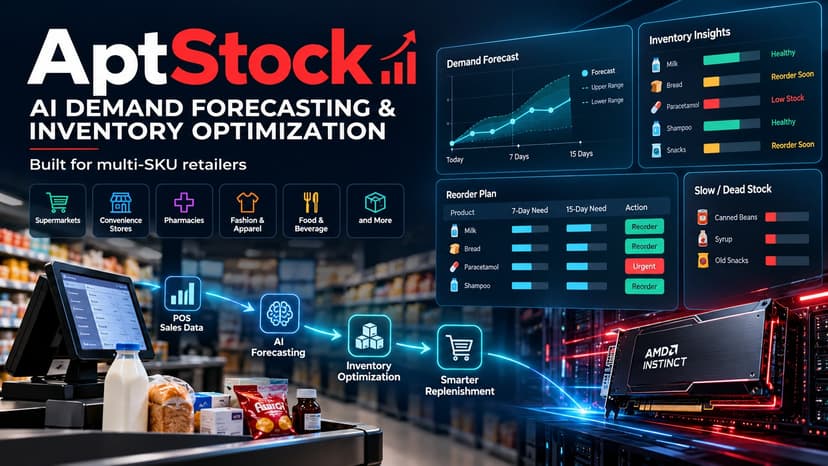
AptStock: AMD-Accelerated Inventory Intelligence
AptStock — AI Demand Forecasting & Inventory Optimization on AMD AptStock transforms point-of-sale (POS) history into demand forecasts and inventory decisions for Multi-SKU stores—even when current-stock data is unavailable. Multi-SKU stores can upload simple CSV/Excel sales data to explore product-level forecasts, forecast ranges, stockout risks, safety-stock estimates, reorder triggers, and recommended stock for 7-day and 15-day planning. AptStock prioritizes replenishment, identifies fast-moving products and slow/dead stock, estimates remaining stock coverage when inventory data is available, and generates purchase lists and exportable reports. Its voice assistant helps retailers identify products needing attention and decide what to reorder first. For AMD Developer Hackathon: ACT III, AptStock uses PyTorch and AMD ROCm to run batched inventory calculations on AMD Instinct MI300X hardware. The workload includes demand statistics, safety stock, 7-day and 15-day stock recommendations, and reorder points. Input validation, CPU-reference comparisons, and shadow-mode execution help verify numerical consistency while preserving the CPU-authoritative recommendation path. In the recorded sample-route integration test, CPU and AMD inventory outputs matched for 5,000 SKUs. An end-to-end benchmark tested 500, 2,000, and 5,000 SKUs using 180 days of synthetic demand history. Timing included data transfer, GPU computation, and result transfer. All nine inventory outputs passed numerical-tolerance checks. The October 18, 2026 report recorded a 1.446× CPU-to-AMD speedup at 5,000 SKUs. This result applies to the tested configuration, not every workload or the complete forecasting pipeline. AptStock combines practical retail decisions, explainable inventory mathematics, conversational insights, AMD execution, CPU/GPU validation, and transparent benchmarking. Next steps include broader retailer-data validation and measurement of forecast quality and operational outcomes.
18 Oct 2026
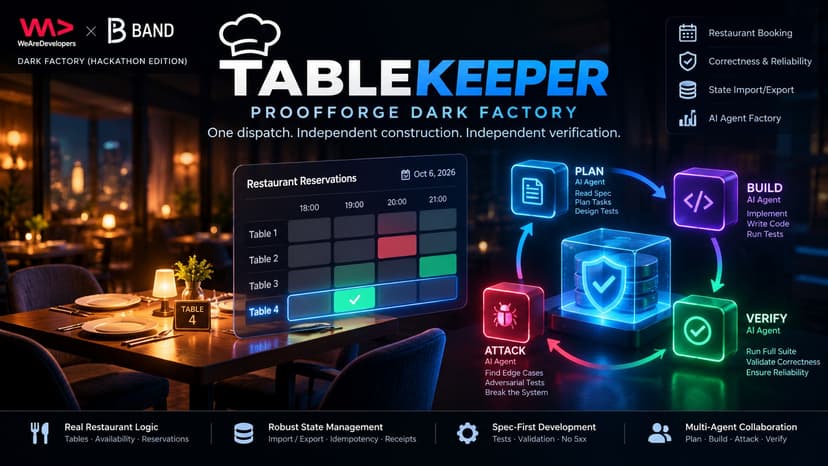
Tablekeeper — ProofForge Dark Factory
Tablekeeper is a restaurant reservation service produced through ProofForge, our autonomous software factory built in BAND Desktop. ProofForge treats software delivery as an evidence-gated process rather than a single coding session: specialized seats plan, implement, test, review, reject, repair, and verify work against the specification, with handoffs and Git-backed revisions. ProofForge is designed to be reusable beyond Tablekeeper. Its mandates define how seats work, communicate, hand off evidence, challenge results, and recover from defects without encoding track-specific endpoints, fields, or error codes. A specification is decomposed into requirements, implementation is divided into owned work, tests are derived from requirements, and independent reviewers inspect revisions rather than trusting the builder's claims. The factory is evidence-driven. Reviewers inspect exact revisions, exercise failure cases that shipped checks may miss, and reject work when implementation violates the specification. Defects are routed back for repair and re-verification, leaving a trace across room history, commits, tests, and accepted revisions. Failure recovery is part of the engineering process, not something hidden behind a polished demo. The resulting Tablekeeper service addresses difficult reservation requirements including availability, booking, amendments, cancellation, concurrency, retries, state handling, and time-zone behavior. The submission contains the application and factory artifacts needed to inspect how the work was planned, implemented, challenged, repaired, and verified. Our submission demonstrates two connected deliverables: the software factory and the software it produces. The repository, mandates, room history, Git history, tests, and verification artifacts provide an inspectable trail from specification to independent acceptance. The goal is to demonstrate a repeatable system in which autonomous seats produce, challenge, repair, and verify software.
6 Oct 2026
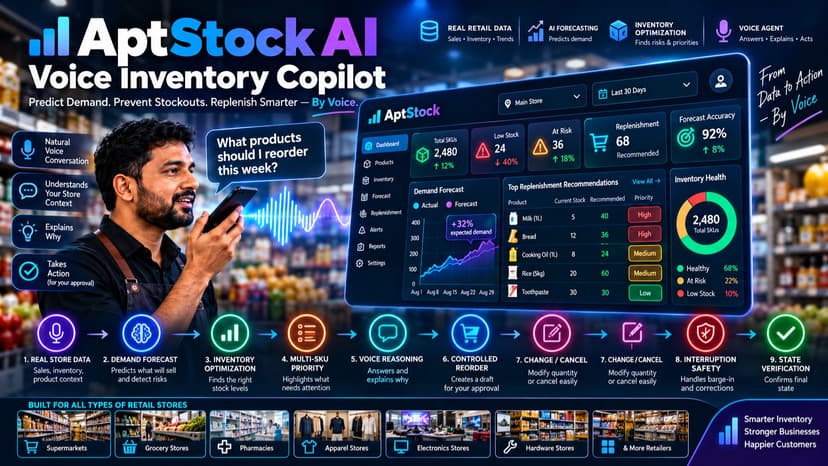
AptStock AI — Voice Inventory Copilot
AptStock AI is a voice-powered demand forecasting and inventory optimization copilot for multi-SKU retailers managing hundreds or thousands of products. Multi-SKU stores already have sales, product, and inventory data; the operational challenge is turning that volume into a clear answer: what needs attention now, why, and what should happen next? AptStock closes that decision loop: REAL STORE DATA → DEMAND FORECAST → INVENTORY OPTIMIZATION → MULTI-SKU PRIORITY → VOICE REASONING → CONTROLLED REORDER → CHANGE/CANCEL → INTERRUPTION SAFETY → STATE VERIFICATION. Its intelligence layer analyzes historical sales and inventory context to forecast demand, identify inventory risk, prioritize products, apply safety-stock logic, and produce actionable replenishment recommendations. Instead of searching spreadsheets, reports, and dashboards, operators ask naturally by voice and receive explanations grounded in store context. The voice layer is not just a conversational front end. It operates the inventory workflow. In the demonstrated flow, the agent identifies a priority item, prepares a reorder draft, accepts a correction to the requested quantity, preserves the updated state, and handles a cancellation request without silently placing the order. It then verifies the resulting state. This makes the interaction a controlled operational workflow rather than a voice-only demo. For the AssemblyAI Voice Agent Hackathon, AptStock uses AssemblyAI's Voice Agent API for real-time conversation, turn-taking, interruption handling, and tool calling. AptStock connects that voice experience to its forecasting, inventory, and action services so spoken requests can move from insight toward a controlled operational decision. The result is a practical bridge between predictive retail intelligence and store operations: AptStock determines what deserves attention, explains why it matters, and gives an operator a natural way to understand, change, cancel, and control the next action.
30 Sep 2026


