🤓 Latest Submissions
VoiceForge AI – Smart Voice Assistant
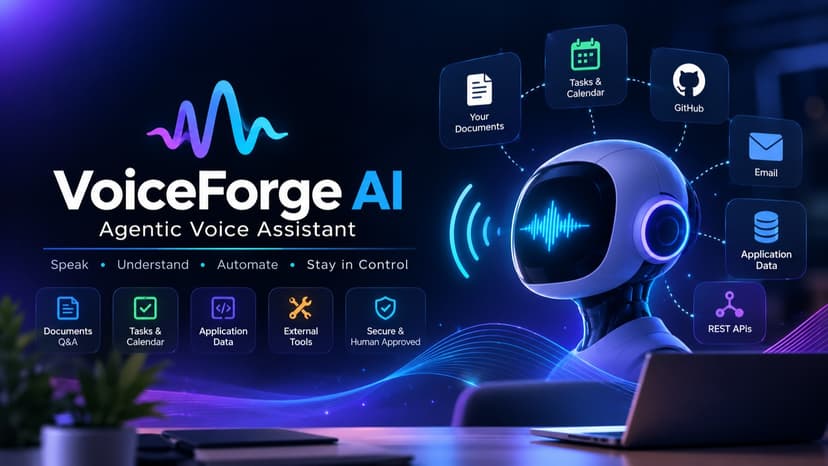
VoiceForge AI is an agentic productivity assistant that provides a real-time voice interface for interacting with documents, tasks, calendars, application data, and external tools. Users can speak naturally, ask questions about uploaded PDF, Markdown, text, CSV, and JSON documents, create and manage tasks, review calendar events, query application data, and interact with integrations such as GitHub, email, and REST APIs. The system uses AssemblyAI Voice Agent API for live speech recognition, audio responses, and voice sessions, while Gemini provides intelligent reasoning, routing, structured decisions, tool usage, and answer verification. LangGraph orchestrates specialist agents for knowledge, research, tasks, data, and actions. Qdrant enables user-scoped document retrieval, while MongoDB stores users, sessions, messages, tasks, documents, and audit data. Security is integrated throughout the platform using JWT authentication, permissions, rate limiting, request validation, audit logs, secure backend credentials, and human approval for sensitive actions. The frontend is built with React, TypeScript, Vite, Tailwind CSS, and Web Audio API, while the backend uses Python, FastAPI, Pydantic, LangGraph, LangChain, and WebSockets. VoiceForge AI brings voice AI, multi-agent orchestration, RAG-based document retrieval, productivity automation, and secure tool execution together in one unified platform.
30 Sep 2026
PromptForge AI
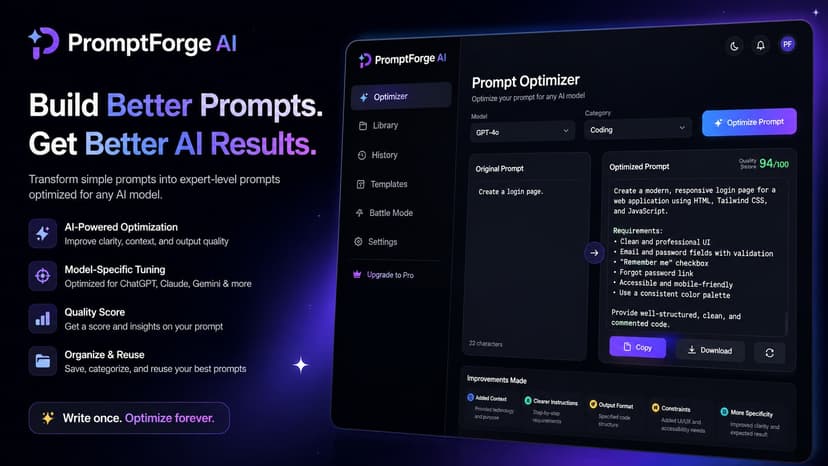
PromptForge AI is an AI-powered prompt engineering platform designed to help users create better prompts and achieve better results from AI models. Users can enter a simple or poorly structured prompt, select their optimization goal, and let AI transform it into a clearer, more specific, concise, or better-structured version. The platform provides an optimized prompt alongside the original prompt, a quality score, and an explanation of the improvements made. Users can copy, edit, regenerate, and organize their prompts in a personal prompt library. PromptForge AI uses a secure server-side AI integration so API credentials are never exposed in the browser.
10 Aug 2026
CrisisMind AI
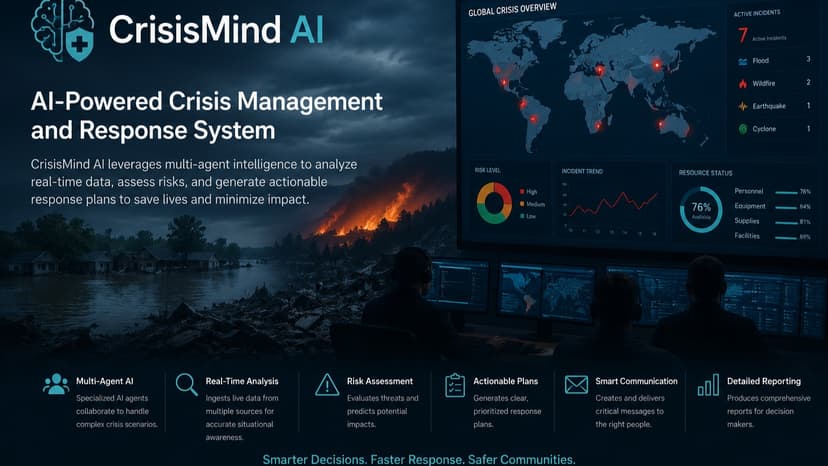
Most AI tools only answer questions. In a real crisis, people don't need Q&A — they need a plan. CrisisMind AI takes a single sentence like "There is a flood in Mumbai, what should I do?" and turns it into a complete, actionable response. Behind the scenes, seven specialist AI agents run in sequence, each handing off structured work to the next: a Planner classifies the crisis type and location; a Research agent pulls live advisories and weather data; a Risk agent scores severity (LOW to CRITICAL); a Response agent builds a prioritized action plan and emergency checklist; a Communication agent drafts a ready-to-send SMS and email so users can tell family or employers they're safe without composing anything under stress; a Summary agent compresses everything into a 10-second situation brief; and a Validator agent checks the output for gaps before it reaches the user. The pipeline isn't hidden behind a spinner — the frontend shows each agent lighting up live as it works, making the "agentic" behavior visible rather than a black box. CrisisMind AI also adapts its playbook by crisis type: natural disasters (floods, earthquakes, wildfires, cyclones) get evacuation-and-safety guidance, while a ransomware report instead produces a security incident response plan — disconnect infected devices, don't pay the ransom, preserve logs, notify IT and CERT. Built with FastAPI and LangGraph on the backend for multi-agent orchestration, Fireworks AI for reasoning, Tavily for live search grounding, Supabase for persistence, and a React + Tailwind frontend with a mission-control-style UI. Every report can be exported as a PDF and revisited later in a searchable history and dashboard.
13 Jul 2026


