
🤝 Top Collaborators

🤓 Latest Submissions
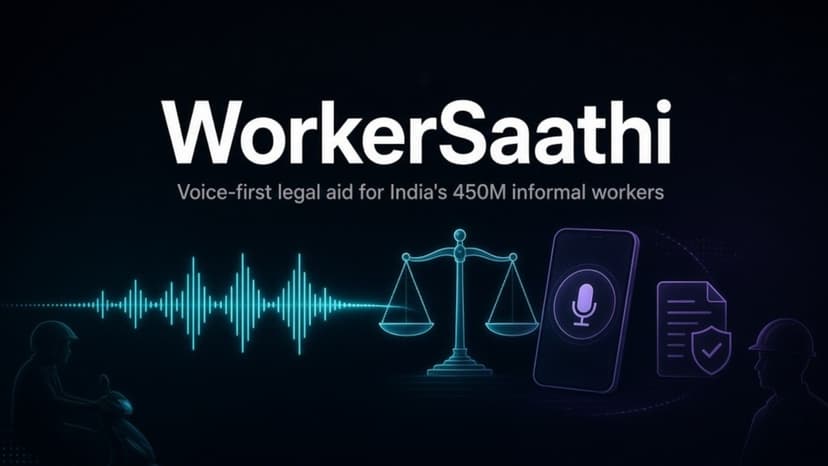
WorkerSaathi - Voice-first legal aid navigator
WorkerSaathi is a voice-first legal aid navigator built for India’s 450+ million informal workers—delivery riders, construction labourers, domestic helpers and others who form 90% of the workforce. Most cannot easily read dense English legal texts, yet they face wage theft, unsafe conditions and arbitrary account deactivations every day. Existing help is text-heavy, English-only or buried in conflicting search results. WorkerSaathi removes those barriers: the worker simply speaks in Hindi, English or Hinglish. The entire experience runs on AssemblyAI. Real-time bidirectional voice uses the Voice Agent API (WebSocket) for STT, TTS and server-side tool-calling. Universal-2 handles multilingual recognition with explicit support for Hindi–English code-switching. After the call, LeMUR turns the full transcript into a structured action plan: case summary, cited legal rights, next steps and a drafted grievance letter. Five backend tools are invoked mid-conversation: update_case_info extracts structured fields from natural speech; retrieve_rights runs a 7-stage hybrid RAG pipeline (semantic + BM25 + RRF, authority reranking, coverage levels FULL/PARTIAL/GAP/CONFLICT); generate_evidence builds formal packages; draft_message produces professional dispute letters tailored to platforms such as Swiggy or Zomato; escalate_safety overrides everything and reads verified helplines (112, 108, etc.). A deterministic 11-state case machine ensures the LLM cannot drift, while dynamic session updates inject new context and tools as the case progresses. Privacy is by design: ephemeral sessions, no audio logging, local embeddings via Ollama, explicit PII protection, and server-side API keys. The result is not another chatbot—it is an end-to-end resolution pipeline from spoken problem to actionable legal document, purpose-built for the people who need it most.
30 Sep 2026

