

🤓 Latest Submissions
ShapeProof Studio: AI CAD with Geometric Proof
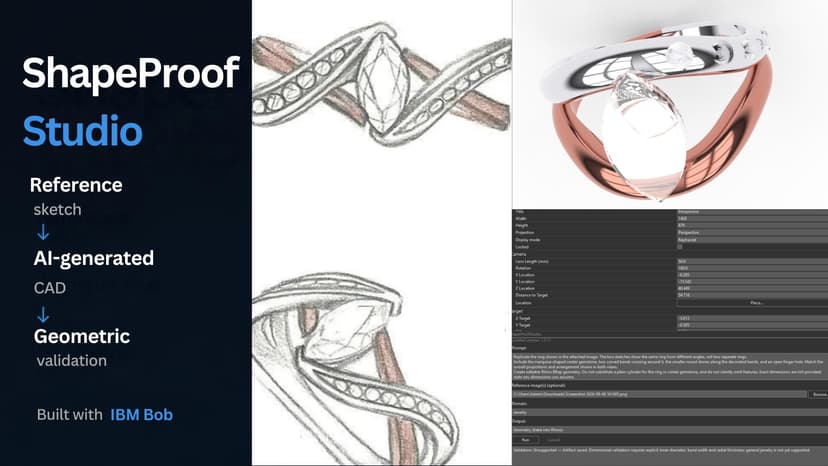
Jewelry designers often begin with sketches or reference images, but translating these into editable CAD requires specialized modeling work. AI-generated code can help, yet code that compiles or produces an attractive render does not necessarily create the intended geometry. ShapeProof Studio brings AI-assisted concept modeling into Rhino with explicit checks and traceable results. Users enter a design request, attach reference images, and generate editable geometry inside their CAD workspace. The system checks generated C# against the installed Rhino SDK before execution. Compiler errors and detected feature omissions are returned to the model for bounded repair attempts. The prototype also supports separate metal and gemstone objects, typed render materials, display colors, and semantic component tags. An AI source reviewer compares proposed construction with the requested features and reference image. This review helps detect omissions but is not presented as proof of visual accuracy. After execution, ShapeProof captures the generated artifact and records execution and validation evidence in a local dashboard. Its deterministic dimensional validator currently supports a narrow case: a plain annular band with explicit dimensions. More complex jewelry is marked “Unsupported” rather than given an unjustified pass. The target users are Rhino jewelry designers and CAD practitioners exploring early concepts. The demonstrated workflow has produced a two-tone ring concept with a marquise-shaped center stone and smaller accent stones. Professional refinement is still required for stone settings, clearances, proportions, and manufacturing constraints. The project’s distinctive contribution is connecting generation, repair, and evidence in one workflow while making verification limits visible. Its output is editable first-pass concept geometry, not automatically certified production-ready jewelry.
27 Sep 2026


