🤓 Latest Submissions

The Build Guild: Tablekeeper Factory
The Build Guild explores how a reusable team of coding agents can build software and catch defects beyond supplied tests. Tablekeeper is a restaurant reservation challenge involving retries, concurrent writes, table pairs and time zones. Seven BAND identities divide coordination, architecture, design, backend, frontend, QA and independent review. Generic mandates define ownership and complete addressed handoffs; one active model turn and bounded repair leases control work. Codex powers the seats. The factory-design PDF documents Run 6, including a Stage 1 defect missed by 120 supplied tests: years below 1000 returned empty availability in Linux. Backend repaired calendar formatting. Operator verification passed 120 supplied checks and six boundary probes; Run 6 independent acceptance remained pending and Stages 2-4 were unfinished. The 3:26 video records a separate Local Sol practice run: actual BAND handoffs, a Reviewer rejection, acknowledgments and the deployed Stage 2 public interface. Local Sol Stage 1 is independently accepted. Stage 2 final independent acceptance remains pending. The deployed demo is an earlier b1f7ef64 snapshot with a known keyboard-focus defect; the newer repair candidate is separate. The video demonstrates public availability search and sign-in gating, not a completed booking. The demo uses synthetic data and in-memory storage. We disclose human instructions, a budget increase and infrastructure recovery during practice, and assisted continuation/post-run checks in Run 6. Reported tokens include cached input; dollar cost is unavailable. These are incomplete engineering experiments, not claims of autonomous completion. The public Tablekeeper repository now includes the factory toolkit, seven mandates, buildable Stage 1/2 candidates, review evidence and a full in-progress room snapshot.
6 Oct 2026
NurseBridge
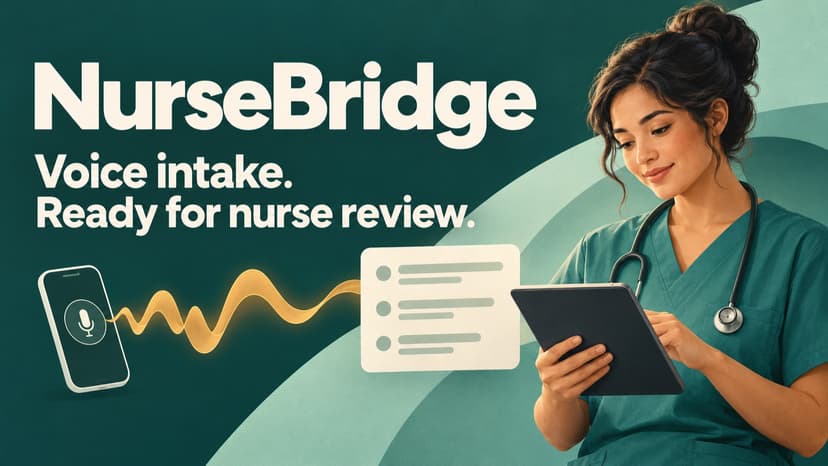
NurseBridge is built for care teams facing nurse shortages and limited nursing capacity. Its voice agent asks routine intake questions while a nurse is occupied, then organizes the answers into a structured draft. When available, a nurse can review the collected information, verify unclear details, and take over the same call, including before automated intake finishes. Patients can join a browser call, consent, and speak naturally. Supporting quotes, visible corrections, and explicit uncertainty help the nurse check the draft. Teams can edit intake questions and acknowledgments, while each call keeps its starting template. The live voice path uses AssemblyAI Voice Agent with Nebius. Separate extraction checks supporting transcript evidence. Next.js runs on Cloudflare Workers, with a Durable Object coordinating each call and D1 storing workspace and case records. Our video includes an actual local AssemblyAI conversation with a fictional prerecorded caller, followed by a labeled transcript-replay workflow tour. Physical-device and telephone-network acceptance remain pending. NurseBridge does not diagnose, recommend treatment, or assess urgency. The intended value is less repetitive intake work and more nursing time for assessment and care. We will evaluate this with nurses using fictional cases, comparing total nursing time for manual intake against agent intake plus review, corrections, and handoff, while measuring information quality. No time savings or clinical benefit are claimed.
30 Sep 2026


