

Muhammad Yameen@yameench463
6
Events attended
5
Submissions made
Pakistan
1 year of experience
About me
Hi! I'm Muhammad Yameen, a Computer Science student (1st year completed). I have hands-on experience in frontend development (HTML/CSS) and database management with MySQL, along with solid programming skills in C, C++, C#, and Python.
🤝 Top Collaborators



🤓 Latest Submissions

ClearVoice 2.0
Over 70 million individuals worldwide live with speech dysfluencies such as stuttering, blocks, repetitions, and mid-sentence restarts. In our voice-first digital world, conventional AI systems fail them: traditional Voice Activity Detection (VAD) abruptly terminates recording during brief pauses, speech-to-text creates garbled repetition bloat, and unconstrained language models introduce dangerous factual hallucinations like altering numbers or stripping negations. ClearVoice 2.0 solves this by introducing a real-time, sub-second speech repair and neural resynthesis pipeline. Built with a high-performance polyglot architecture, our Python core engine uses PyTorch Silero VAD with a custom 1,500ms adaptive silence window and 512-sample frame slicing to eliminate premature cutoffs, streaming live audio directly to AssemblyAI's Realtime WebSocket API. When speech is transcribed, our Node.js intelligence server leverages Groq-hosted open-weights models alongside a 6-utterance rolling context buffer to intelligently remove dysfluencies while preserving intentional emphasis. To guarantee zero hallucination, a deterministic Meaning Validator rigorously inspects every repair, ensuring critical numbers, dates, negations, and named entities remain 100% faithful to the original speech. If any drift is detected, an automated zero-trust fallback engine serves a conservatively cleaned or raw transcript. Approved speech is resynthesized through a resilient 3-tier failover engine: primary high-fidelity streaming via ElevenLabs PCM16, secondary on-server system TTS via pyttsx3, and tertiary browser-level client synthesis. Deployed in a Dockerized AWS EC2 backend with an interactive Next.js 16 frontend on Vercel, ClearVoice 2.0 democratizes voice interfaces and empowers dysfluent speakers with clarity, dignity, and confidence.
30 Sep 2026
Autonomous Multi Agent AI trading system
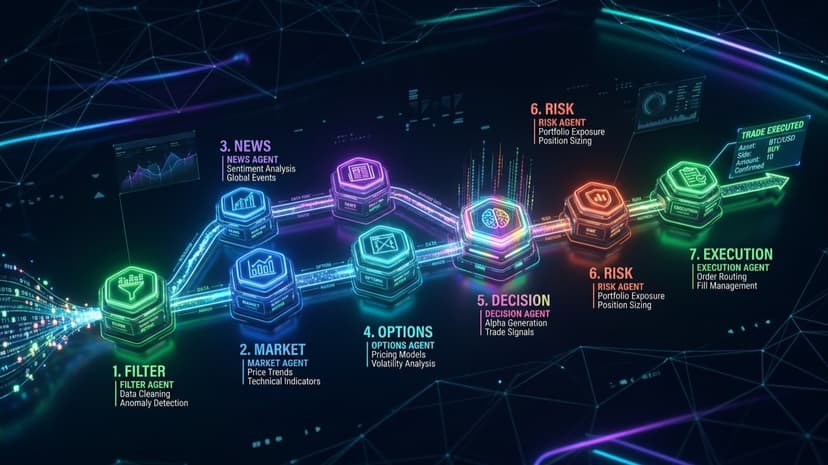
This project is a fully autonomous, multi-agent AI trading system built on top of the Alpaca Trading API. Our architecture leverages a sophisticated pipeline of specialized AI agents working in tandem to identify, analyze, and execute profitable options and equity trades. The pipeline begins with a Deterministic Filter that scans live market data to identify high-probability setups based on volume, liquidity, and implied volatility. These candidates are then passed to our Market Agent (for technical thesis generation) and News Agent (for real-time sentiment analysis). An Options Agent synthesizes this data to construct optimal multi-leg strategies. Finally, a Risk Assessment Engine mathematically validates every trade against strict portfolio constraints—such as max daily loss and exposure limits—before our Execution Agent routes the orders live to Alpaca. To visualize this complex orchestration, we built a stunning, real-time Next.js dashboard. It provides traders with an interactive command center to monitor live portfolio equity, track individual AI agent decisions, view strategy payoff charts, and audit the complete execution lifecycle. By combining strict quantitative risk management with advanced LLM reasoning, we’ve created an institutional-grade trading terminal.
4 Sep 2026
CareLoop - Catching Caregiver Burnout Early
Family caregivers looking after aging parents or sick relatives often don't notice their own burnout until it's already a crisis. There's rarely time to reflect, and by the time exhaustion becomes visible to others, the caregiver has usually been struggling alone for a while. CareLoop was built to catch that decline earlier, fitting into a caregiver's day instead of adding another task to it. The idea is simple: a caregiver writes or speaks a short journal entry about their day, the way they'd say it out loud to a friend. CareLoop reads that entry and reflects back what it notices across five areas that tend to surface first in burnout: sleep loss, isolation, resentment, physical strain, and emotional exhaustion. Each entry is scored gently, not clinically, and saved so the caregiver sees a trend over time rather than one isolated bad day. When strain builds, CareLoop surfaces relevant support, like local respite care, caregiver support groups, or counseling, matched to whatever's showing up most. Under the hood, a FastAPI backend scores each entry using an AI model (Gemini, or Fireworks hosting Gemma), with a free rule-based fallback so the app still works without an API key. Entries are stored simply in a local JSON file, so the data pipeline stays transparent. The frontend is a single, custom-designed interface built to feel calm and human rather than clinical, with a signature trend line that reads more like a gentle pulse than a corporate dashboard. Voice input is supported too, so caregivers can speak an entry instead of typing when they're too tired to write. The whole app is containerized with Docker, backend and frontend as separate services tied together with Docker Compose, ready to run on AMD Developer Cloud infrastructure.
13 Jul 2026


