
🤝 Top Collaborators


🤓 Latest Submissions

AXIS:Agentic eXecution Infrastructure as a Service
Problem: Shipping software across multiple clouds forces developers to manage dozens of disparate surfaces: authoring container files, provisioning serverless runtimes, managing IAM roles, setting environment variables, and writing custom health checks. When a production service breaks due to configuration drift or an unhandled dependency, engineers spend hours grepping logs across separate cloud consoles to diagnose what changed. Small engineering teams lack the dedicated DevOps headcount to maintain these pipelines reliably. Solution: AXIS (Agentic eXecution Infrastructure as a Service) is an autonomous multi-cloud DevOps and self-healing platform driven by IBM Bob 2.0 and IBM watsonx.ai. Developers give Bob a target repository and a release goal. AXIS analyzes the codebase, provisions and builds the required runtime assets, deploys simultaneously to IBM Cloud and AWS, continuously monitors live health, and automatically diagnoses and heals configuration incidents when failures occur. Target Users & Interaction: AXIS is built for software engineers, platform teams, and technical founders. Users interact primarily inside the IBM Bob IDE using custom slash commands (/deploy and /investigate). When Bob synthesizes a deployment or remediation plan, the engineer opens the AXIS Control Center (a Next.js 15 dashboard) to review architectural rationale and approve the release with a single click. Creativity & Technical Uniqueness: 1. Cryptographic Approval Guard: Bob cannot deploy on its own. Every submitted plan is hashed using SHA-256. The orchestrator rejects unapproved execution with HTTP 403 guard.blocked. The decision token lives exclusively in the human dashboard, and Bob's custom MCP server contains 17 lifecycle tools with deliberately zero approval capability. 2. Independent GitHub Sentinel & Self-Healing: An external GitHub Actions workflow probes deployed endpoints every 5 minutes. Tri-probe failures automatically file a GitHub Issue with structured JSON evidence. Bob's /investigate command parses this issue, correlates CloudWatch and Code Engine logs against source files, and pinpoints the root cause down to the exact file and line number. 3. Chaos Detection & Automated Email Alerting: When infrastructure fails or a vulnerability is injected, AXIS invokes IBM Granite to generate a concise incident impact narrative and immediately delivers an executive alert to on-call engineers via the Resend email API. 4. Single Cloud Provider Contract: Both IBM Cloud and AWS Lambda implement an identical provider interface, allowing new platforms like Vercel or GCP to plug in without modifying workflow logic. Efficiency & Measured Impact: In live verification against active AWS Lambda and IBM Cloud instances: - Time from repository inspection to verified multi-cloud deploy: 42 seconds (a 64x speedup over manual configuration). - Mean Time to Recovery (MTTR): 7 to 9 seconds. - Human intervention: exactly two approval clicks, with zero cloud consoles opened. - Test reliability: 55 out of 55 automated unit and lifecycle tests passing.
27 Sep 2026
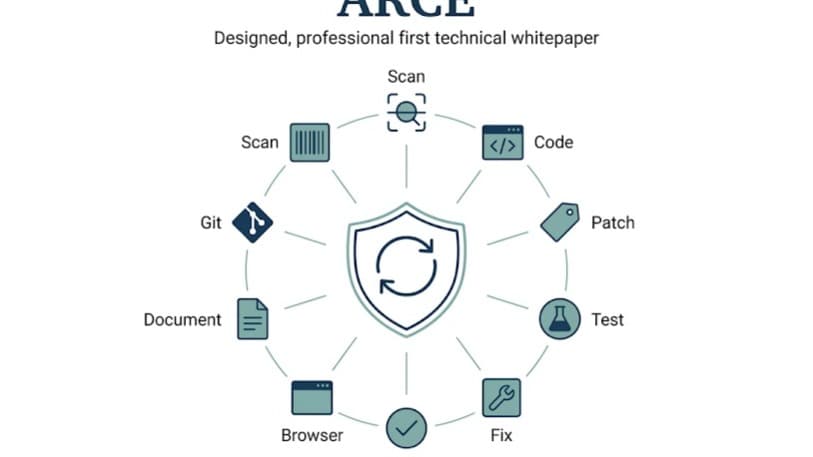
ARCE-Autonomous Remediation and Compliance Engine
ARCE (Autonomous Remediation & Compliance Engine) transforms how organizations handle supply chain vulnerabilities. Instead of alerting engineers and waiting days for manual patches, ARCE closes the entire loop autonomously. Powered by IBM Bob in a custom compliance-remediator mode, ARCE orchestrates two MCP servers to execute a 9-step pipeline: it scans dependencies with pip-audit, verifies exploitability through AST-based reachability analysis (ensuring the vulnerable function is actually called, not just imported), upgrades to the latest stable version, runs tests, and — when tests break due to API changes — self-corrects by reading the error and reasoning about the fix. After tests pass, Playwright verifies the running application works end-to-end. ARCE then generates a compliance-ready audit trail documenting every decision, attaches a CycloneDX SBOM, and opens a governed GitHub Pull Request with full evidence. The self-correction loop is the breakthrough: Bob doesn't blindly patch — it upgrades, discovers the upgrade broke tests, reads the TypeError, identifies the breaking API change, and applies the fix. This is agentic reasoning, not scripted automation. Key differentiators: AST reachability analysis eliminates false positives, severity-aware policy engine gates remediation decisions, real-time React dashboard shows live metrics (MTTR, CVSS delta, success rate), and the entire stack costs $0. ARCE reduces mean-time-to-remediate from days to under 4 minutes while producing governance artifacts that satisfy CISO and compliance requirements out of the box.
17 May 2026


